Sigma 28 mm f/1.8 EX DG Aspherical Macro
8. Vignetting
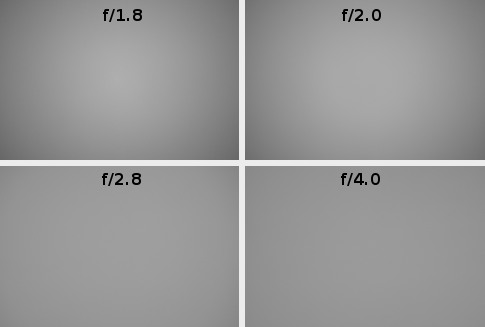
At the maximum aperture this aberration will cause us some pain, though, because at this point we lose 39% of light (−1.43 EV). It’s a lot for such a small detector. Fortunately on stopping down we see the situation improving swiftly. By f/2.0 the brightness loss in the frame corners decreases to 33% and by f/2.8 – to a not very bothersome level of 14%. By f/4.0 and f/5.6 this aberration stop being a nuisance because it reaches 10-11% there.
Please Support UsIf you enjoy our reviews and articles, and you want us to continue our work please, support our website by donating through PayPal. The funds are going to be used for paying our editorial team, renting servers, and equipping our testing studio; only that way we will be able to continue providing you interesting content for free. |
- - - - - - - - - - - - - - - - - - - - - - - - - - - - - - - - - - - - - - - - - - - - - - - -
Now let’s assess the situation on full frame.
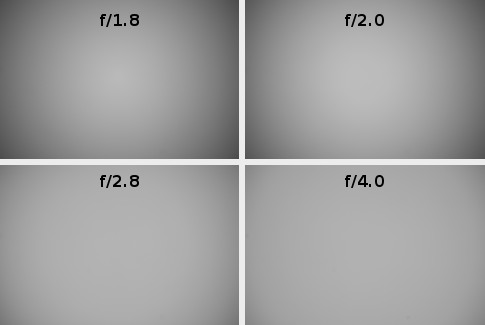
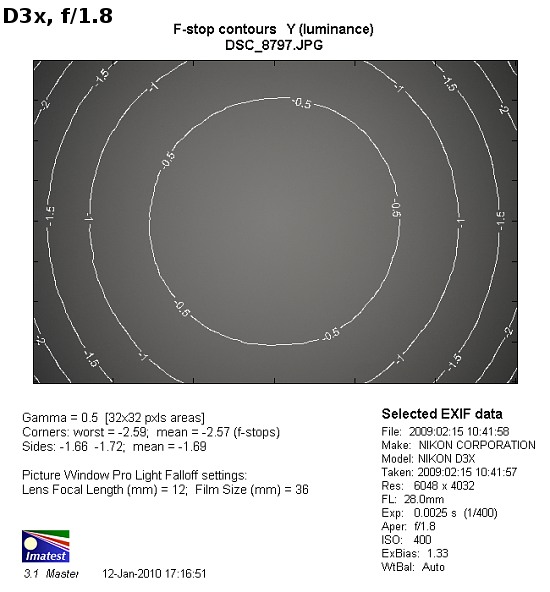
Wide angle, good fastness and a big detector – those are factors that favour the vignetting. This time we see the same story. At the maximum relative aperture in the frame corners we lose as much as 59% of light (−2.57 EV). This result is high but we’ve already been accustomed to it on full frame.
On stopping down to f/2.0 the vignetting decreases to 54% and by f/2.8 it amounts to 34%. Moderately bothersome or not bothersome results we see only by f/4.0 and f/5.6 where the vignetting is 25% and 19% respectively. On further stopping down we see the vignetting changing only slightly.
 |