Tamron AF 18-270 mm f/3.5-6.3 Di II VC LD Asph. (IF) MACRO
3. Build quality and image stabilization
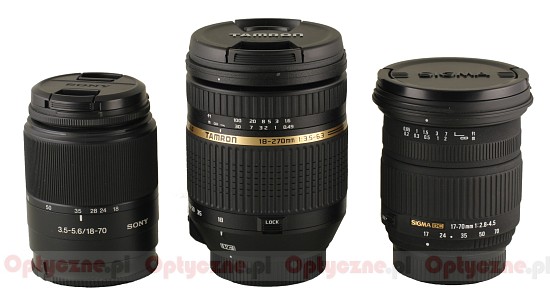 |
The bayonet mount of this lens is metal, the outer casing was made of plastics and the rings are rubberized. As we already mentioned the rings we must complain about them a bit. The zoom ring is big and seems to be comfortable. Unfortunately it is just an impression. In the range from 18 to 40 mm it moves very loosely, near 40 mm it starts being stiff resistant and then up to 270 mm it moves loosely again. So loosely in fact, that the lens gets a bad case of zoom creep – it changes its focal length under its own weight even if you move it only slightly.
Please Support UsIf you enjoy our reviews and articles, and you want us to continue our work please, support our website by donating through PayPal. The funds are going to be used for paying our editorial team, renting servers, and equipping our testing studio; only that way we will be able to continue providing you interesting content for free. |
- - - - - - - - - - - - - - - - - - - - - - - - - - - - - - - - - - - - - - - - - - - - - - - -
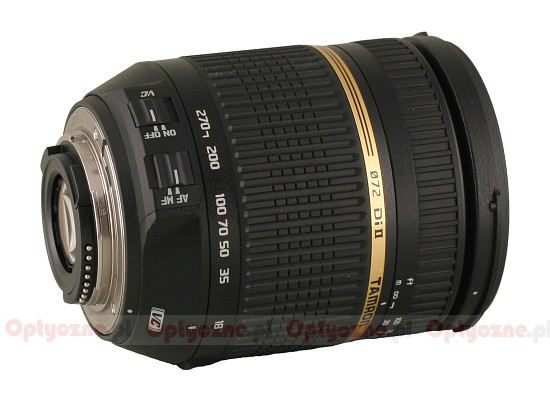 |
The manual focus ring is also rather wide and comfortable to hold but a bit too loose. The lens has a LOCK switch on its one side, which allows you to block the zoom in the folded position at 18 mm, and an autofocus mode switch (AF/MF) with a stabilization switch (VC On/VC Off) on the other side.
The front element system is surrounded by a non-rotating filter thread with a diameter of 72 mm.
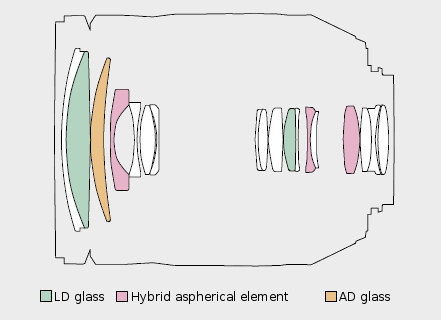
A wide range of focal lengths and the image stabilization guarantee that the optical construction of the lens certainly won’t be simple. This chart shows that the Tamron 18-270 mm has two elements more than other 18-250 mm class instruments. Overall, there are as many as 18 of them, positioned in 13 groups. The manufacturer was generous with special kind of glass. We deal here with two low dispersion LD elements, one abnormal dispersion AD element and three hybrid aspherical elements. Inside there is also an aperture with seven diaphragm blades which can be closed down from f/22 to f/40, depending on the focal length used.
The buyer gets both caps and a petal-type lens hood included in box.
Stabilization
The Tamron 18-270 mm VC is the second lens in this company’s line-up which offers optical image stabilization. The graph below shows the results of this mechanism’s performance at the maximum aperture in the form of a percentage of blurred photos depending on the exposure time, expressed in EV.
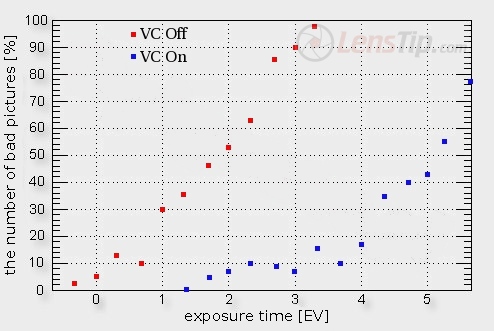
The results are very positive by all means. The stabilization reaches the level of 3 EV without any problems, sometimes even a tad higher and it should be praised for it.