Sigma 17-50 mm f/2.8 EX DC OS HSM
8. Vignetting
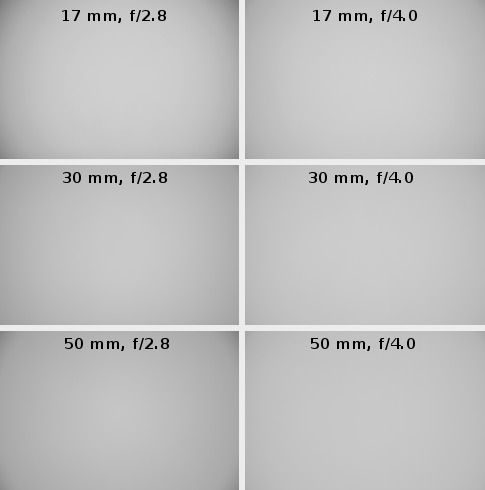
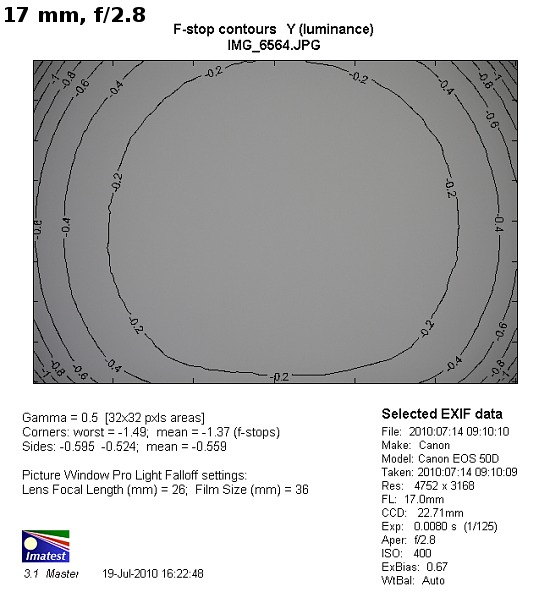
At the widest angle and maximum relative aperture the vignetting will be the most bothersome. It amounts there to 38% (-1.37 EV) and can be noticed without any problems in real life photos. The Sigma fares a bit worse here than the Nikkor 17-55 mm, which reached the level of 33% ,and a bit better than the Canon 17-55 mm, which lost as much as 40 % of light. In the case of the Sigma the vignetting decreases quite slowly on stopping down the aperture. By f/4.0 it is 22%, by f/5.6 it amounts to 18%. Further stopping down doesn’t influence the vignetting any longer – it keeps a fixed level of 17-18%.
Please Support UsIf you enjoy our reviews and articles, and you want us to continue our work please, support our website by donating through PayPal. The funds are going to be used for paying our editorial team, renting servers, and equipping our testing studio; only that way we will be able to continue providing you interesting content for free. |
- - - - - - - - - - - - - - - - - - - - - - - - - - - - - - - - - - - - - - - - - - - - - - - -
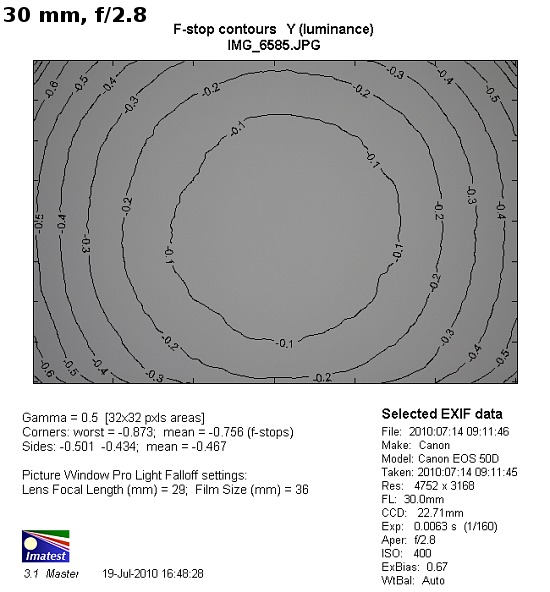
In the middle of the focal lengths range the problems with vignetting are the least significant. By f/2.8 the light fall-off in the frame corners amounts to 23% (-0.76 EV) and it decreases to 13% by f/4.0. On further stopping down we see a very slight influence on vignetting once again – by f/5.6 it is 12% and by f/8.0 – 11%.
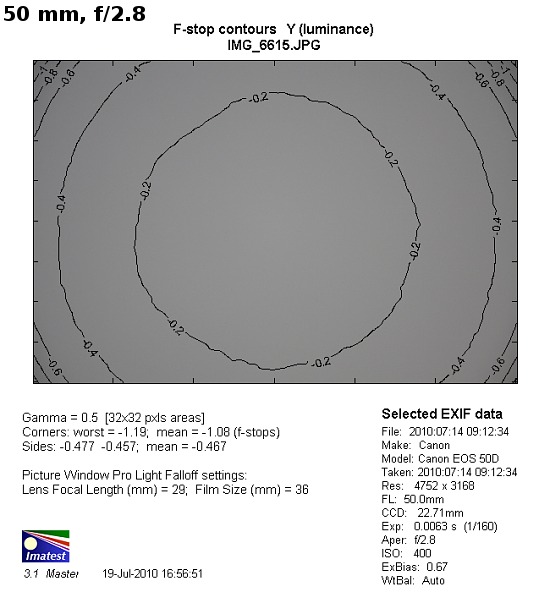
At 50 mm we see the increase of this aberration. At the maximum relative aperture our measurements show that the lens loses in the corners 31% of light (-1.08 EV). Fortunately in this case the stopping down is very efficient when it comes to vignetting correction. By f/4.0 the brightness loss in the frame corners reaches 14% and by f/5.6 it decreases to an imperceptible level of 9%.
 |
 |
 |