Nikon Nikkor AF-S 85 mm f/1.4G
8. Vignetting
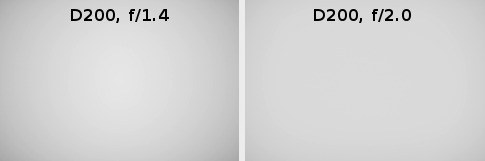
The results of the Nikkor are typical for this class of equipment. As you see in the chart below, the 85 mm class lenses by f/1.4 and on the APS-C/DX class matrix have the vignetting level near 21-25%. On stopping down to f/2.0 this aberration decreases to 8-10%.
Please Support UsIf you enjoy our reviews and articles, and you want us to continue our work please, support our website by donating through PayPal. The funds are going to be used for paying our editorial team, renting servers, and equipping our testing studio; only that way we will be able to continue providing you interesting content for free. |
- - - - - - - - - - - - - - - - - - - - - - - - - - - - - - - - - - - - - - - - - - - - - - - -
|
|
Nikkor AF-S 1.4/85 |
Canon 85 mm f/1.2L |
Samyang 1.4/85 |
Zeiss 1.4/85 |
|
f/1.4 |
25% |
23% |
25% |
21% |
| f/2.0 |
10% |
9% |
9% |
8% |
| f/2.8 |
2% |
2% |
2% |
2% |
Full frame is quite another story, though. The photos taken on the Nikon D3x and presented below, show it well.
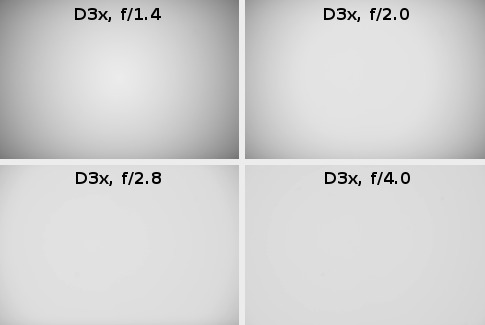
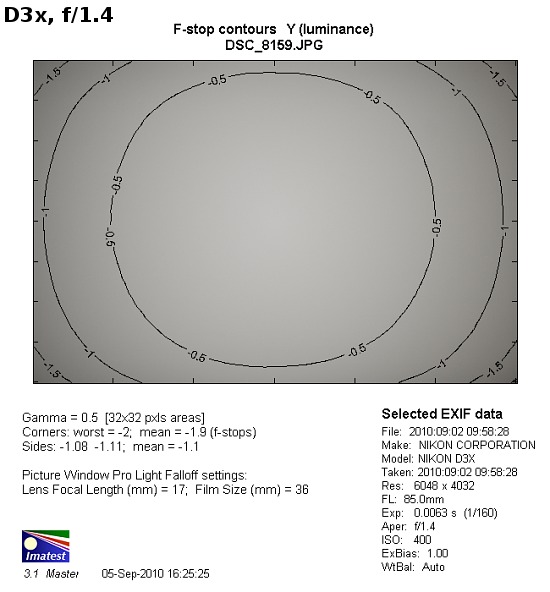
The situation is not so rosy here. The Nikkor AF-S 85 mm f/1.4G at the maximum relative aperture loses as much as 48% of light in the frame corners (-1.9 EV). On stopping down to f/2.0 the vignetting amounts to 35% and by f/2.8 it decreases to 16%. Only by f/4.0 it becomes imperceptible, reaching just 5%.
Looking at the chart below you can see that the Nikkor doesn’t compare favourably with its rivals in this category . We can fully understand the fact that it lost out to the faster and more expensive Canon; also the defeat at the hands of the Sony, after all designed and made by the renowned Zeiss company, is nothing to be ashamed of. But losing to the Samyang, a device six times cheaper, should give us something to think about…
|
|
Nikkor AF-S 1.4/85 |
Canon 85 mm f/1.2L |
Samyang 1.4/85 |
Zeiss 1.4/85 |
|
f/1.4 |
48% |
43% |
38% |
41% |
| f/2.0 |
35% |
22% |
22% |
22% |
| f/2.8 |
16% |
5% |
13% |
7% |
| f/4.0 |
5% |
4% |
8% |
5% |
 |