Carl Zeiss Distagon T* 25 mm f/2.0 ZE/ZF.2
8. Vignetting
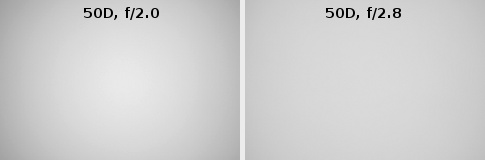
It can be seen at the maximum relative aperture where it amounts to 28% (-0.96%) but already by f/2.8 it is slight, reaching just 13% (-0.39 EV) and by f/4.0 it disappears completely (9%). Comparing these results to those of competitors you can assume there will be problems on full frame - you should notice that the vignetting level of the Zeiss by f/2.0 is very similar to the vignetting level of the Nikkor by f/1.4.
Please Support UsIf you enjoy our reviews and articles, and you want us to continue our work please, support our website by donating through PayPal. The funds are going to be used for paying our editorial team, renting servers, and equipping our testing studio; only that way we will be able to continue providing you interesting content for free. |
- - - - - - - - - - - - - - - - - - - - - - - - - - - - - - - - - - - - - - - - - - - - - - - -
| |
Zeiss 2.0/25 |
Nikkor 1.4/24G |
Canon 1.4/24L II |
Samyang 1.4/24 |
| f/1.4 |
– |
29% |
34% |
32% |
| f/2.0 |
28% |
12% |
17% |
27% |
| f/2.8 |
13% |
7% |
9% |
15% |
The problems on full frame are undoubtedly more serious – one look at the thumbnails is enough to see it rather clearly.
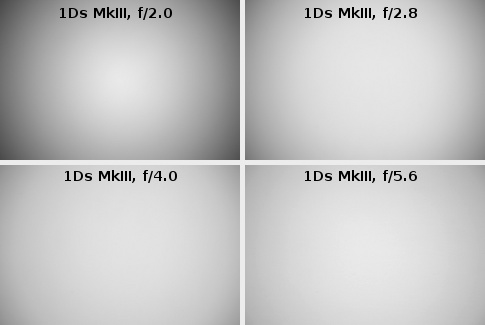
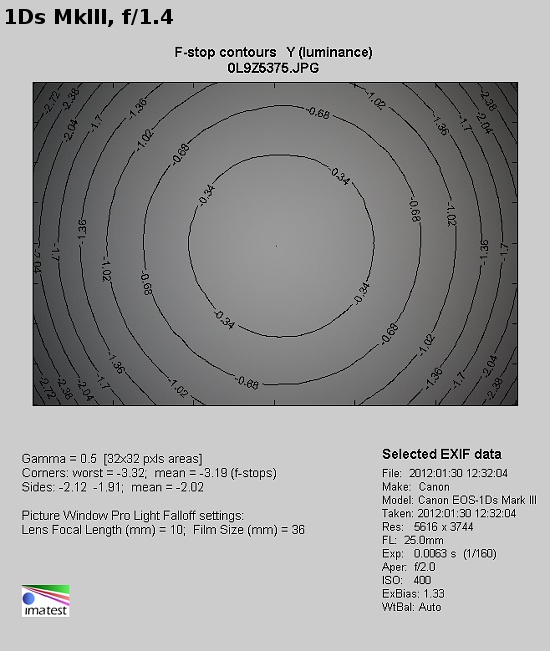
At the maximum relative aperture the vignetting gets to a huge level of 67% (-3.19 EV). On stopping down the aperture to f/2.8 the brightness loss in the frame corners remains pronounced, reaching 46% (-1.78 EV). The performance by f/4.0 and f/5.6 is far from perfect as well, being respectively 34% (-1.20 EV) and 29% (-0.99 EV) On further stopping down you don’t see the level of this aberration decrease – it doesn’t want to drop lower than 25%.
The comparison with its competitors, shown below, proves that the Zeiss is much worse than the faster Nikkor. In the case of a duel between the Canon and the Zeiss we must admit the tested lens, despite being slower, fights as equal.
| |
Zeiss 2.0/25 |
Nikkor 1.4/24G |
Canon 1.4/24L II |
Samyang 1.4/24 |
| f/1.4 |
- |
54% |
78% |
65% |
| f/2.0 |
67% |
38% |
62% |
63% |
| f/2.8 |
46% |
25% |
43% |
46% |
| f/4.0 |
34% |
19% |
37% |
31% |
 |