Panasonic Lumix S 100 mm f/2.8 Macro
6. Distortion and field of view
Field of view
A rectilinear lens with a focal length of 100 mm should provide a 24.4-degree angle of view on a full-frame sensor, whereas the manufacturer specifies a value of exactly 24 degrees.
We decided to assess the actual field of view by photographing the starry sky, first using JPEG files and then uncorrected RAW files. We subsequently transformed the pixel coordinates (X,Y) into equatorial coordinates (right ascension and declination), which describe the positions of stars in the sky. This enabled us to determine the lens's field of view very precisely and, as it should be done, for light rays arriving from infinity.
Please Support UsIf you enjoy our reviews and articles, and you want us to continue our work please, support our website by donating through PayPal. The funds are going to be used for paying our editorial team, renting servers, and equipping our testing studio; only that way we will be able to continue providing you interesting content for free. |
- - - - - - - - - - - - - - - - - - - - - - - - - - - - - - - - - - - - - - - - - - - - - - - -
The transformation for the JPEG file was based on the positions of 91 stars distributed evenly across the entire image. The mean coordinate-grid fitting error was just 6 arcseconds. In this case, the resulting angle of view was 24.39 degrees, with an error of 0.02 degrees. This is in good agreement with the specifications.
For the uncorrected RAW files, the transformation was based on the positions of 103 stars, and the grid-fitting error was 5 arcseconds. In this case, the developed file always has a slightly higher physical resolution, so the resulting angle of view reached a marginally higher value of 24.41 degrees, with an error of 0.02 degrees.
There are no surprises here, as the lens delivers virtually exactly what its specifications state and what its focal length would lead us to expect.
Distortion
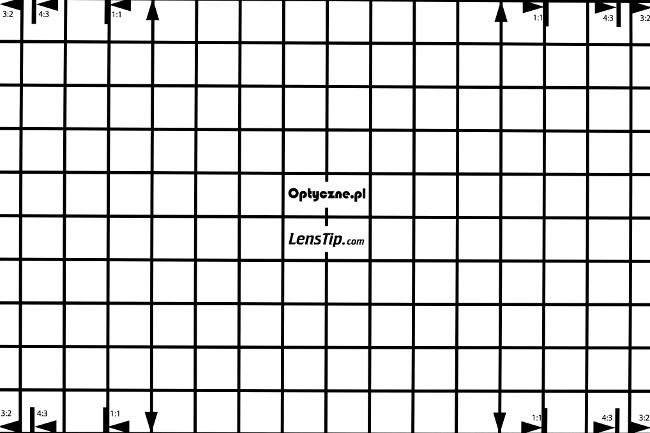
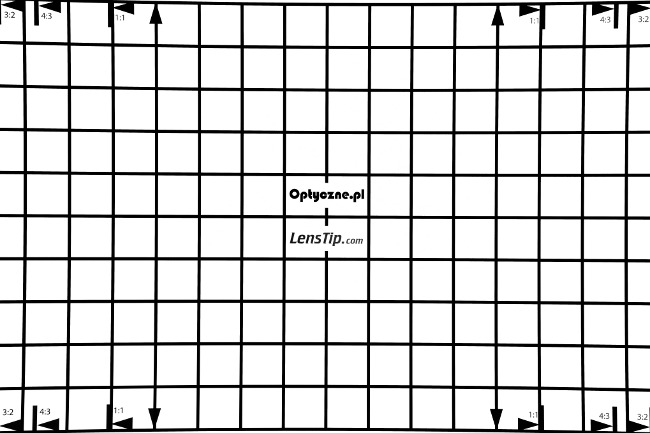
Panasonic surprised us somewhat when it came to distortion. We did not expect any differences between JPEG and RAW files, as we assumed that the optical design would correct distortion effectively. However, distortion is readily visible in the RAW files, where we can observe pincushion distortion, which we measured at +1.90%. Switching to JPEG files forces this aberration to be corrected, and the software does a good job: distortion drops to a negligible level of -0.04%, which, within the limits of measurement error, is consistent with zero.
The comparison with competing lenses is very unfavorable for Panasonic in this respect. All the full-frame mirrorless macro lenses with focal lengths ranging from 90 to 105 mm that we have tested exhibited lower levels of this aberration, and we have never recorded absolute distortion values exceeding 1% in this category.
| Panasonic S1R II, 100 mm, JPEG, FF | |||
 |
|||
| Panasonic S1R II, 100 mm, RAW, FF | |||
 |
|||