6. Distortion and field of view
Field of view
A rectilinear 35 mm lens on a full frame sensor should provide you an angle of view of 63.4 deg and the producers of the Sigma A 35 mm f/1.2 DG II in their official specifications state the same value, 63.4 deg. Of course we decided to check how big this field really is anyway. In order to do so, we took photos of a starry sky and saved them as uncorrected JPEG files. Then we transformed the pixel layout (X,Y) from the photo into the equatorial coordinate system (right ascension and declination), which locates a star on a celestial sphere. That way we were able to measure the field very precisely and exactly as it should be done for rays of light coming from infinity. Our transformation was based on positions of 162 stars spread evenly across the frame. An average mesh-fitting error amounted to just 44 seconds of arc.Our result amounts to 63.90 deg with a measurement error on a level of 0.06 of a degree. It's even a tad higher than stated in official specifications and suggested by the focal length value but the differences are slight. It seems the resulting angle of view is the equivalent of the distortion-free 34.7 mm focal length.
Distortion
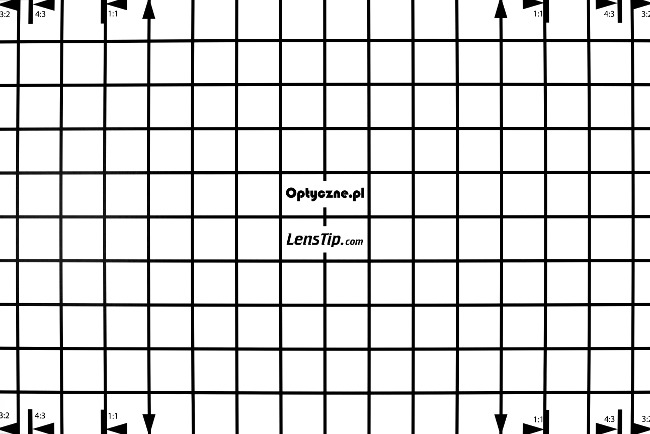
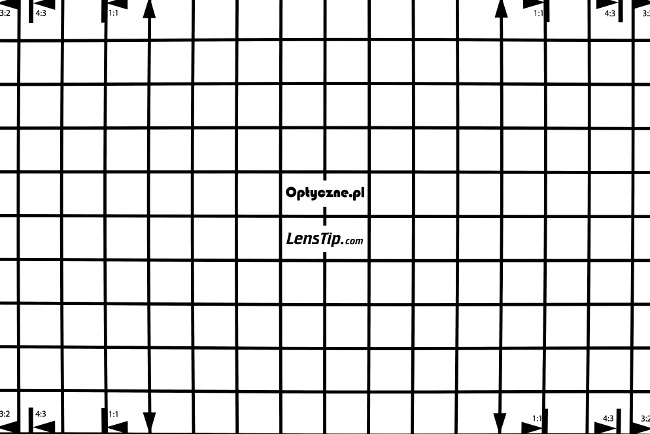
The older Sigma 1.2/35 didn't correct distortion perfectly well because on the smaller APS-C/DX sensor it showed a level of -1.11%; on full frame the value was even more noticeable, amounting to -2.53%.
Considering the decrease in weight and physical dimensions of the version II, and also current trends that consider it normal when a lens shifts the responsibility of correcting geometric deformations to the software of a camera, we felt a bit anxious before this part of our test.
Please Support UsIf you enjoy our reviews and articles, and you want us to continue our work please, support our website by donating through PayPal. The funds are going to be used for paying our editorial team, renting servers, and equipping our testing studio; only that way we will be able to continue providing you interesting content for free. |
- - - - - - - - - - - - - - - - - - - - - - - - - - - - - - - - - - - - - - - - - - - - - - - -
Still, the Sigma A 35 mm f/1.2 DG II surprised us very nicely because on the smaller sensor it showed a negligible value of -0.59% and on full frame distortion was at a not especially bothersome level of -0.89%. These are very good results, not only compared to the results of the predecessor but also compared to direct rivals. The level of the Nikkor was a tad higher, at -1.45%, and the Viltrox showed very nasty moustache deformations. The Sigma in this category is simply an example to follow – a round of applause!
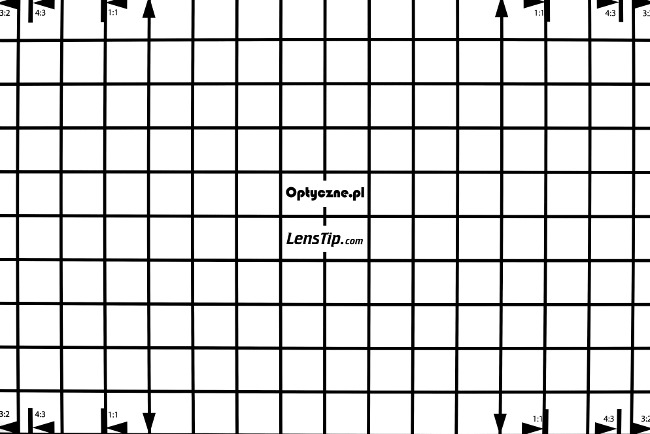
At the end of this chapter, you can only add that, after switching on the deformation correction in the camera menu, distortion on full frame decreases to -0.38%.
| Sony A7R IIIa, 35 mm, APS-C | |||
 |
|||
| Sony A7R IIIa, 35 mm, FF | |||
 |
|||
| Sony A7R IIIa, 35 mm, FF CORRECTED | |||
 |
|||