Tamron SP 24-70 mm f/2.8 Di VC USD
8. Vignetting
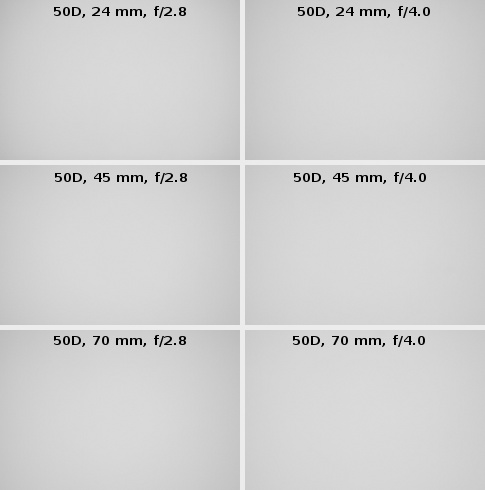
Our measurements confirm it completely. At the shortest focal length and the maximum relative aperture the light fall-off in the frame corners is just 14% (-0.42 EV) and it becomes even more imperceptible already on stopping down by 1 EV. The situation in the middle of the focal range is even better because there the vignetting is difficult to spot even with the lens wide open – it amounts to just 11% (-0.35 EV). On stopping down to f/4.0 the vignetting decreases to 8%. At 70 mm focal length the performance is very similar. The results, recorded by us by f/2.8 and f/4.0 are respectively 12% and 7%.
Please Support UsIf you enjoy our reviews and articles, and you want us to continue our work please, support our website by donating through PayPal. The funds are going to be used for paying our editorial team, renting servers, and equipping our testing studio; only that way we will be able to continue providing you interesting content for free. |
- - - - - - - - - - - - - - - - - - - - - - - - - - - - - - - - - - - - - - - - - - - - - - - -
You can meet with serious difficulties only on full frame – it can be noticed very clearly below.
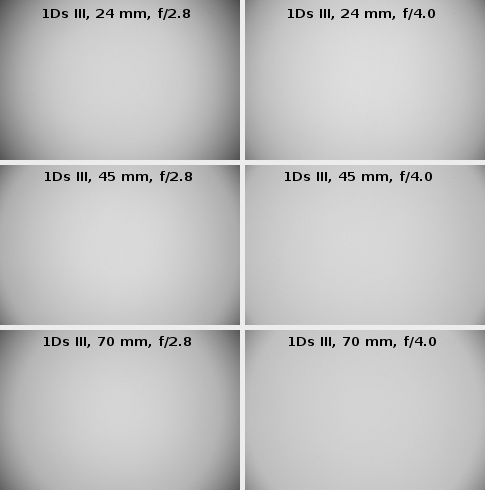
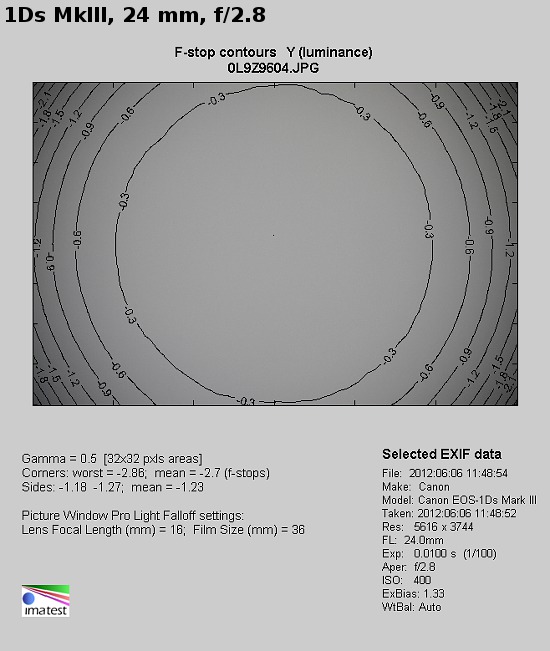
At the combination of f/2.8 aperture and 24 mm focal length the brightness loss in the frame corners amounts to as much as 61 % (-2.70 EV). It’s worth noticing that the competitors deal much better here because the Nikkor 24-70 mm has a result of 42% and the Sigma 24-70 mm gets to 50%. Stopping down allows you to decrease the vignetting a bit but this aberration does so a bit too slowly for our tastes. By f/4.0 you still have a high value of 44% (-1.65 EV) so higher than in the case of the Nikkor at the maximum aperture! On stopping down the aperture to f/5.6 you see the vignetting reduced to the level of 32% (-1.11 EV) but further stopping down won’t help much because by f/8 we get the result of 30% and by f/11 – just 1% lower.
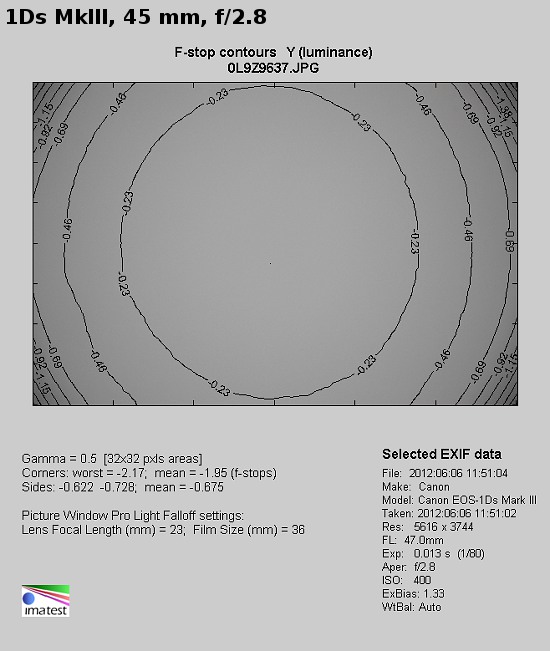
In the middle of the focal range at the maximum relative aperture the vignetting reaches 49 % (-1.95 EV). Once again this performance is worse than that of the Nikkor and the Sigma. On stopping down to f/4.0 we can reduce that aberration to the value of 30% (-1.05 EV) and implementing f/5.6 aperture gives a result of 21% (-0.67). This aberration remains noticeable by f/8 and f/11 where it reaches near 17% (0.55 EV).
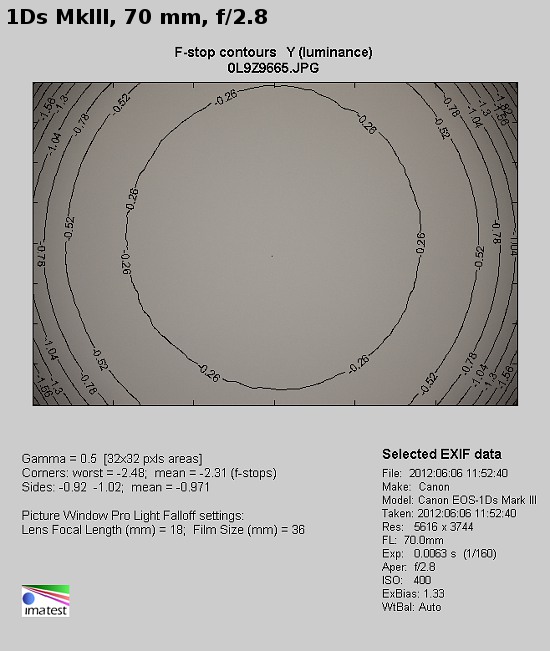
At the maximum focal length and maximum relative aperture the light fall-off in the corners of the frame gets to 55% (-2.31 EV). Once again it is a result much worse than in the case of the tested lens’s competitors (the Sigma had 43% here and the Nikkor – 38%). On stopping down to f/4.0 you see the vignetting drop to the value of 35% (-1.23 EV) and using f/5.6 aperture reduces it to the level of 25% (-0.83 EV). This aberration remains still visible by f/8 and f/11 where it reaches respectively 18% and 13%.
 |
 |
 |