Canon EF 28 mm f/1.8 USM
5. Chromatic aberration
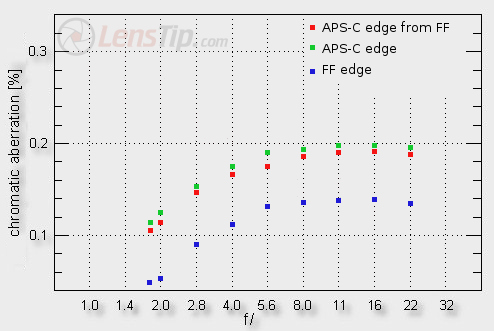
The results for the Canon 1.8/28 are presented on the graph below; the red points correspond to the APS-C sensor’s edge and the blue points – to the FF edge (in both cases we got them from pictures taken with the EOS 1Ds MkIII).
Please Support UsIf you enjoy our reviews and articles, and you want us to continue our work please, support our website by donating through PayPal. The funds are going to be used for paying our editorial team, renting servers, and equipping our testing studio; only that way we will be able to continue providing you interesting content for free. |
- - - - - - - - - - - - - - - - - - - - - - - - - - - - - - - - - - - - - - - - - - - - - - - -
As you see, the full frame aberration results are lower than those for the APS-C sensor. Two factors are responsible for such an effect. Firstly, the aberration expressed in pixels is similar in both cases which means that it increases very slowly at the frame edge. As a result, the aberration measurement is expressed in percentages which allows us to become independent from the pixel size and from the distance between the measurement area and the optical axis – in the end the result will be lower for the full frame. It will be also in full accordance with impressions of a photographer who makes use of full frame and doesn’t pay attention to the 1:1 scale magnification.
Similarly to the previous chapter, we also decided to check how the APS-C sensor’s aberration at the frame edge, determined on full frame, correlates with that measured straight on the APS-C sensor (in this case on the 50D). In the picture above, the green points correspond to the 50D results. They are situated very closely to the red points. The difference is slight and it stems mainly from measurement errors which are not much lower than the average distance between the two curves.
Once again we got a very positive result, showing that we can use the full frame photos analysis to determine a level of chromatic aberration on an APS-C/DX sensor.
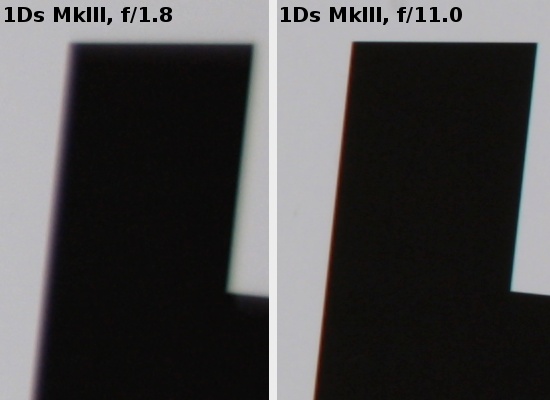
In the heat of comparing different results we forgot to mention the most important thing – how the tested lens performs in this category. Unfortunately the news are not good. The chromatic aberration will be moderate only near the maximum relative aperture, which is not very useful at the frame edge anyway because of low resolution. Improving the resolution means stopping the lens down and it will entail the increase of the chromatic aberration level which soon reaches a high level for the APS-C sensor and an average and high level borderline for the full frame.
 |