Sigma 30 mm f/2.8 EX DN
4. Image resolution
It’s worth reminding here that in the case of tests performed on that body the decency level is situated near 42 lpmm. So far the highest result among the system optics of Olympus and Panasonic was reached by the Leica DG MACRO-ELMARIT 45 mm f/2.8 ASPH. MEGA O.I.S. lens which by f/4.0 got to 80 lpmm. The values got by Panasonic “pancakes” were a bit worse. The 1.7/20 model brushed against 75 lpmm and the wide angle LUMIX G 14 mm f/2.5 ASPH. exceeded slightly the level of 70 lpmm.
Let’s check how the fixed-focal Sigma compares here.
Please Support UsIf you enjoy our reviews and articles, and you want us to continue our work please, support our website by donating through PayPal. The funds are going to be used for paying our editorial team, renting servers, and equipping our testing studio; only that way we will be able to continue providing you interesting content for free. |
- - - - - - - - - - - - - - - - - - - - - - - - - - - - - - - - - - - - - - - - - - - - - - - -
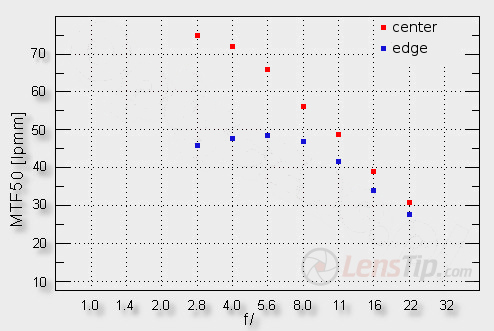
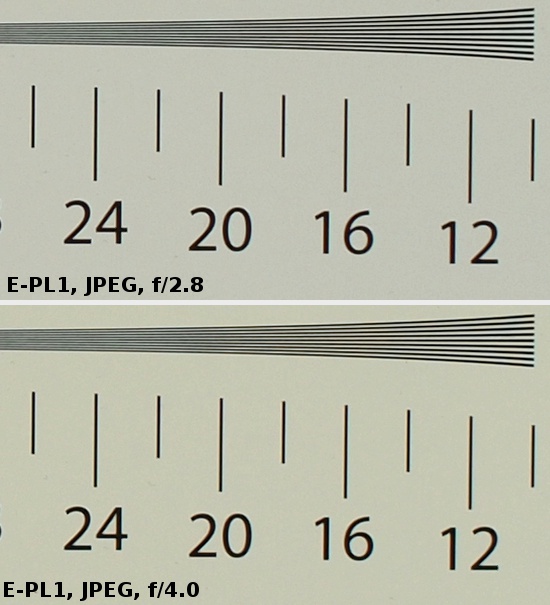
It is impressing that quite a good result of about 75 lpmm can be reached at its maximum relative aperture. The Sigma’s performance is still influenced by noticeable astigmatism (which we are going to describe in more detail later) and if the constructors had managed to eliminate that aberration the Sigma would have exceeded the value of 80 lpmm. 75 lpmm is still a very good result, similar to the performances of other Micro 4/3 ‘primes’ on stopping down. Mind you the Sigma fares so well when wide open.
A worse situation can be observed on the edge of the Micro 4/3 sensor. There are no impressive values to be seen anywhere and the graph is quite flat in the range of apertures we are interested in the most. It should be admitted honestly that even at the maximum relative aperture the lens exceeds the decency level. On the bigger APS-C sensor there might be more problems, though - the image quality might be on the decency borderline or just slightly lower.
Below we present some crops of our test chart taken from JPEG files.
 |