Sony DT 16-50 mm f/2.8 SSM
5. Chromatic and spherical aberration
 |
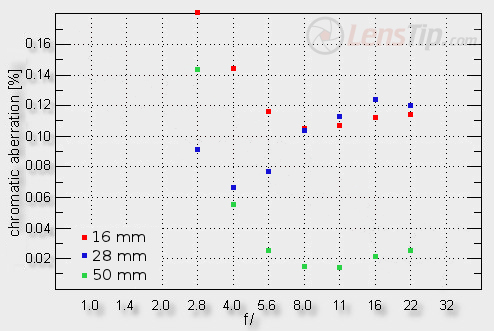
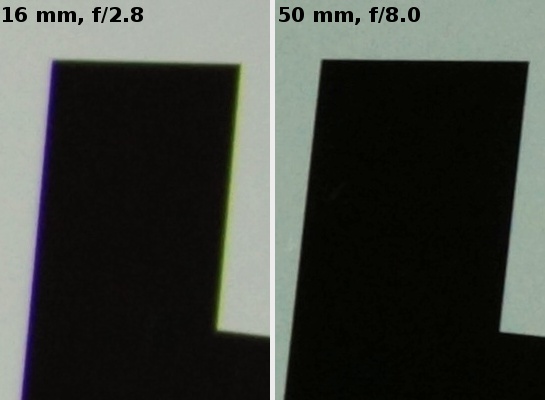
The situation of the lateral chromatic aberration looks worse – in fact it is the biggest challenge at a difficult combination of the widest angle of view and the maximum relative aperture where it exceeds a very high level of 0.18%. Such a result is still good when compared to those of the rival 16-50 mm lenses from Tokina and Pentax in which cases the aberration could rise above 0.25%. It is obvious that aberration control in a lens of this type is not easy. Although the level of it in the Sony 16-50 mm is not low it would be difficult to criticize the tested lens for it as it still fares the best of all other instruments of this type. Even 17-5x class lenses, allegedly easier to manufacture, fare alike. For example the chromatic aberration of the expensive Nikkor 17-55 mm f/2.8 reached almost 0.16% so was very similar to that of the Sony.
Please Support UsIf you enjoy our reviews and articles, and you want us to continue our work please, support our website by donating through PayPal. The funds are going to be used for paying our editorial team, renting servers, and equipping our testing studio; only that way we will be able to continue providing you interesting content for free. |
- - - - - - - - - - - - - - - - - - - - - - - - - - - - - - - - - - - - - - - - - - - - - - - -
 |
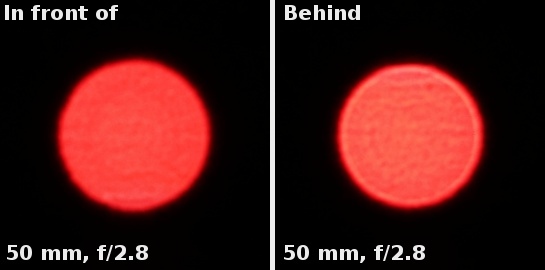
Defocused photos or a diode (front and back focus), posted below, show that the spherical aberration is not corrected perfectly well. In the first case we have a smooth, homogeneous light spread in a circle; in the second case you can notice a significant rim near the edge.