Sigma 120-300 mm f/2.8 APO EX DG OS HSM
5. Chromatic and spherical aberration
 |
Also the lateral chromatic aberration is kept properly in check. The first of the graphs, shown below, concerns the edge of the APS-C/DX sensor, the second one is for the full frame edge.
Please Support UsIf you enjoy our reviews and articles, and you want us to continue our work please, support our website by donating through PayPal. The funds are going to be used for paying our editorial team, renting servers, and equipping our testing studio; only that way we will be able to continue providing you interesting content for free. |
- - - - - - - - - - - - - - - - - - - - - - - - - - - - - - - - - - - - - - - - - - - - - - - -
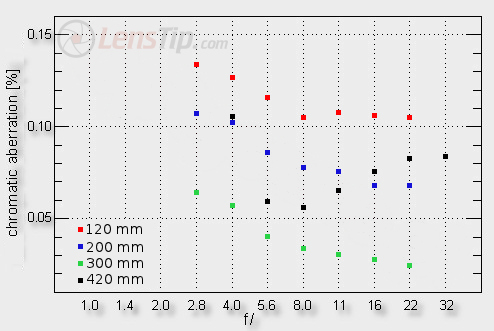
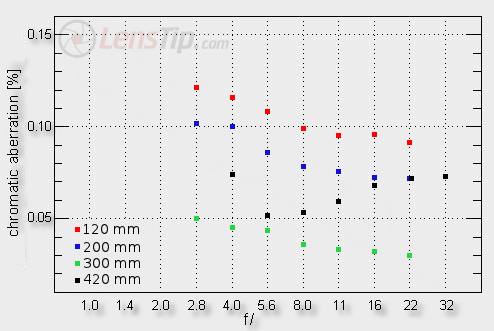
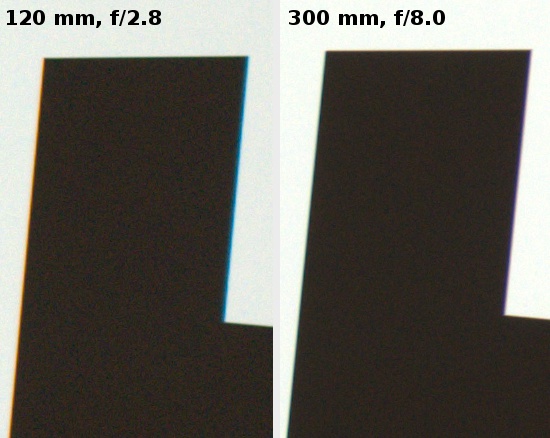
As you see, the aberration never reaches a high level. The biggest values you get at the shortest focal length and the maximum relative aperture but even there they are medium at most. With the lengthening of the focal length the chromatic aberration decreases and at 300 mm, for all aperture values, it is simply low.
In many lenses the chromatic aberrations likes to „explode” and reaches unacceptable values after using a teleconverter. The Sigma 120-300 mm is a nice exception to this rule because its values are on the borderline between low and medium level so not bothersome at all.
 |
Spherical aberration
The photos below show a defocused image of a diode in front of and behind the focus.
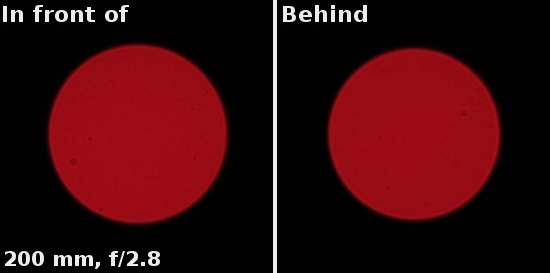
It can be noticed that in both cases we deal with circles with a very even light spread, without any local or global extremes or noticeable concentric rings. All of it proves that the spherical aberration is corrected very well.