Panasonic Lumix S 85 mm f/1.8
4. Image resolution
We can also mention the fact that the decency level is positioned here near 40-42 lpmm, the best system primes should reach about 80 lpmm and the record-breakers might go as high as near 85 lpmm or even slightly exceed this value. Of course, as we add more and more tests of lenses from this system to our database, we might refine these estimations even further. So far, the Leica APO-Summicron-SL 75 mm f/2 (83.4 lpmm) and the Panasonic S Pro 50 mm f/1.4 (85.4 lpmm) can boast of the highest resolution levels.
Now let's check how the performance of the Panasonic Lumix S 85 mm f/1.8 compares – its results in the frame centre, on the edge of the APS-C sensor and on the edge of full frame presents a graph below.
Please Support UsIf you enjoy our reviews and articles, and you want us to continue our work please, support our website by donating through PayPal. The funds are going to be used for paying our editorial team, renting servers, and equipping our testing studio; only that way we will be able to continue providing you interesting content for free. |
- - - - - - - - - - - - - - - - - - - - - - - - - - - - - - - - - - - - - - - - - - - - - - - -
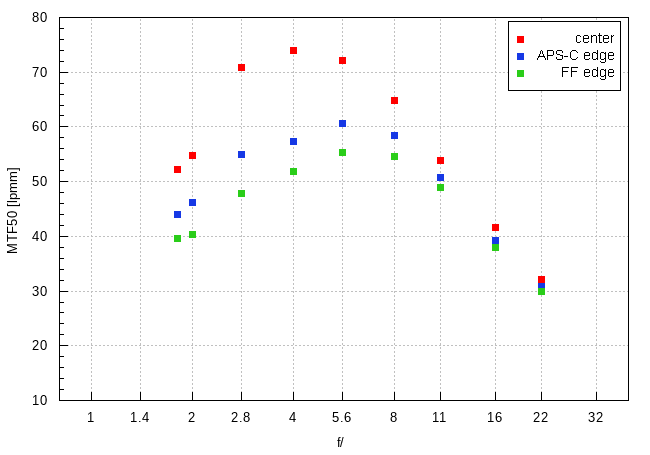
The performance in the frame centre is very good. Already at the maximum relative aperture you deal with a praiseworthy result of over 52 lpmm; on stopping down the resolution level is able to exceed noticeably 70 lpmm. It's worth reminding here that the Panasonic S 50 mm f/1.8 didn't manage to fare so well.
It's also worth comparing the tested lens to its rivals and the graph below shows a comparison between the tested Panasonic, the Sony FE 85 mm f/1.8, a lens equally priced and optically as complex as the Lumix, and the noticeably more expensive Nikkor Z 85 mm f/1.8 S that is also optically more advanced.
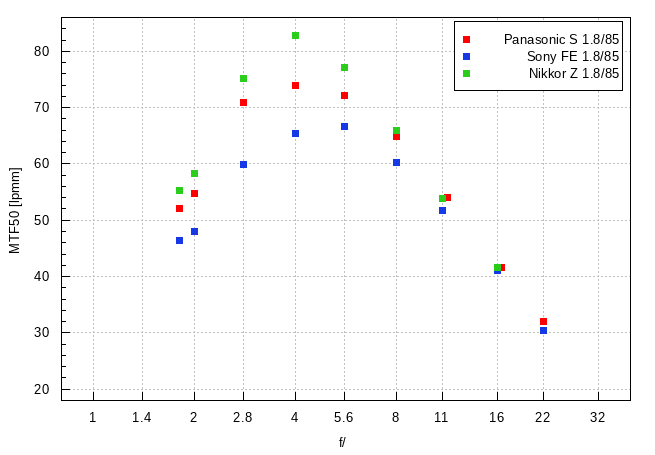
The graph above puts the Panasonic in a more favourable light than a similar comparison made for 1.8/50 lenses. Here the Panasonic is distinctly better than the Sony and it lands close to the much more expensive Nikkor. In case of the 50 mm instruments the Nikkor outdistanced the Lumix noticeably being just about 25% more expensive. In this case the difference in price amounts to 50% and the difference in MTFs is far less conspicuous.
At the same time, in case of 50 mm lenses, the advantage of the Panasonic over the Sony wasn't any kind of a surprise because the Sony was a cheap double gauss construction. In the 1.8/85 class the Sony is every bit as optically complex and expensive as the Panasonic so the victory of the tested instrument is more powerful.
When it comes to the edge of the APS-C/DX sensor once again everything looks good. Even at the maximum relative aperture you get a result of 44 lpmm, significantly over the decency level. What's more, on stopping down the aperture the lens is able to produce MTFs of very good levels, about 60 lpmm.
The performance on the edge of full frame near the maximum relative aperture is the only weak point of the Panasonic S 1.8/85. The results we got by f/1.8 and f/2.0 amount to, respectively, 39.6 and 40.3 lpmm so are on the borderline of the decency level. I admit that more demanding users can find such a performance lacking. On further stopping down the lens doesn't have any problems with reaching good results because in the aperture range from f/4.0 to f/8.0 it exceeds a level of 50 lpmm.
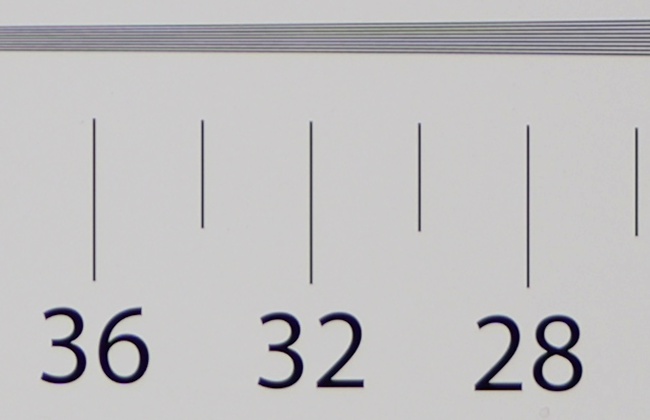
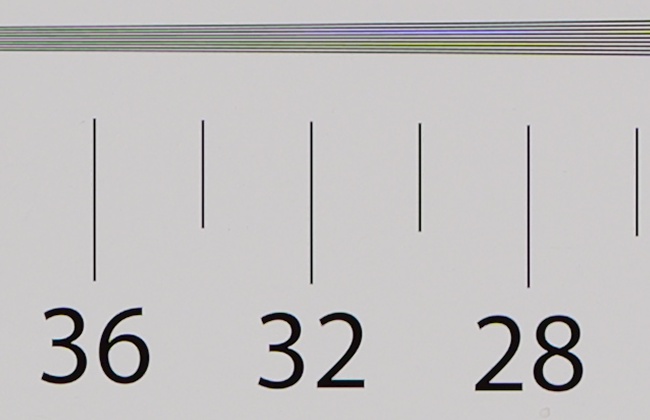
At the end of this chapter, traditionally, we present crops taken from photos of our resolution chart; they were taken from JPEG files saved along RAW files we used for the analysis above.
| Panasonic S1R II, JPEG, 85 mm, f/1.8 |
 |
| Panasonic S1R II, JPEG, 85 mm, f/4.0 |
 |