The following chart presents a comparison between the basic parameters of different 50-56 mm lenses with apertures ranging from f/1.7 to 2.0 that are designed to cooperate with APS-C/DX sensors.
The Viltrox AF 56 mm f/1.7 Air, even if the fastest and optically the most complex lens in this group, weighs the least. Unfortunately it lags behind its rivals when it comes to the minimum focusing distance.
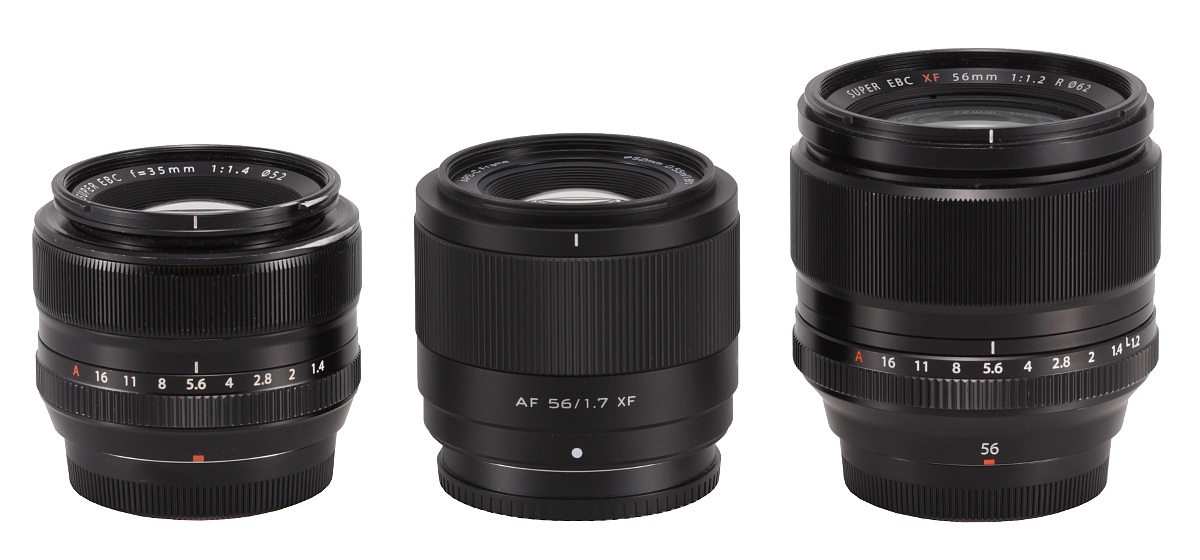
In the photo below we positioned it between two Fujinons, the XF 35 mm f/1.4 R, and the XF 56 mm f/1.2 R.
Please Support Us
If you enjoy our reviews and articles, and you want us to continue our work please, support our website by donating through PayPal. The funds are going to be used for paying our editorial team, renting servers, and equipping our testing studio; only that way we will be able to continue providing you interesting content for free.
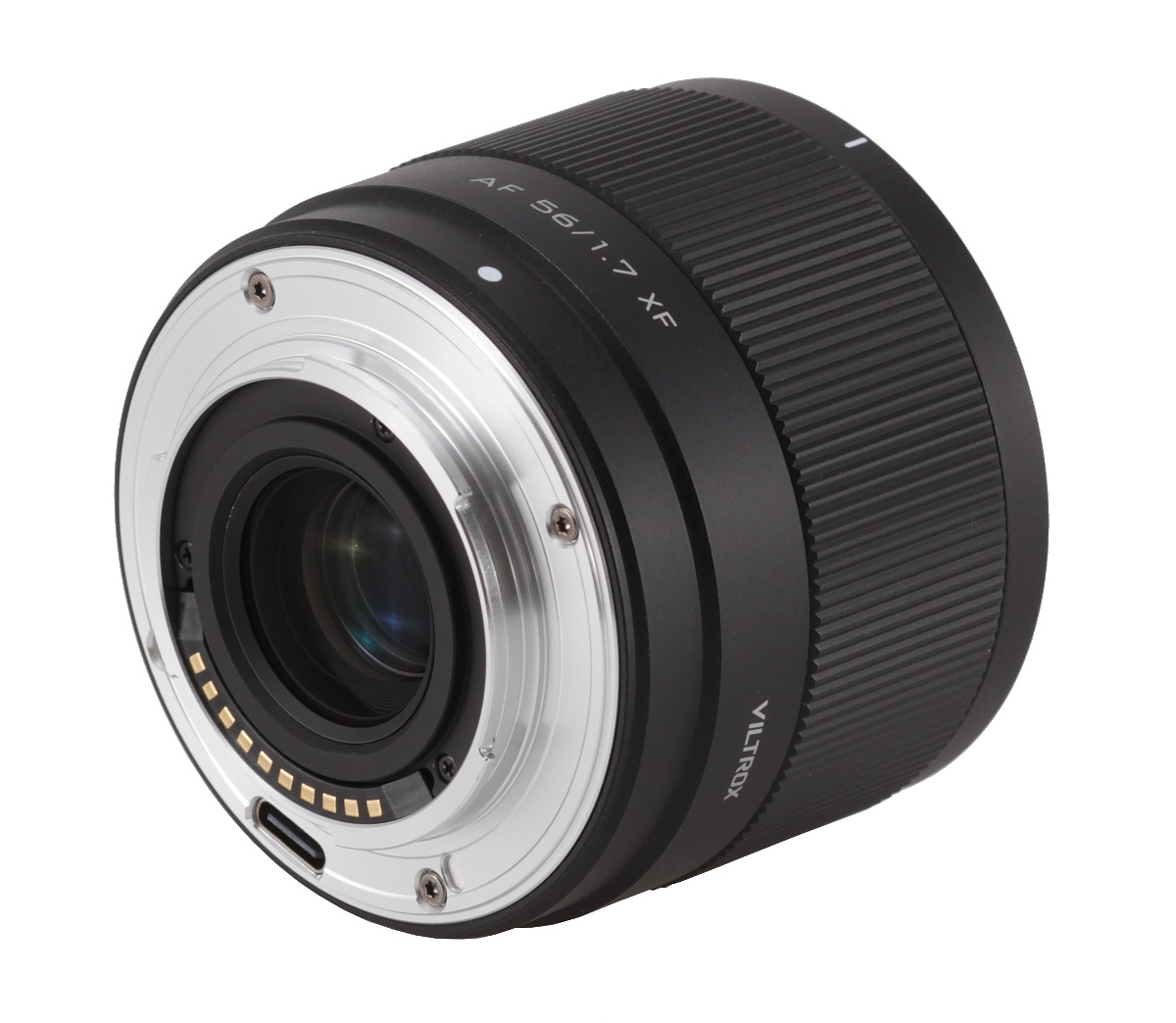
The Viltrox AF 56 mm f/1.7 Air starts with a metal mount which rim features an USB-C port that allows you to join the lens to a computer and install software updates. Inside the mount you can find a black ring with embedded contacts that surrounds a rear element of the lens, 22 mm in diameter. This element doesn't move and is positioned practically on the same level as the contacts. From this side everything looks very well.
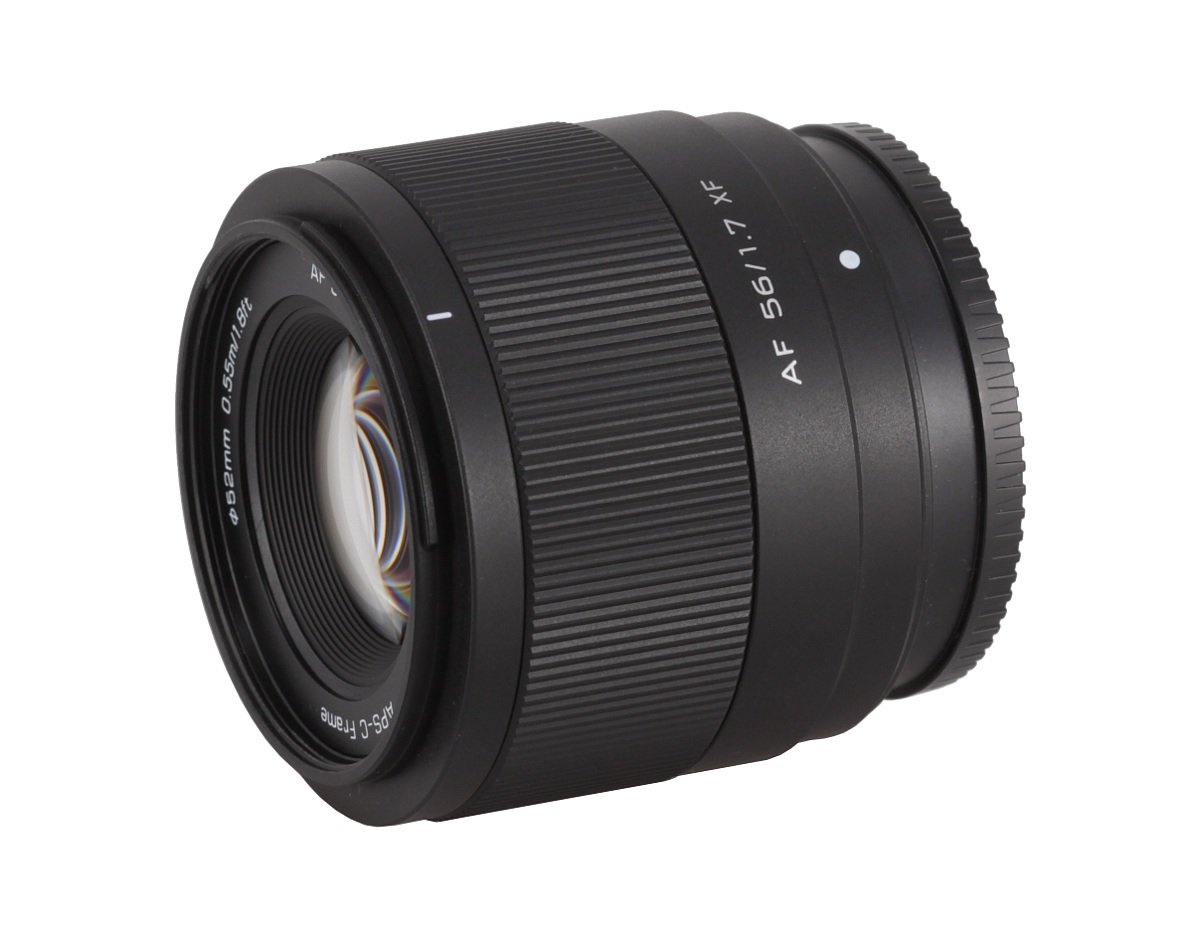
The proper body of the lens is covered by black plastics. It starts with an immobile ring with a white dot that makes an alignment with a camera easier, the logo of the company, a model number, a serial number, and information about the place of production, China. Then the ring increases its diameter and on the already enlargened part you find another producer's logo, and an inscription 'AF 56/1.7 XF'.
A manual focus ring, as wide as 24 mm and completely covered by rubber ribbing, is the next part of the lens. It is a focus-by-wire construction without any distance and/or DOF scale, that turns with a slight but still tolerable resistance. The range depends very slightly on the speed of your turning – running through the whole distance range needs an angle of about 200 degrees. This value is so significant that allow you very precise manual settings.
Further on, you see another immobile ring that ends with a hood mount. It can be properly aligned with the help of a white mark on the edge of the lens.
The front element of the tested Viltrox is convex, immobile, 29 mm in diameter. It is surrounded by a part with fine ribbing that turns into a ring with the name and basic parameters of the lens. Here you also find information about the detector's size (APS-C Frame), the minimum focusing distance value (0.55m/1.8ft), filter diameter that amounts to 52 mm and also a series of abbreviations that indicate different technologies applied: STM, meaning a silent Stepping Motor, ASPH - aspherical elements inside the construction, ED - low dispersion glass elements, and IF meaning internal focusing (the lens doesn't rotate or change the focal length while focusing). All of this is surrounded by a non-rotating filter thread with a diameter of 52 mm
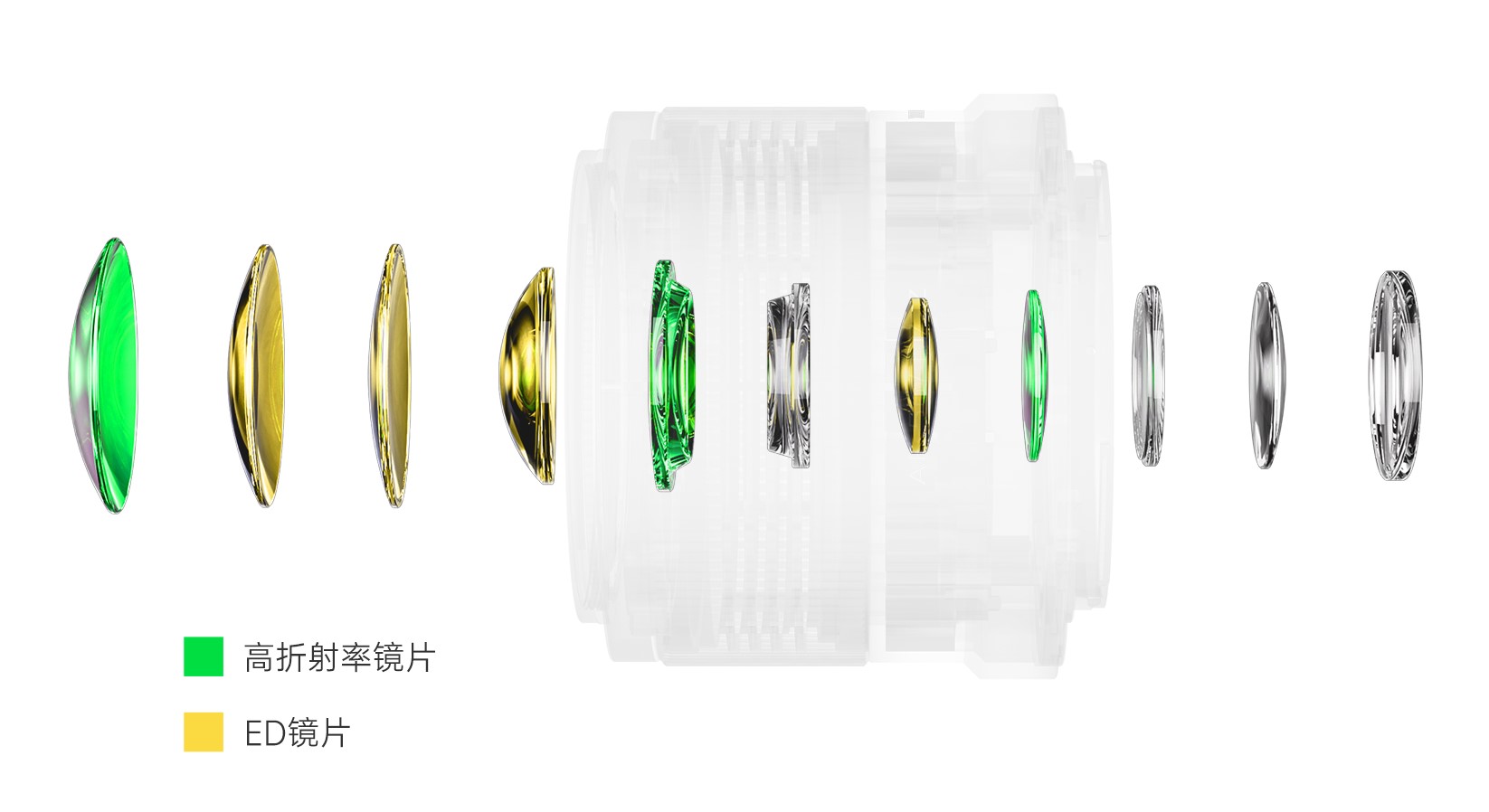
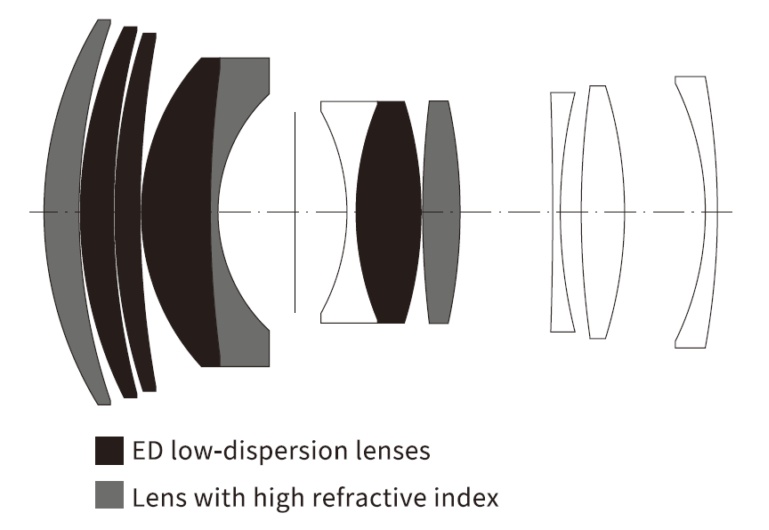
When it comes to optical construction, you deal here with 11 elements positioned in 9 groups. Among them you can find as many as four ED elements, and three elements made of high refractive index glass (HR). As you see the producers weren't skimpy when it comes to special elements, a fact worth emphasizing especially that the price of this model is very reasonable, not exceeding 800 PLN. Inside you can also find a round aperture with nine blades that can be closed down to a value of f/16 at the maximum.
As we've already mentioned the complexity of optics it's worth consulting specific data. In the following chart you can find a comparison between parameters of different full frame 1.8/85 class lenses so providing the same angle of view as the Viltrox, tested here. Overall these full frame lenses are more difficult to design that the 1.7/56 model designed for smaller APS-C/DX sensors; despite this fact many of them feature the same number of elements, or even less, than the Viltrox. Only the expensive Nikkor is more complex, but it still features less element groups than the Viltrox. As if it wasn't enough, the Viltrox features the highest number of special elements. Mind you, in this group it is the cheapest instrument of all.
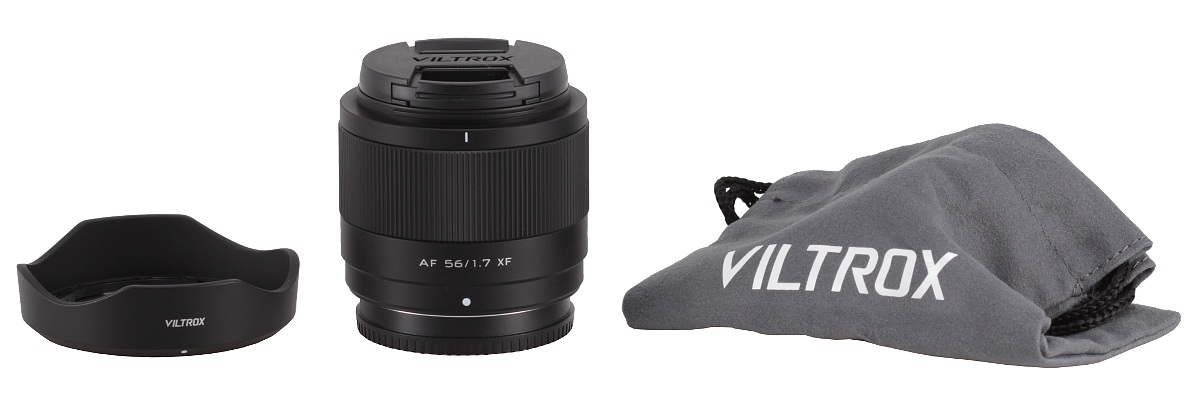
Buyers get in the box with the lens: both caps, a petal-type hood, and a soft pouch. The pouch is perhaps not very solid but the fact that the producers added it at all is worth our praise. After all this instrument costs about $180; many more expensive lenses are sold with a more modest accessory kit. Like in case of other Viltrox devices, you also get up to 5-year warranty period.