Leica APO-Summicron-SL 35 mm f/2 ASPH.
4. Image resolution
We can also mention the fact that the decency level is positioned here near 40-42 lpmm, the best system primes should reach about 80 lpmm and the record-breakers might go as high as near 85 lpmm or even slightly exceed this value. Of course as we add more and more tests of lenses from this system to our database we might refine these estimations even further. So far the highest results were reached by the Leica APO-Summicron-SL 75 mm f/2 (83.4 lpmm) and the Panasonic S Pro 50 mm f/1.4 (85.4 lpmm).
Let's check how the performance of the Leica APO-Summicron-SL 35 mm f/2 compares – its results in the frame centre, on the edge of the APS-C sensor and on the edge of full frame presents a graph below.
Please Support UsIf you enjoy our reviews and articles, and you want us to continue our work please, support our website by donating through PayPal. The funds are going to be used for paying our editorial team, renting servers, and equipping our testing studio; only that way we will be able to continue providing you interesting content for free. |
- - - - - - - - - - - - - - - - - - - - - - - - - - - - - - - - - - - - - - - - - - - - - - - -
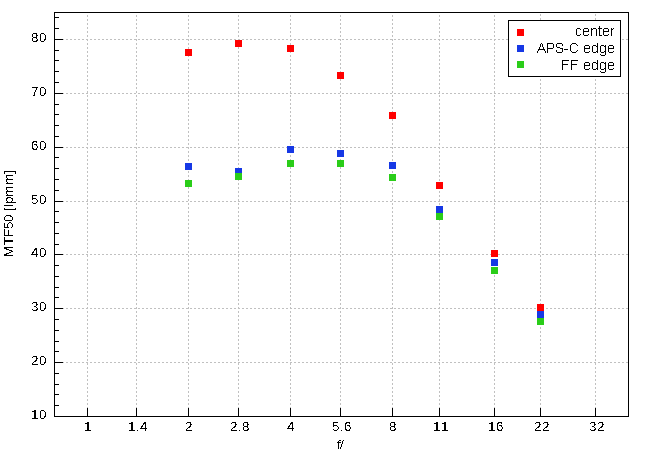
The performance in the frame centre is excellent indeed. The result of the Leica, tested here, amounting to 79.3 lpmm, is not better than the result of its 75 mm brother and the faster Panasonic S Pro 1.4/50 but it gets a really impressive level of almost 78 lpmm already at the maximum relative aperture and, in this regard, is better than both models mentionned above.
It's worth checking how this performance compares to the performances of other lenses with similar parameters - an appropriate graph you can find below.
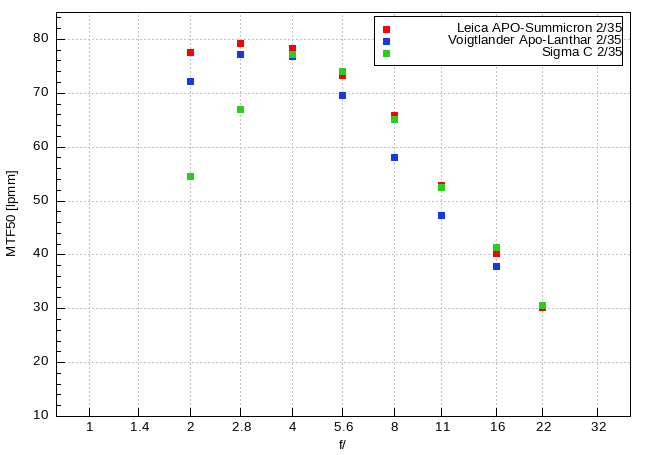
The performance of the Leica is noticeably higher than that of the Voigtlander Apo-Lanthar 2/35 and the Sigma C 2/35. From f/2.8 upwards the differences are slight and might partially stem from the higher resolution of the sensor used in the test. Of course by f/2.0 the advantage of the Leica is indisputable.
Let's return to the first graph of this chapter and check how the APO-Summicron-SL 35 mm f/2 ASPH deals on the edge of the frame. Here you get a kind of a surprise in a form of a slight difference between the results on the edge of the APS-C sensor and the edge of full frame. The Leica, as you move from the frame centre, first loses resolution quite fast, and then this loss almost stops.
It is not something we like but it should be said that even in area close to the maximum relative aperture on edges of both detectors the lens can exceed a good level of 50 lpmm; at apertures near f/5.6 and f/8.0 it is able to reach even better values in proximity of 60 lpmm. It ensures you a completely hassle-free performance.
To sum up, the centre of the frame fares exceedingly well but I suppose it's an open question whether or not you should demand from an instrument costing over $5500 better results on the edge of the detector.
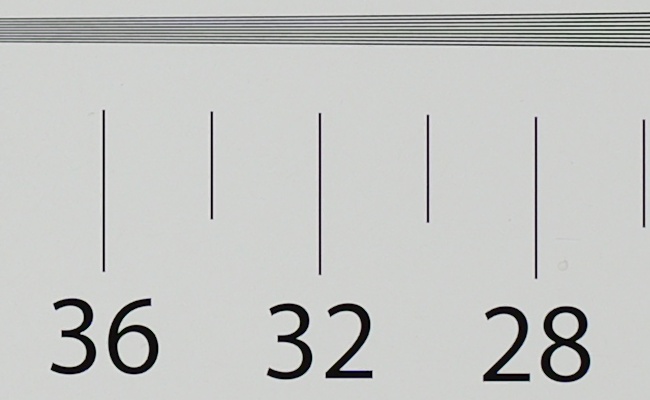
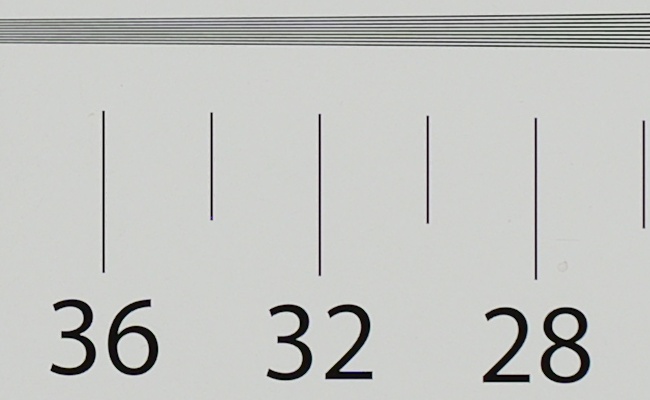
At the end of this chapter, traditionally, we present crops from our resolution testing chart taken from JPEG files saved along with RAW files used for the analysis above.
| Panasonic S1R II, JPEG, 35 mm, f/2.0 |
 |
| Panasonic S1R II, JPEG, 35 mm, f/2.8 |
 |