Sigma A 85 mm f/1.2 DG
8. Vignetting
| A7R IIIa, APS-C/DX, f/1.2 | A7R IIIa, APS-C/DX, f/1.4 |

|

|
Even at maximum aperture, vignetting is not particularly troublesome, reaching a relatively mild level of 23% (-0.75 EV). At f/1.4, it decreases to 14% (-0.44 EV), while the problem disappears completely at f/2.0, where the measured result is just 5% (-0.14 EV).
Please Support UsIf you enjoy our reviews and articles, and you want us to continue our work please, support our website by donating through PayPal. The funds are going to be used for paying our editorial team, renting servers, and equipping our testing studio; only that way we will be able to continue providing you interesting content for free. |
- - - - - - - - - - - - - - - - - - - - - - - - - - - - - - - - - - - - - - - - - - - - - - - -
When switching to the larger full-frame sensor, the problems become noticeably more pronounced, as clearly illustrated by the photographs below.
| A7R IIIa, FF, f/1.2 | A7R IIIa, FF, f/1.4 |

|

|
| A7R IIIa, FF, f/2.0 | A7R IIIa, FF, f/2.8 |

|

|
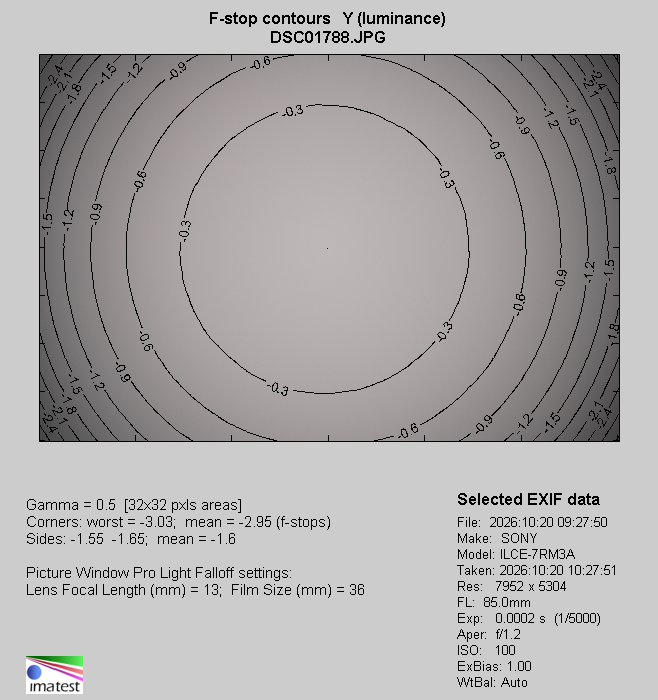
At maximum aperture, our measured result reaches 64% (-2.95 EV). This is a very high level, although one that could be expected given the relatively compact dimensions of the tested lens in relation to its impressive maximum aperture. It is also worth mentioning that this result is noticeably worse than those recorded for the f/1.2 85 mm DSLR lenses we tested previously, which exhibited vignetting levels of 45–51%.
At f/1.4, vignetting remains very pronounced at 55% (-2.32 EV), decreasing to 34% (-1.21 EV) when the lens is stopped down to f/2.0. The aberration becomes moderate at f/2.8, where it reaches 22% (-0.71 EV), and then becomes almost negligible at f/4.0, where we recorded a result of 16% (-0.51 EV). Stopping down further had no measurable effect on the results.
| Sony A7R IIIa, JPEG, f/1.2 |
 |