Sigma 100-300 mm f/4 DG EX APO IF HSM
3. Build quality
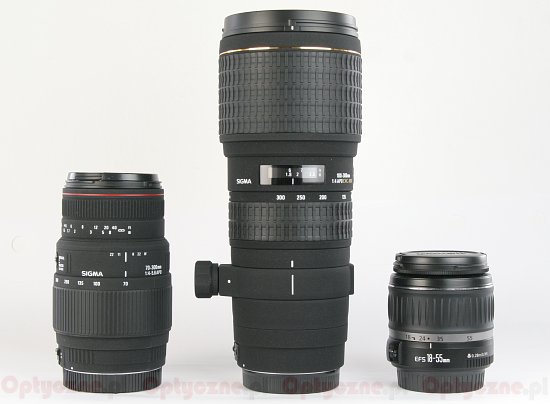
For users of some cheaper 70-300 mm lenses, a first glance at the Sigma 100-300 mm could be a shock. It is a sizable lens with a heavy weight. This can be easily justified. First of all, the quality of the build is much higher that its competitors. It is important to add that the Sigma is not changing its size while changing focal length and its front lenses do not rotate. This is a big advantage since no dust gets inside the lens and we are free to use any kind of filter (as long as it has an 82 mm diameter). Another explanation for Sigma's large size is the wide open aperture. The diaphragm for the cheaper model measures f/5.6, while for the Sigma it is f/4. This results in a double increase in the collected light as well as more than a two-centimeter increase in the front lens diameter.
Please Support UsIf you enjoy our reviews and articles, and you want us to continue our work please, support our website by donating through PayPal. The funds are going to be used for paying our editorial team, renting servers, and equipping our testing studio; only that way we will be able to continue providing you interesting content for free. |
- - - - - - - - - - - - - - - - - - - - - - - - - - - - - - - - - - - - - - - - - - - - - - - -
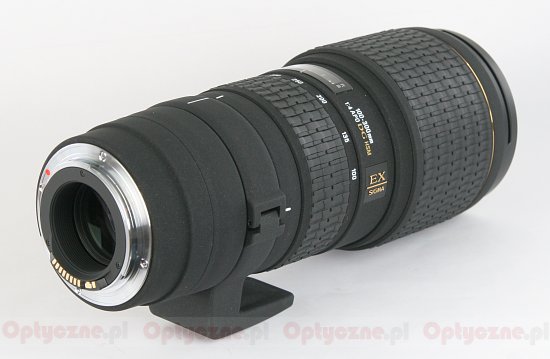
If we add two large rings - one for focal length adjusting and a second one for manual zooming, as well as the inbuilt tripod mount, then Sigma's large size should not come as any surprise.
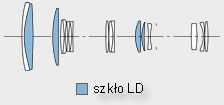
As far as the inner construction is concerned the tested lens has as many as 16 lenses set up in 14 groups. The low dispersion glass is used in four of those elements and the APO sign on the lens's body should guarantee flawless chromatic and spherical aberration correction. The lens also contains a nine-blade diaphragm, which can be stopped down to an f/32.