Nikon Nikkor AF 35 mm f/2D
5. Chromatic aberration
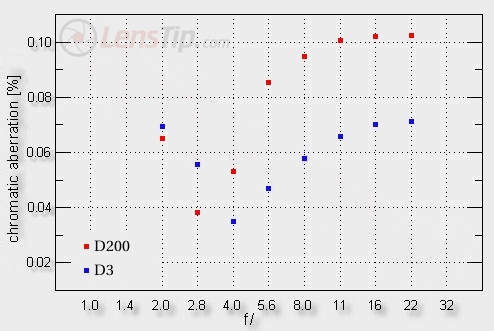
This effect can be understood if we stop for a while and think how the chromatic aberration happens and how we measure it. When pixels are larger, the chromatic aberration is more difficult to register and, additionally in our methods it is measured by determining the size of an area, expressed in pixels, between the resolution graph for blue/cyan and for red. When the pixels are bigger, there are less of them in this area – thus a lower result and a necessity to redefine the scale.
Please Support UsIf you enjoy our reviews and articles, and you want us to continue our work please, support our website by donating through PayPal. The funds are going to be used for paying our editorial team, renting servers, and equipping our testing studio; only that way we will be able to continue providing you interesting content for free. |
- - - - - - - - - - - - - - - - - - - - - - - - - - - - - - - - - - - - - - - - - - - - - - - -
It can’t change the level of the Nikkor 2.0/35 assessment in this category, which can be only very good. From f/2.0 to f/4.0 the chromatic aberration won’t disturb us at all. By f/5.6 and higher values, the aberration will reach a medium level, visible in real pictures only in very specific situations.