Canon EF 300 mm f/4L IS USM
4. Image resolution
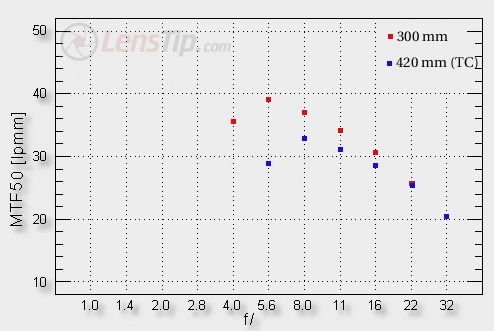
First, let’s look how the lens fared without a converter (red dots). Here, the behaviour is difficult to be faulted – the lens did a great job indeed. As soon as from the maximum aperture the image quality is very good; on stopping down to f/5.6 it even becomes excellent. It is worth notice that the lens’s performance is better than that of a Sigma 100-300 f/4 set at 300 mm or a Canon 100-400 mm set at 300 mm.
Please Support UsIf you enjoy our reviews and articles, and you want us to continue our work please, support our website by donating through PayPal. The funds are going to be used for paying our editorial team, renting servers, and equipping our testing studio; only that way we will be able to continue providing you interesting content for free. |
- - - - - - - - - - - - - - - - - - - - - - - - - - - - - - - - - - - - - - - - - - - - - - - -
When the lens cooperates with a converter, the situation is a bit less rosy though. At the maximum aperture we just border on the 30 lpmm decency level and only by f/8.0 we can start speaking about good quality images. It’s worth stressing that the Canon 100-400 mm at 400 mm fared better in our tests than the Canon EF 300 mm f/4L IS USM with a converter attached. By f/8 the difference becomes negligible and within the margin of error but by f/5.6 the zoom performs significantly better than the prime lens with a converter.
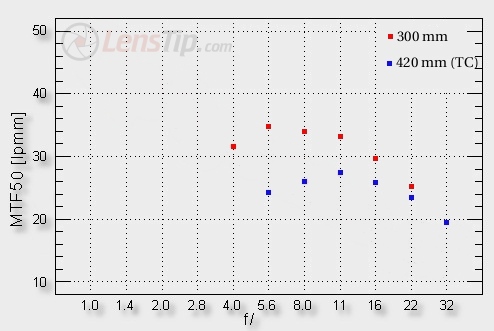
It often happens that good zooms can rival the primes for sharpness in the frame centre but usually they lose the competition at the edge of the frame. Here we deal a situation that clearly proves that rule – the Canon EF 300 mm f/4L IS USM puts both to the Sigma 100-300 mm and the Canon 100-400 mm in their place. It doesn’t concern the performance with a converter, though, when the lens + converter set fares significantly worse than the Canon 100-400 at 400 mm.
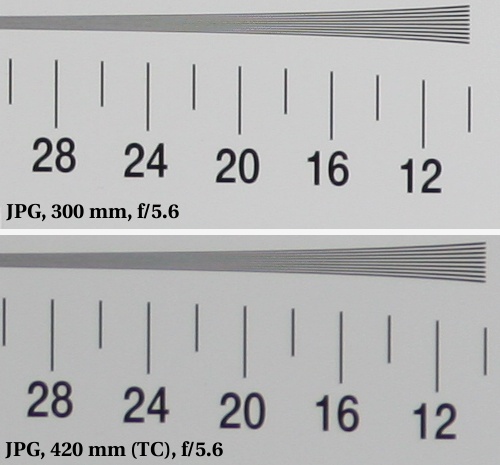
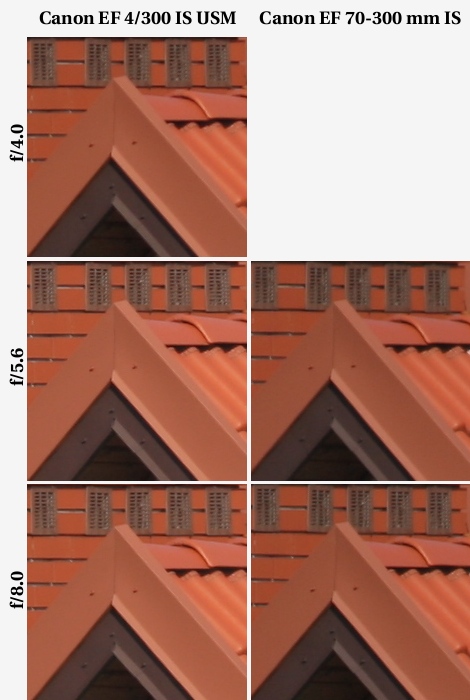
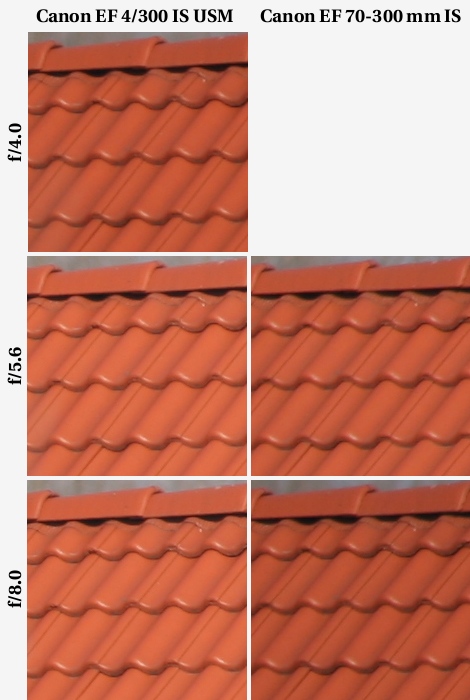
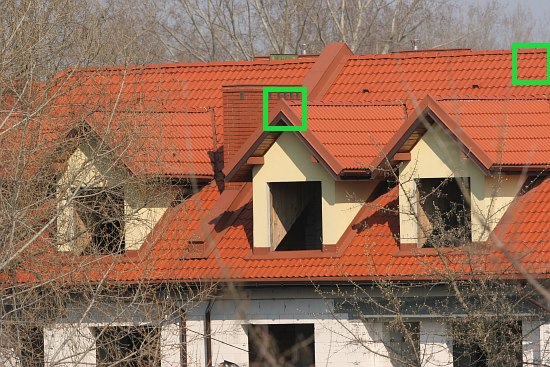
At the end of the chapter we traditionally present our test charts crops and, in addition, a field comparison of our tested lens with a lot cheaper Canon 70-300 mm IS set at 300 mm.
Comparison with a Canon EF 70-300 IS USM
 |