Tokina AT-X 124 PRO DX II AF 12-24 mm f/4
8. Vignetting
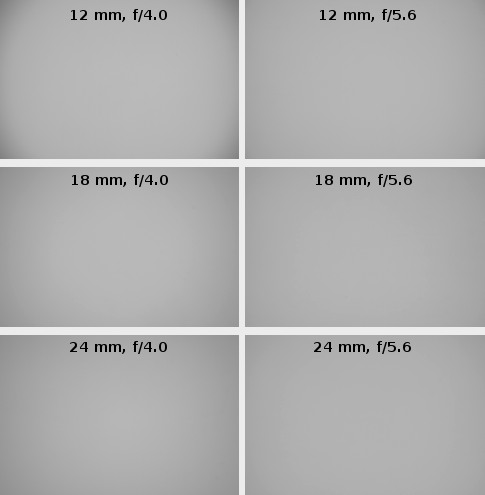
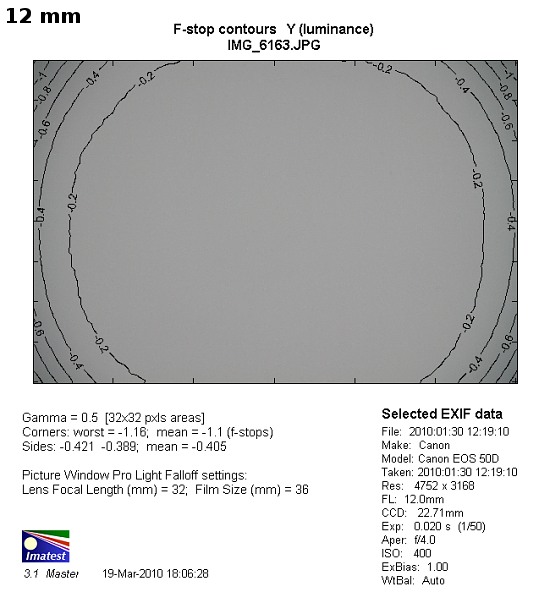
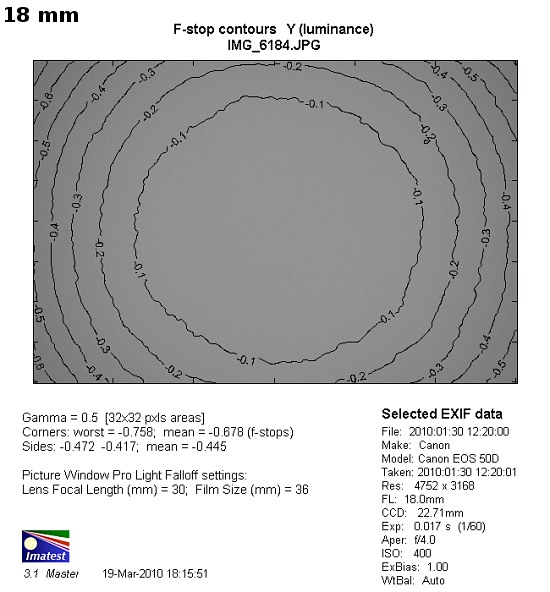
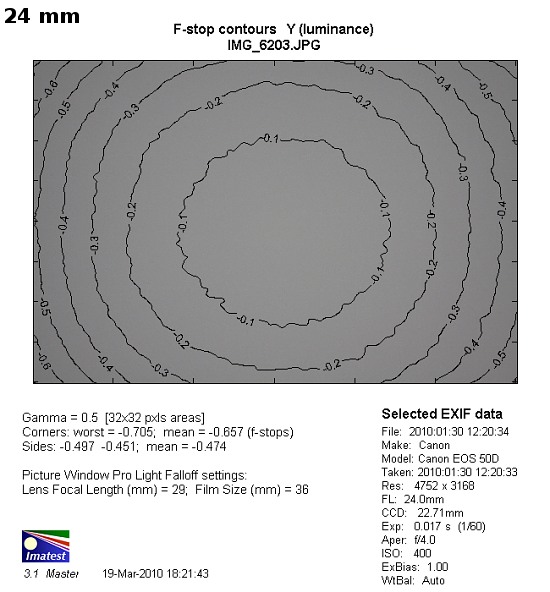
How the new model performs here? First, let’s have a look at the pictures.
Please Support UsIf you enjoy our reviews and articles, and you want us to continue our work please, support our website by donating through PayPal. The funds are going to be used for paying our editorial team, renting servers, and equipping our testing studio; only that way we will be able to continue providing you interesting content for free. |
- - - - - - - - - - - - - - - - - - - - - - - - - - - - - - - - - - - - - - - - - - - - - - - -
For the most difficult combination of ultra wide angle and f/4.0 aperture the vignetting reaches 32% (-1.1 EV). This result is significantly lower than in the case of its predecessor but once again we must stress the fact that a part of this decrease might be due to a bit smaller sensor of the Canon 50D. On stopping down by 1EV the vignetting decreases to 18% and on stopping down by 2 EV – to 15%. On further stopping down we don’t see any significant improvement.
What’s interesting, although a smaller sensor was used in the test, the vignetting at longer focal lengths of the new model is higher than in the old one. At 18 mm and by f/4.0 the light fall-off in the frame corners amounts to 21% (-0.68 EV) and it decreases to 13% by f/5.6. By f/8.0 the level of this aberration becomes practically imperceptible (11%).
At the maximum focal length the situation is very similar. By f/4.0 we get the vignetting level of 20% (-0.66 EV) and it decreases to 12% by f/5.6 and becomes unnoticeable by f/8.0 amounting to just 9%.
Noticeable and distinct changes in vignetting, compared to the performance of the predecessor, indicate that the company might have shaped the curves of the elements differently and/or the construction of the barrel might have been altered. It is a move in the right direction. The lowering of the very bothersome vignetting at the widest angle, even by increasing it slightly at longer focal lengths, was a correct decision.
 |
 |
 |