Tokina AT-X 124 PRO DX II AF 12-24 mm f/4
9. Ghosting, flares and transmission
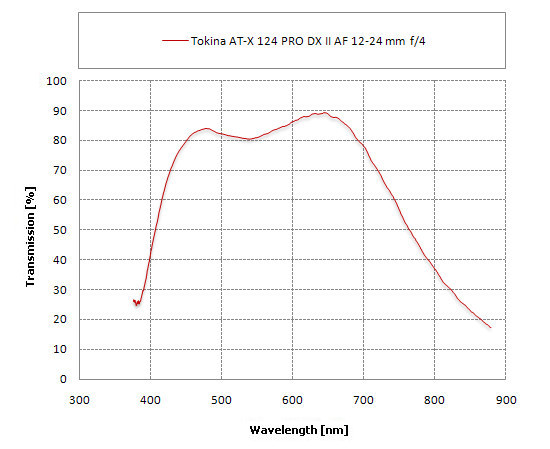 |
It is quite characteristic for typical greenish multi-coating, so fashionable lately. A significant “hole” in the transmission near the centre of the visible spectrum is, of course, responsible for their greenish hue. The tested lens loses as much as 20% of light there. The situation improves in the red part of the spectrum, where the transmission increases to 89%, and near the 480 nm length of the light's waves, where it amounts to 82-83%.
Please Support UsIf you enjoy our reviews and articles, and you want us to continue our work please, support our website by donating through PayPal. The funds are going to be used for paying our editorial team, renting servers, and equipping our testing studio; only that way we will be able to continue providing you interesting content for free. |
- - - - - - - - - - - - - - - - - - - - - - - - - - - - - - - - - - - - - - - - - - - - - - - -
The Tokina 12–24 mm II consists of 11 groups of elements. Its producer has as many as 22 air-to-glass surfaces to cover. In the red part of the spectrum the loss on one of these surfaces amounts to 0.5-0.6%, then. You can describe such a result as average. The best coatings in photographic lenses can minimize the losses to 0.2-0.25%.
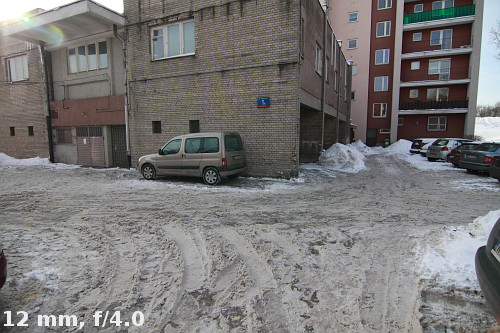
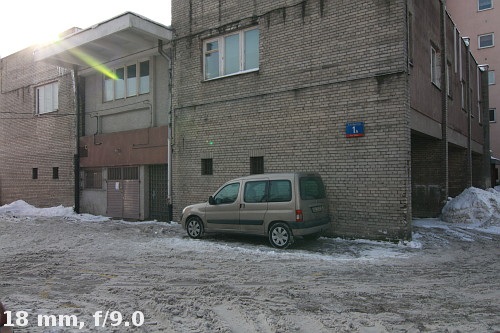
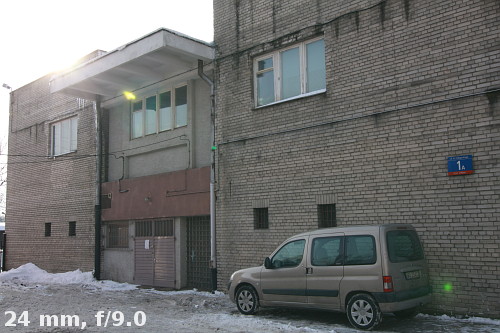
Fortunately, the inside of the Tokina’s barrel is constructed well and blackened properly so its work against bright light can be assessed positively. It is quite significant because when you work with an ultra-wide angle you have plenty of bright light in the frame corners. As you can notice in the pictures below, light artifacts are caught but there aren’t many of them and they aren’t particularly bothersome.
 |
 |
 |