Nikon Nikkor AF-S 24-120 mm f/4G ED VR
5. Chromatic aberration
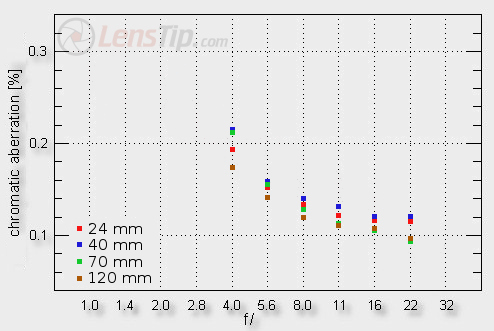
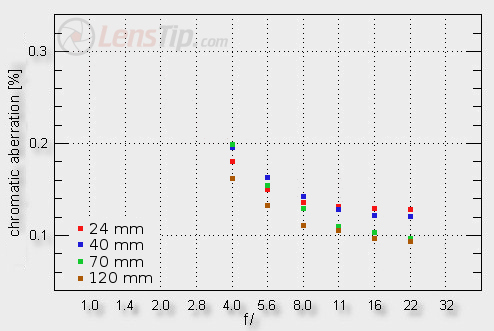
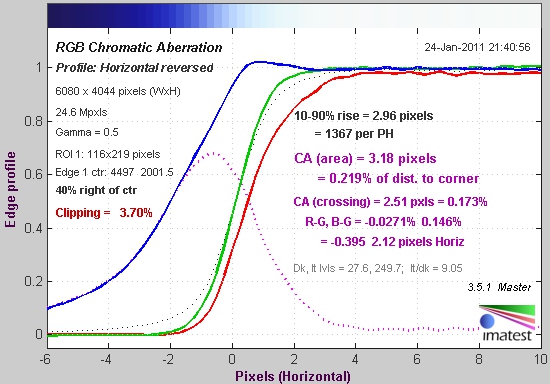
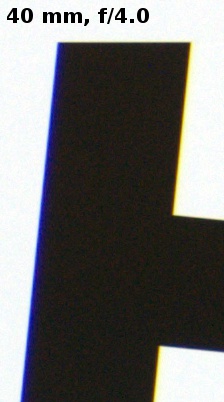
At the maximum relative aperture and all focal lengths we deal with a high level, amounting to 0.2%. What’s interesting this aberration is characterized by intensive blue-purple borders because the shortest wavelengths of the visible spectrum are exactly the worst controlled here; on the other hand we can also notice yellow borders only slightly less intensive than the blue ones. It can be observed very well on the MTF function graph presented below which has been divided into separate basic colours. The blue curve stands out from the average and the curves of other colours a lot.
Please Support UsIf you enjoy our reviews and articles, and you want us to continue our work please, support our website by donating through PayPal. The funds are going to be used for paying our editorial team, renting servers, and equipping our testing studio; only that way we will be able to continue providing you interesting content for free. |
- - - - - - - - - - - - - - - - - - - - - - - - - - - - - - - - - - - - - - - - - - - - - - - -
 |
On stopping down the aperture the lateral chromatic aberration is corrected in a better way. The problem is that only near f/11 we see it reduced to average levels. If you want to take a photo in the range from f/4.0 to f/8.0 you must take into account huge lateral aberration problems.
 |