Nikon Nikkor Z 135 mm f/1.8 S Plena
8. Vignetting
| Z7, APS-C/DX, f/1.8 | Z7, APS-C/DX, f/2.0 |

|

|
In case of this size of the sensor vignetting won't be problematic at all. Already at the maximum relative aperture brightness loss in frame corners amounts to just 7% (-0.21 EV), so is negligible. The situation improves further by f/2.0 and f/2.8 apertures where we got the following results: 4% (-0.13 EV) and 2% (-0.06 EV).
Please Support UsIf you enjoy our reviews and articles, and you want us to continue our work please, support our website by donating through PayPal. The funds are going to be used for paying our editorial team, renting servers, and equipping our testing studio; only that way we will be able to continue providing you interesting content for free. |
- - - - - - - - - - - - - - - - - - - - - - - - - - - - - - - - - - - - - - - - - - - - - - - -
Now let's check how the situation changes after passing to full frame – appropriate thumbnails you can find below.
| Z7, FF, f/1.8 | Z7, FF, f/2.0 |

|

|
| Z7, FF, f/2.8 | Z7, FF, f/4.0 |

|

|
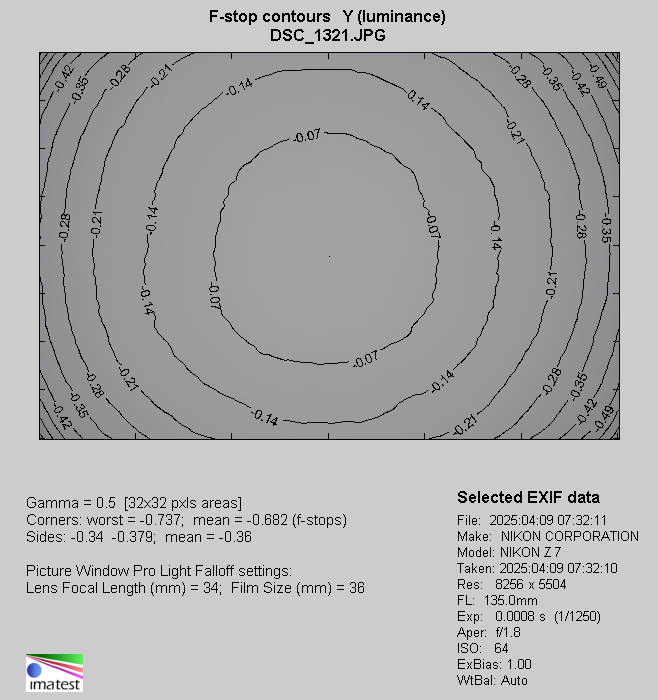
The loss of light in frame corners at the maximum relative aperture reaches just 21% (-0.68 EV) and it is a really good result, proving that the producers made a good use of physical dimensions of this instrument.
What's more, vignetting decreases quite quickly on stopping down the aperture. By f/2.0 you deal with a value of 17% (-0.55 EV), by f/2.8 it decreases to 7% (-0.22 EV), and by f/4.0 to merely 5% (-0.15 EV).
The situation is really strange – we praise a lens designed for full frame mirrorless cameras for low vignetting. Way to go, Nikon!
| Nikon Z7, JPEG, 135 mm, f/1.8 |
 |