Viltrox AF 16 mm f/1.8
6. Distortion and field of view
Field of view
A rectilinear 16 mm lens on the full frame sensor should provide an angle of view of exactly 107 deg. The official specifications of the Viltrox feature also a slightly lower value of the field, amounting to 105.6 degrees.We decided to check the real size of the field In order to do that we took photos of the starry sky, saving them as uncorrected JPEG files and RAW files developed by neutral software. Then we transformed the pixel layout (X,Y) from the photo into the equatorial coordinate system (right ascension and declination), which locates a star on a celestial sphere. That way we could determine the field of view of the lens with utter precision and in the right way, so for rays of light coming from infinity.
Our transformation was based on positions of 158 stars spread evenly across the frame. An average mesh-fitting error of the coordinates amounted to 39 seconds of arc. Our result of 105.17 degrees, with the measuring error not exceeding 0.03 of a degree, is a bit lower than official values stated by the producers.
Please Support UsIf you enjoy our reviews and articles, and you want us to continue our work please, support our website by donating through PayPal. The funds are going to be used for paying our editorial team, renting servers, and equipping our testing studio; only that way we will be able to continue providing you interesting content for free. |
- - - - - - - - - - - - - - - - - - - - - - - - - - - - - - - - - - - - - - - - - - - - - - - -
In a moment we are going to prove that the lens features slight barrel distortion. The necessity of its correction entails further cropping of images, limiting the angle of view to about 103-104 deg that corresponds to the real focal length of 17 mm.
It's a pity that the Viltrox didn't manage to keep the value appropriate for its focal length and amounting to exactly 107 deg. They limited the field of view to near 105 deg at the very start.
Distortion
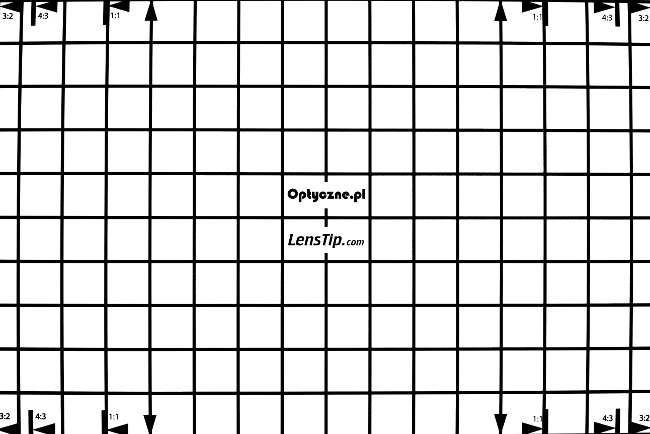
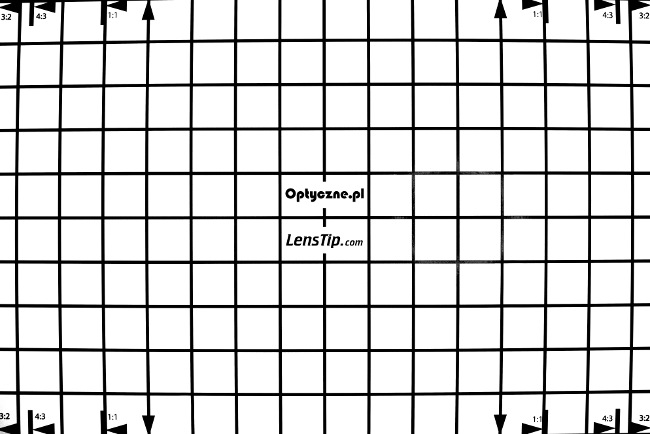
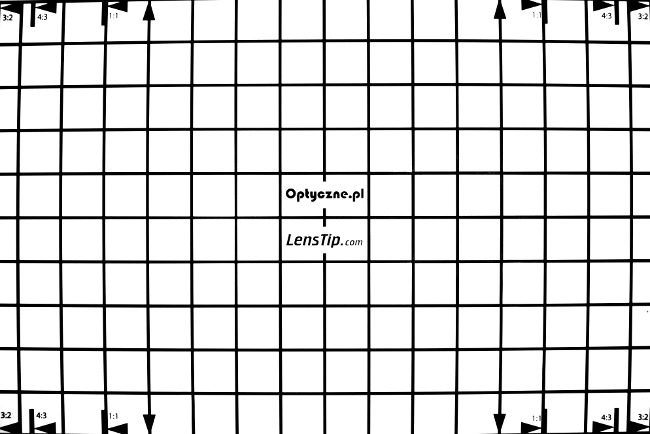
First, let's deal with distortion levels for the smaller APS-C sensor. In this case the problem is practically nonexistent because our measurements show just traces of barrel distortion which level we assessed as -0.49%.After passing to full frame these deformations become of course bigger. This time we got a result of -1.51%, noticeable but not that high taking into account the angle of view of this lens. What's more, Viltrox took proper care to ensure that distortion doesn't change much with the change of the distance from the photographed object. The result mentioned moments ago was reached for a chart positioned above 1 meter from the object. Its significant depth of field and the f/22 aperture allowed us to produce a sharp photo of the chart in situation when the sharpness is set at infinity. We got a value of -1.48% and it is, within the margin of measuring error, exactly the same as the previous one.
In this category the Viltrox definitely should be praised. Contrary to its more expensive Sony rival it corrects distortion and in a relatively efficient way. A round of applause!
| Sony A7R IIIa, 16 mm, APS-C, JPEG | |||
 |
|||
| Sony A7R IIIa, 16 mm, FF | |||
 |
|||
| Sony A7R IIIa, 16 mm, FF, nieskończoność | |||
 |
|||