Viltrox AF 16 mm f/1.8
8. Vignetting
| A7R IIIa, APS-C, f/1.8 | A7R IIIa, APS-C, f/2.0 |

|

|
In case of this type of detector at the maximum relative aperture vignetting remains moderate, amounting to 32% (−1.12 EV). By f/2.0 it decreases to 28% (−0.96 EV), by f/2.8 it drops further to an almost imperceptible level of 15% (−0.49 EV).
Please Support UsIf you enjoy our reviews and articles, and you want us to continue our work please, support our website by donating through PayPal. The funds are going to be used for paying our editorial team, renting servers, and equipping our testing studio; only that way we will be able to continue providing you interesting content for free. |
- - - - - - - - - - - - - - - - - - - - - - - - - - - - - - - - - - - - - - - - - - - - - - - -
Now let's check the performance in the frame corners on full frame – appropriate thumbnails are shown below.
| A7R IIIa, FF, f/1.8 | A7R IIIa, FF, f/2.0 |

|

|
| A7R IIIa, FF, f/2.8 | A7R IIIa, FF, f/4.0 |

|

|
Significant dimensions of this lens suggested that it might fare better than its smaller rival, the Sony. On the other hand wide angle lenses are tricky – rays of light might fall on air-to-glass surfaces in many places and at really steep angle. That's why anti-reflection coatings in such devices are so important and here older and more renowned producers still prevail over much younger Chinese companies.
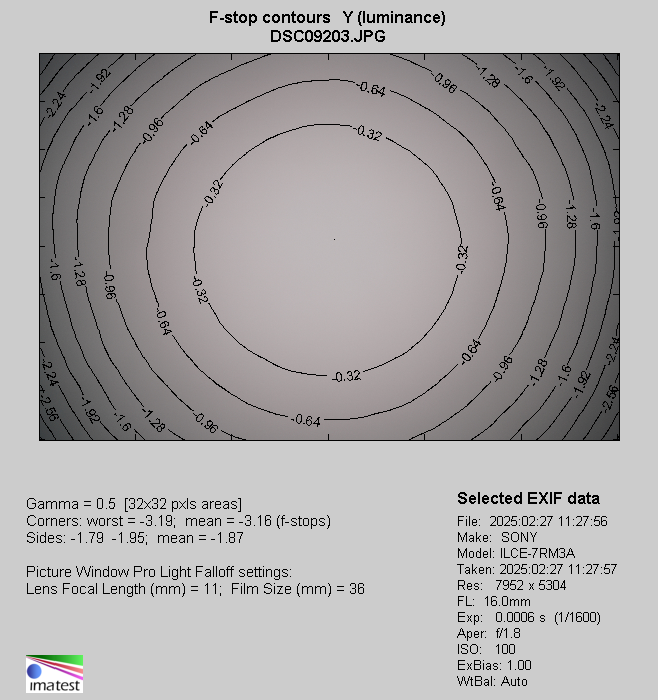
The final effect is such that the bigger Viltrox has vignetting higher than the smaller Sony. At the maximum relative aperture the brightness loss in the frame corners is huge, amounting to as much as 67% (-3.16 EV). By f/2.0 it decreases to 62% (-2.83 EV), at by f/2.8 to 46% (-1.79 EV). By f/4.0 and f/5.6 apertures vignetting still remains noticeable and without any problems, with the results of 37% (-1.35 EV) and 36% (-1.30 EV) respectively. Further stopping down doesn't produce any measurable effects. Such a significant amount of vignetting, even after a significant stopping down, only proves our diagnosis: coatings of the Viltrox are not especially effective for light falling at steep angles.
| Sony A7R IIIa, JPEG, f/1.8 |
 |