Samyang AF 85 mm f/1.8 P FE
4. Image resolution
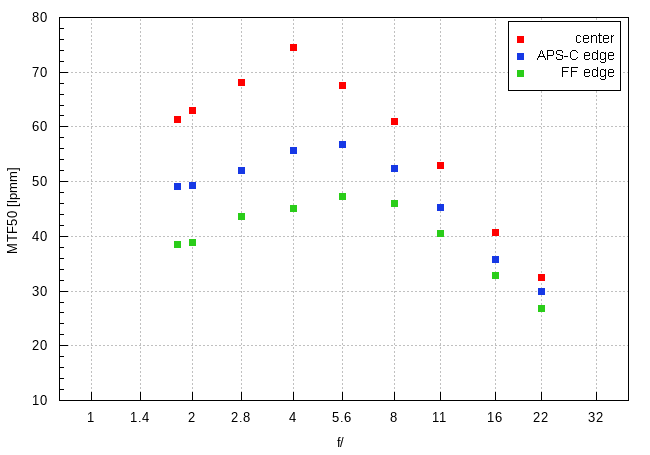
Let's see how the Samyang AF 85 mm f/1.8 P compares here – its results in the frame centre and on the edge of the APS-C/DX sensor and on the edge of full frame presents a graph below.
Please Support UsIf you enjoy our reviews and articles, and you want us to continue our work please, support our website by donating through PayPal. The funds are going to be used for paying our editorial team, renting servers, and equipping our testing studio; only that way we will be able to continue providing you interesting content for free. |
- - - - - - - - - - - - - - - - - - - - - - - - - - - - - - - - - - - - - - - - - - - - - - - -
One glance and you can notice three important things. Firstly, in the frame centre the performance is really praiseworthy, with results exceeding 60 lpmm already at the maximum relative aperture. Secondly, on stopping down you are able to reach a very good level of almost 75 lpmm. Thirdly, the edge of the frame lags very distinctly behind the performance in the centre.
All these results are far easier to analyse if you compare them to the results of the direct rivals of the tested Samyang. Let's start with the frame centre – an appropriate graph is presented below.
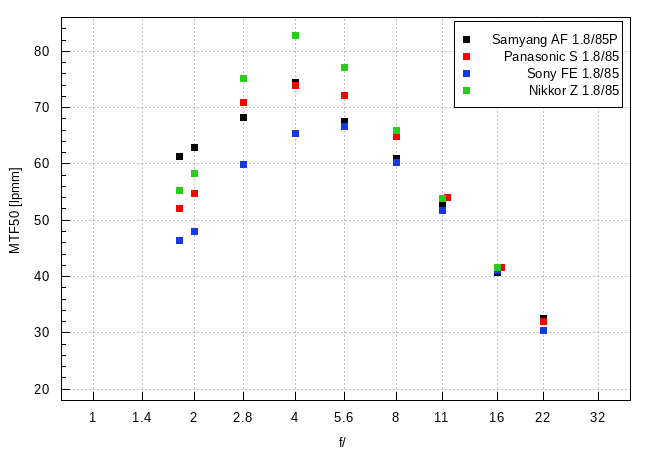
Samyang really cared about the area near the maximum relative aperture, a very interesting fact to notice. It fares the best out of all group of lenses, described here, even these much more expensive models. Only after stopping down to f/2.8 the Panasonic and the Nikkor are able to prevail.
The Sony is definitely the weakest here and it is a very bad piece of news for this company, especially that their lens costs now about $650 and the Samyang is $250 cheaper.
Now let's check a similar comparison for the edge of the APS-C/DX sensor.
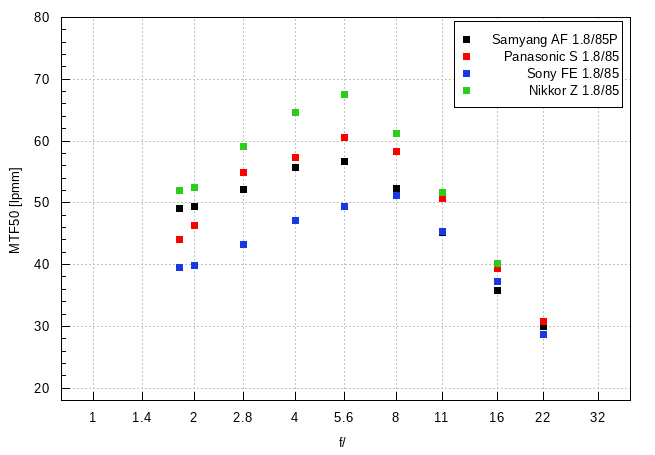
Here the most expensive Nikkor doesn't leave any doubts about the winner. The Panasonic is outperformed slightly by the Samyang only in the nearest areas of the maximum relative aperture and the Sony once again fares the weakest.
Now let's find out how the situation changes when you pass to the edge of full frame by analysing the next graph.
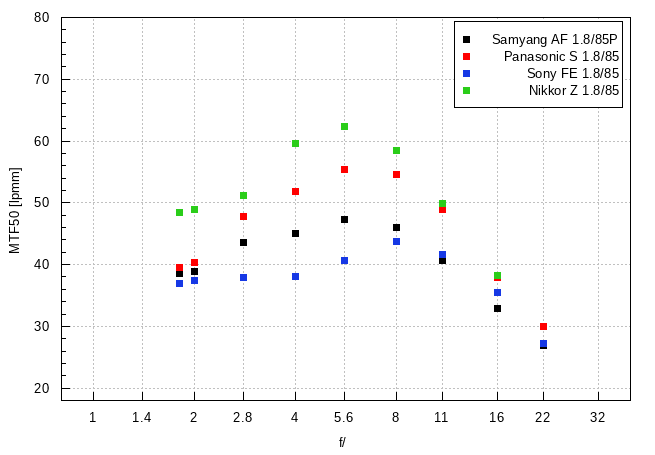
Small dimensions of the Samyang become a liability here – it loses the duel to the Nikkor and the Panasonic but still it defeates the more expensive Sony model with ease.
To sum up, taking into account the price, dimensions, and the weight of the tested Samyang we are very pleasantly surprised by its performance. In the frame centre and on the edge of the APS-C/DX sensor it fares very well, momentarily even exceedingly well. If you want to search for weak spots there is just the performance by f/1.8 and f/2.0 on the edge of full frame but even there the MTFs are brushing against the decency level, a completely forgivable slip-up if you keep the price and the physical dimensions in your mind.
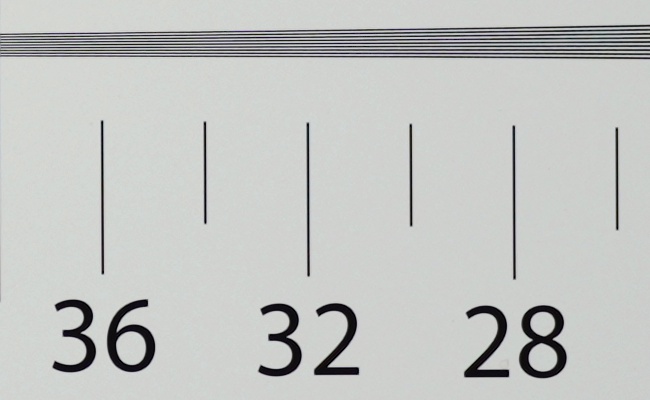
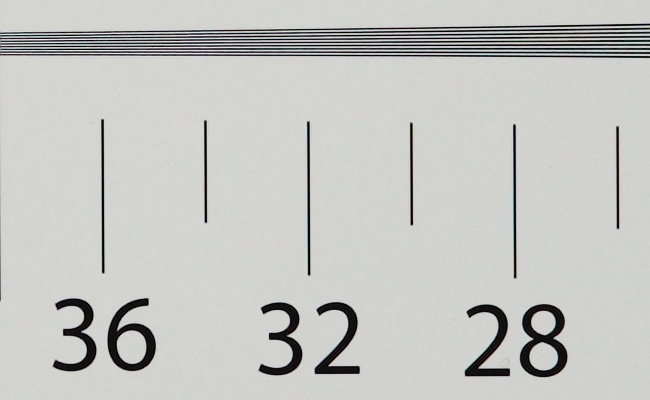
At the end of this chapter, traditionally, we present crops from the photos of our resolution testing chart taken from JPEG files that we saved alongside RAW files, used for the analysis above.
| A7R IIIa, JPEG, 85 mm, f/1.8 |
 |
| A7R IIIa, JPEG, 85 mm, f/4.0 |
 |