When it comes to the optics of full frame mirrorless devices the 18 mm focal length seems to be underrepresented. Apart from the Panasonic you see just a Samyang in this segment but, as it is as fast as f/2.8 it would be difficult to any binding comparisons. That's why our chart features just two wide angle Sony models, the 16 and the 20 mm.
It's clear that, when it comes to weight and dimensions, the Panasonic Lumix S 18 mm f/1.8 can be placed exactly between the two Sony lenses. At the same time it features the same filter thread, with a diameter of 67 mm, so the filters won't cost you an arm and a leg.Still, the fact that both Sony models are optically more complex is significant. Will this thriftiness on the number of elements influence the performance of the Panasonic? Let's find out!
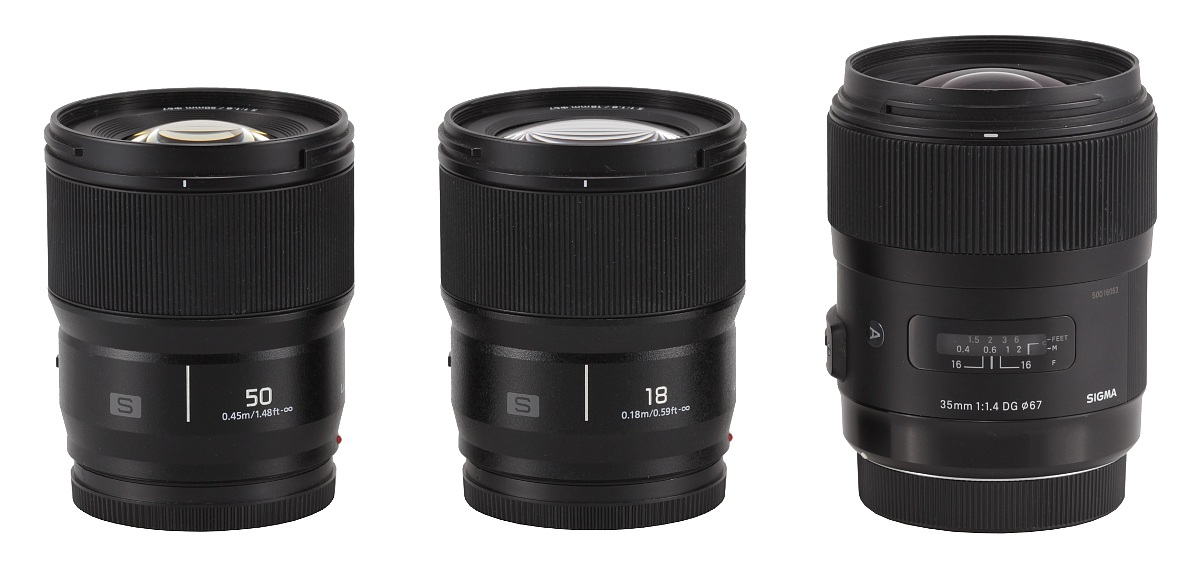
In the photo below the Panasonic Lumix S 18 mm f/1.8 is positioned between its system 1.8/50 brother and the reflex camera Sigma A 35 mm f/1.4 DG HSM.
Please Support Us
If you enjoy our reviews and articles, and you want us to continue our work please, support our website by donating through PayPal. The funds are going to be used for paying our editorial team, renting servers, and equipping our testing studio; only that way we will be able to continue providing you interesting content for free.
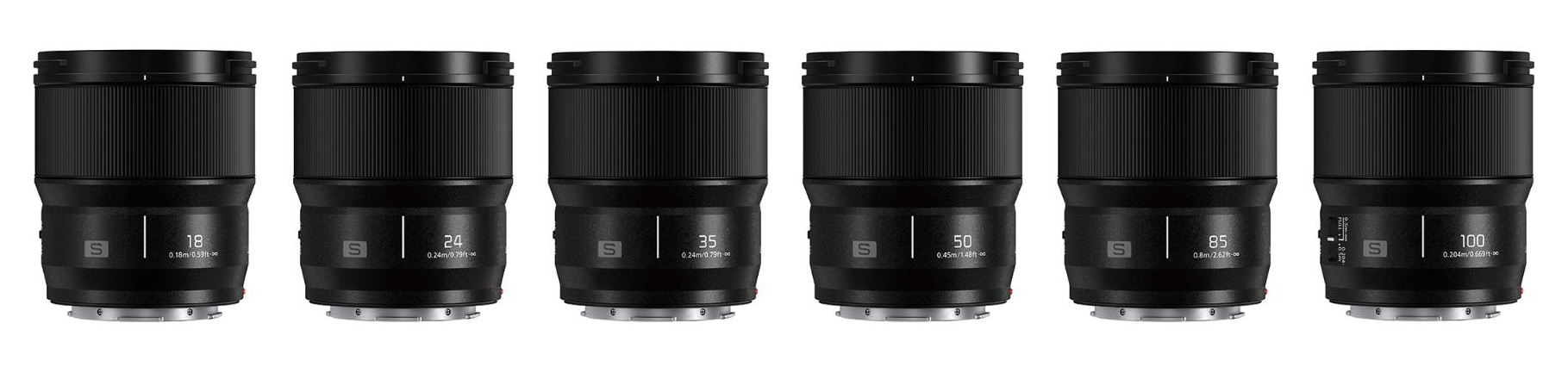
One more thing is worth noticing here: even though their series of fixed focal f/1.8 lenses encompass a wide range of focal lengths, from 18 t0 100 mm, all of them are of the same physical size. It allows the producers to preserve an identical layout of controlling parts, a feature that will undoubtedly appreciated by filmmakers, and the same filter thread diameter, something everyone will appreciate for a change.
The tested lens starts with a metal mount surrounded by a dark, well-matted ring with embedded contacts. The ring also features a serial number of the instrument and information that it was produced in China. Inside the ring there is an immobile rear element 29 mm in diameter. It is positioned very shallowly inside, practically on the same level as the contacts. From this side everything seems to be correct and the lens remains completely sealed.
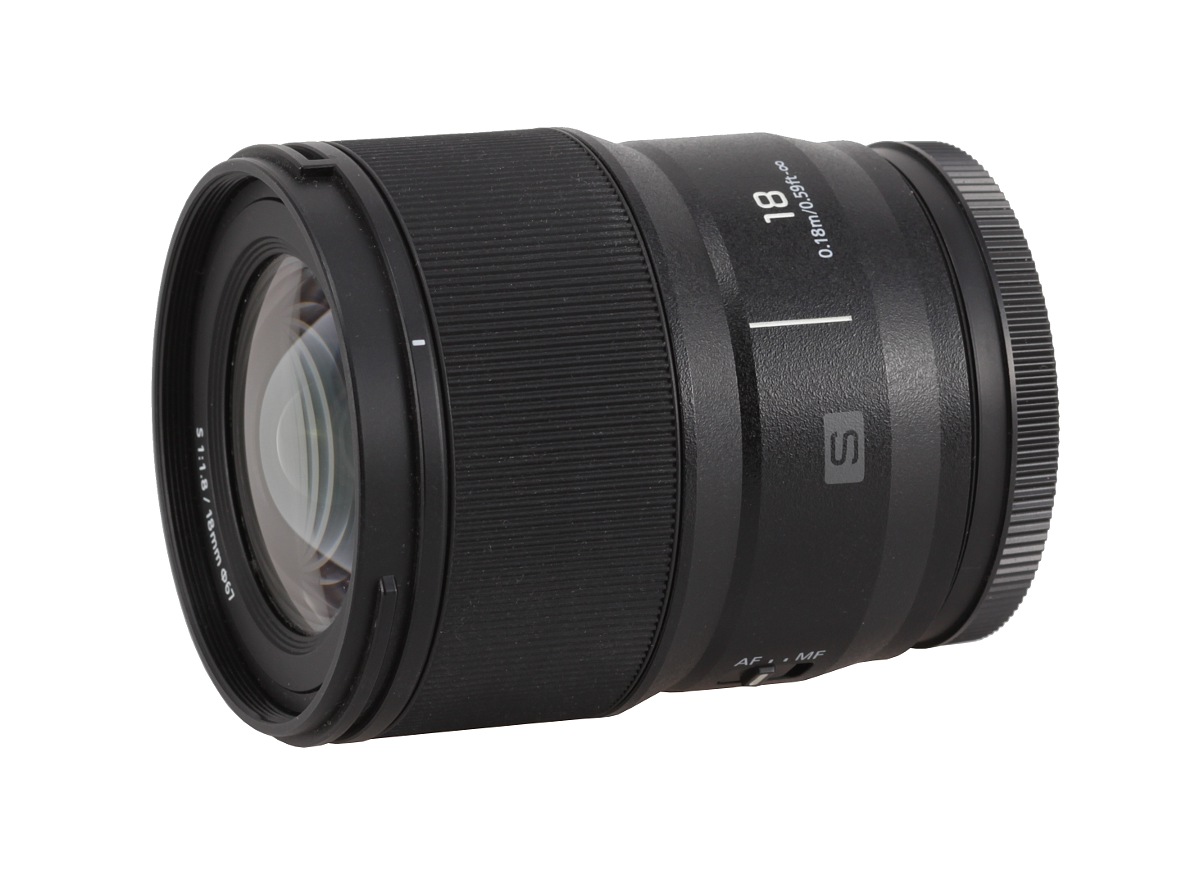
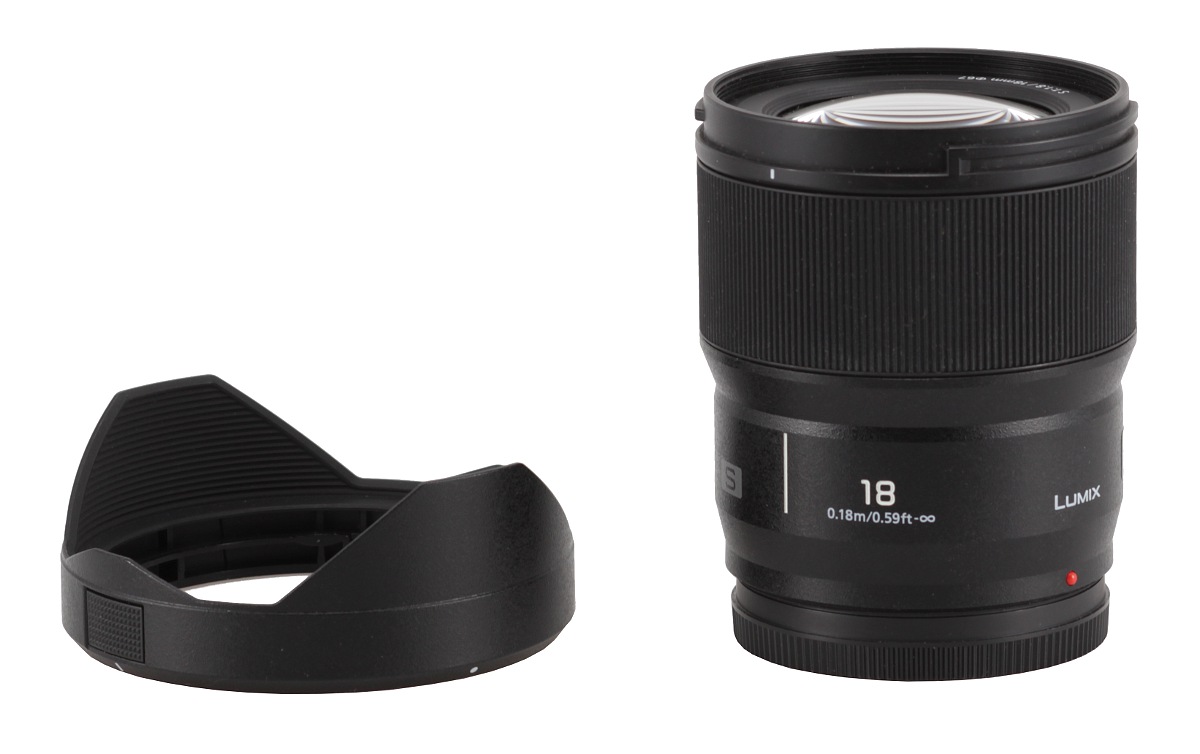
The proper barrel of the lens is covered by black plastics. A red dot, making an alignment with the camera easier, is one of the first features. Further on, looking from above, there is a white vertical line – on its left there is the capital 'S', on its right '18' meaning the focal length and the focusing range, '0.18m/1.59ft-∞'.
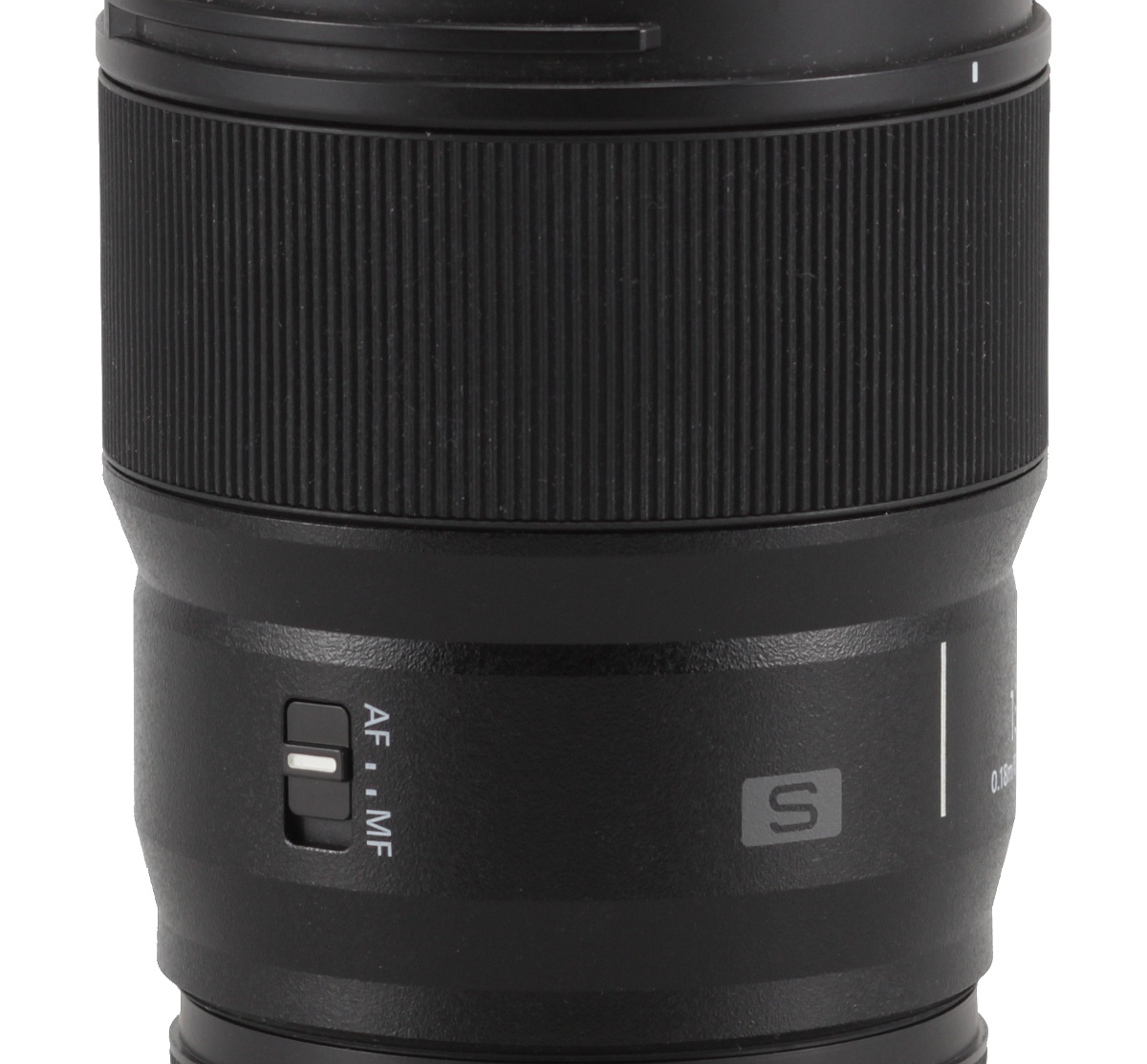
On the same level, completely to the left, you get a switch that controlls the focusing mechanism modes AF/MF, and underneath you see the name of the company, the model number of the lens, its mount type and an inscription 'LUMIX'.
Then you see an immobile ring that slightly enlarges its diameter and it turns into another ring for manual focusing, with a width of 30 mm, completely covered by relatively fine rubber ribbing. The lens is devoid of any depth of field or distance scale. The manual focus ring is a focus-by-wire construction, it moves smoothly, and is properly damped. In standard settings running through the whole distance range needs a turn through an angle of 110-120 deg, a value allowing you precise settings. It's worth adding that the value of this angle can be also set in the camera's menu.
The next part of the barrel is just 10 mm wide, it mainly features a mount for a hood that is added in the box to the lens.
The front element of the lens is convex, immobile, 46 mm in diameter. It is surrounded by a ring with an inscription 'LUMIX' and parameters of the lens, along with a non-rotating filter thread 67 mm in diameter, a moderate size for a ultra wide-angle lens with such a good aperture fastness.
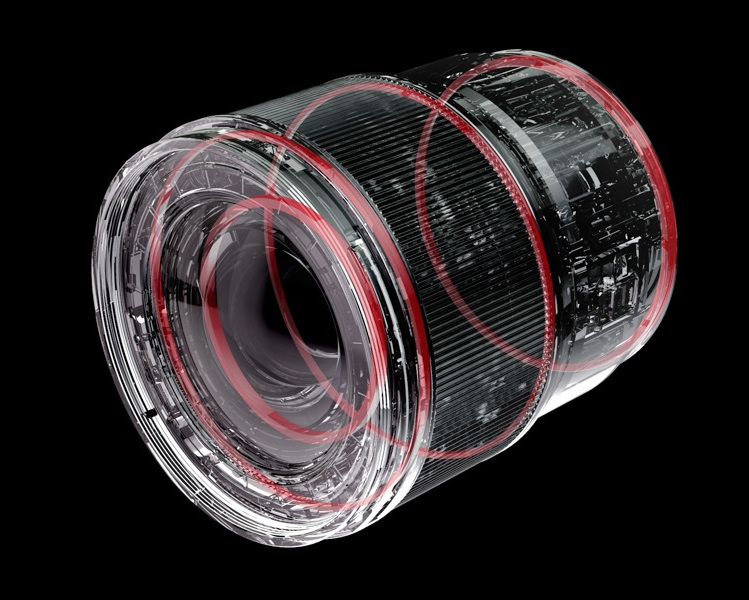
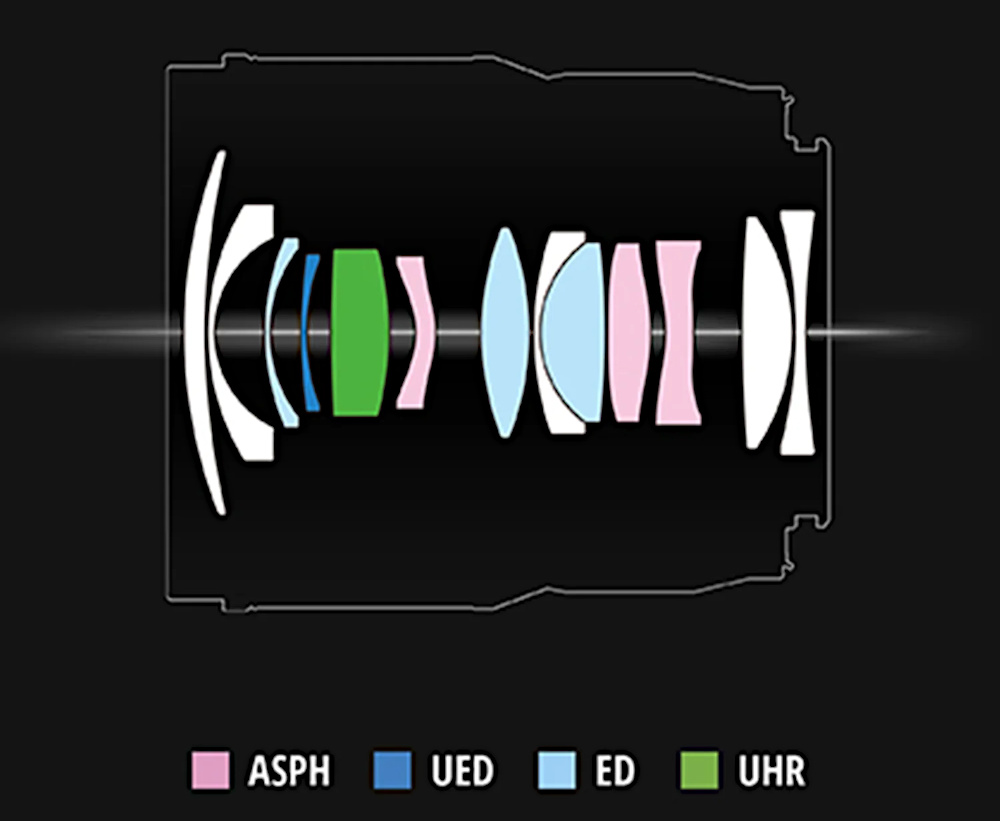
When it comes to the optical construction you deal here with 13 elements positioned in 12 groups. The producers weren't skimpy when it comes to special elements – inside there are as many as three aspherical elements, three others are made of low dispersion ED glass, and one is made of ultra high refraction index glass (UHR). Inside there is also a round aperture with nine blades that can be closed down to a value of f/16 at the maximum.