Panasonic Lumix S 18 mm f/1.8
6. Distortion and field of view
Field of view
A rectilinear 18 mm lens on full frame should provide an angle of view amounting to 100.4 deg. In the official specification the producer states a value of 100 deg exactly.We decided to assess the real value of the field of view; in order to do so we took photos of a starry sky and saved them first as corrected JPEG files and then as uncorrected RAW files. Then we transformed the pixel layout (X,Y) from the photo into the equatorial coordinate system (right ascension and declination), which locates a star on a celestial sphere. That way we were able to measure the field very precisely, and exactly as it should be done, for rays of light coming from infinity.
Our transformation of JPEG format files was based on positions of 143 stars spread evenly across the frame. An average mesh-fitting error amounted to 1 minute and 5 seconds of arc. Our final result amounted to 99.58 degrees with a measurement error on a level of 0.08 of a degree. It's a value very slightly lower than in official specifications but the difference doesn't exceed 0.5 % so it can be called negligible.
Please Support UsIf you enjoy our reviews and articles, and you want us to continue our work please, support our website by donating through PayPal. The funds are going to be used for paying our editorial team, renting servers, and equipping our testing studio; only that way we will be able to continue providing you interesting content for free. |
- - - - - - - - - - - - - - - - - - - - - - - - - - - - - - - - - - - - - - - - - - - - - - - -
In case of uncorrected RAW files the transformation was based on positions of 165 stars and an average mesh-fitting error increases noticeably to 5 minutes and 19 seconds of arc. In this case the result amounted to a distinctly higher value of 106.13 degrees with a measurement error on a level of 0.09 of a degree.
If you take photos and save them as neutral RAW files you can enjoy a field of view that is by over 6 deg wider than in official specifications. It means you deal with an equivalent of a focal length approaching 16 mm. Still, such a performance comes at a price and we are going to explain it in a moment.
Distortion
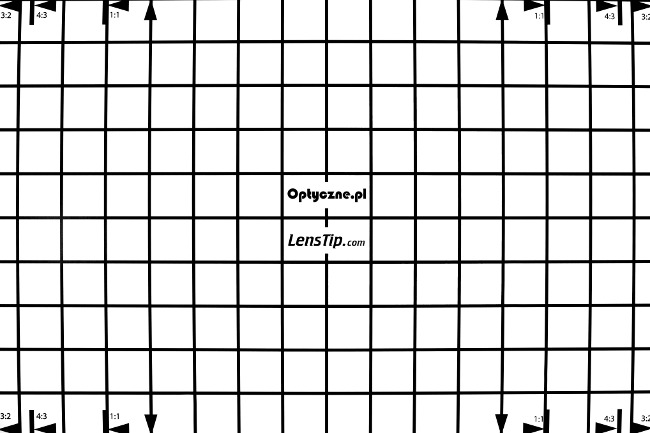
When you work with corrected JPEG files that, as we showed a little while ago, provide you a field of view reaching almost 100 deg, you have to deal with slight barrel distortion of -0.69%. Such a low value is not a result of a properly designed optical system but software correction done by the camera's body.One glance at the results reached with uncorrected RAW files and you know that Panasonic optics specialists have given up the correction of geometric deformations. The result we got by averaging out the measurements across the whole image reaches a very high value of -6.61%. It's not all, though. You can notice immediately the presence of huge moustache distortion. As a result, when you limit your measurements to an area limited by 1:1 markings, you get a result as high as -8.17%. Now we are not surprised by the fact that the mesh-fitting error of coordinates on RAW files is so high.
When you compare this performance to the rivals it seems the 18 mm focal length seems to be a limit value from which, upward, it's worth correcting distortion. Both 20 mm instruments mentioned here, the Sony FE 1.8/20G and the Sigma A 1.4/20, try to minimize deformations so in their case distortion on full frame is not especially high. The Sony FE 1.8/16G for a change, where the task was the most difficult, performed exactly like the tested Panasonic, with a result reaching as high as -7.47% and the presence of moustache distortion.
| Panasonic S1R II, 18 mm, JPEG, FF | |||
 |
|||
| Panasonic S1R II, 18 mm, RAW, FF | |||
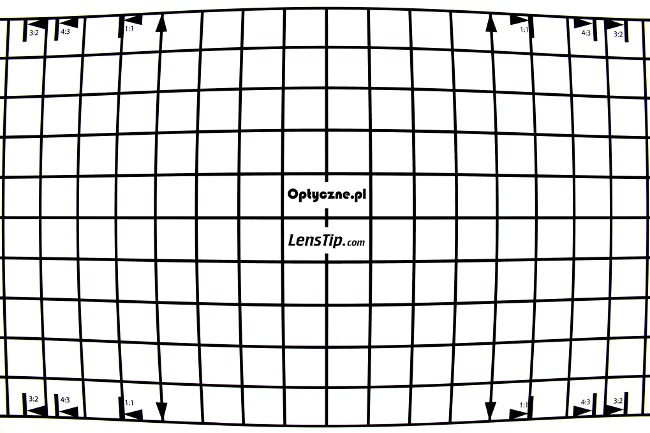 |
|||