Sigma 8-16 mm f/4.5-5.6 DC HSM
4. Image resolution
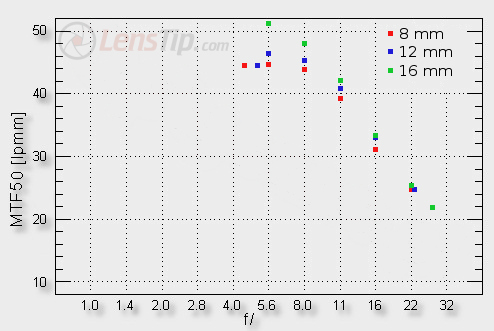
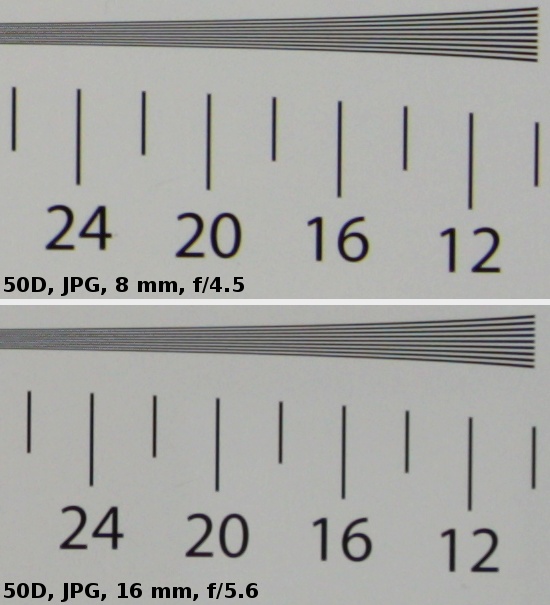
Let’s look at the results in the frame centre.
Please Support UsIf you enjoy our reviews and articles, and you want us to continue our work please, support our website by donating through PayPal. The funds are going to be used for paying our editorial team, renting servers, and equipping our testing studio; only that way we will be able to continue providing you interesting content for free. |
- - - - - - - - - - - - - - - - - - - - - - - - - - - - - - - - - - - - - - - - - - - - - - - -
In the case of tests conducted on a 50D, the best fixed-focal lenses can reach the level of about 52-53 lpmm; we consider the value near 34 lpmm to be the decency level so more or less as much as good lenses can get when stopped down to f/16. How does the tested Sigma compare here?
Taking into account the fact that the lens is not very fast, the results are very good. In the case of 8-12 mm focal lengths already at the maximum aperture we reach very high MTF50 values of 44-46 lpmm. These values are also the highest possible at these focal lengths. Why you can’t get any higher? The details you will find in the astigmatism chapter, a little further on.
At 16 mm we don’t have the slightest reservations. The result of 50 lpmm, achieved there already at the maximum relative aperture, is simply sensational.
Let’s find out what the Sigma 8-16 mm has to show at the edge of the APS-C/DX sensor, as it was designed to cooperate with it.
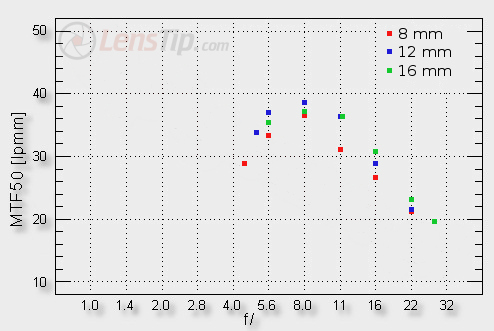
The combination of off-axis aberrations, about which we are going to write in detail later, doesn’t allow the Sigma to reach the decency level only in the most difficult conditions so at 8 mm focal length and by f/4.5 aperture. Fortunately on stopping down by 1 EV we see this problem disappear. The results are better for the rest of focal lengths – in their cases we can speak about fully useful image at the frame edge even at the maximum relative aperture.
Taking into account extremely wide angles of view the Sigma 8-16 mm offers, its performance in the resolution category we can describe in only favourable terms.
 |