Panasonic Lumix S Pro 50 mm f/1.4
4. Image resolution
We can also mentioned the fact that the decency level is positioned here near 40-42 lpmm, the best system primes should reach about 80 lpmm and the record-breakers might go as high as near 85 lpmm or even slightly exceed this value. Of course as we add more and more tests of lenses from this system to our database we might refine these estimations even further.
Now let's check how the performance of the Panasonic Lumix S Pro 50 mm f/1.4 compares – its results in the frame centre, on the edge of the APS-C sensor and on the edge of full frame presents a graph below.
Please Support UsIf you enjoy our reviews and articles, and you want us to continue our work please, support our website by donating through PayPal. The funds are going to be used for paying our editorial team, renting servers, and equipping our testing studio; only that way we will be able to continue providing you interesting content for free. |
- - - - - - - - - - - - - - - - - - - - - - - - - - - - - - - - - - - - - - - - - - - - - - - -
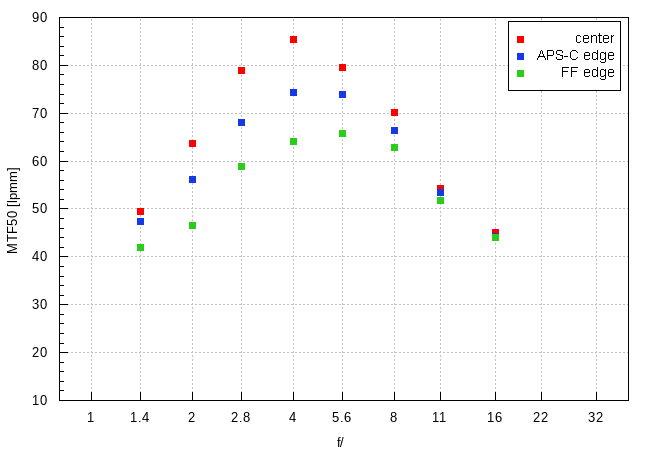
It is difficult to discuss the results of the first tested lens of a given system because you simply lack any reference point. Well, in order to be precise I have to add that in reality You, Dear Readers, lack any reference point. My position is a tad better – I never decide to publish the first test in a given system without knowing the results of a bigger number of measurements of other instruments with the same mount. I am happy to say I have processed the resolution results of as many as seven L-mount fast 'primes' and I know that the maximum result of the Lumix S Pro 1.4/50, amounting to 85.4 +\- 0.6 lpmm, is, so far, record-breaking.
Small wonder – it is one of the biggest and the heaviest system 'primes', a construction without any compromises concerning the weight or physical dimensions. If I had to point at another L-mount lens that able to top the record of the Panasonic 1.4/50 I would choose the Leica Summilux-SL 50 mm f/1.4 ASPH., just slightly smaller than the Lumix, tested here, but heavier. Unfortunately I haven't had an opportunity to test this model of Leica yet.
Is a level of 85 lpmm really that high? Let's remind here our tests of the Sony FE and Nikon systems. In the first case record-breaking lenses got only near 80 lpmm and not higher for a very long time. Such models as the Voigtlander Apo Lanthar 50 mm f/2 (81.0 lpmm) or the Sigma C 65 mm f/2 DG DN (82.7 lpmm) managed to remain on the podium for years. Approaching 85 lpmm was a matter of last 1-2 years and only because such outstanding instruments as the Sigma A 28-45 mm f/1.8 DG DN (84.5 lpmm) and the Sony FE 85 mm f/1.4 GM II (85.8 lpmm) appeared on the market. So far only two lenses, the Meike 85 mm f/1.4 FF STM and the Sony FE 50 mm f/1.4 GM, managed to reach a completely record-breaking level of about 90 lpmm.
In case of the Nikon Z system there have been more high results even though the pixel density is also the highest. The Nikkor Z 50 mm f/1.8 S (83.7 lpmm) had been the record-holder for a long time. The cheaper but faster Nikkor Z 50 mm hovered near that value along with the Nikkor Z 35 mm f/1.8 S (82.2 lpmm) and the Nikkor Z 85 mm f/1.8 S (82.9 lpmm). Not long ago they all were beaten by the huge Nikkor Z 135 mm f/1.8 S Plena (93.5 lpmm) that, as the first, emphasized the real potential of the most pixel-packed sensor we have ever used in our tests.
As we have already entered the area of comparing different systems, let's create a graph with the performance of the Lumix S 1.4/50 and that of the Sony FE system record-holder, the FE 50 mm f/1.4 GM model. We can also add the results of the huge Nikkor Z 50 mm f/1.2 S that, when it comes to physical dimensions and weight, can easily compete with the Lumix, tested here.
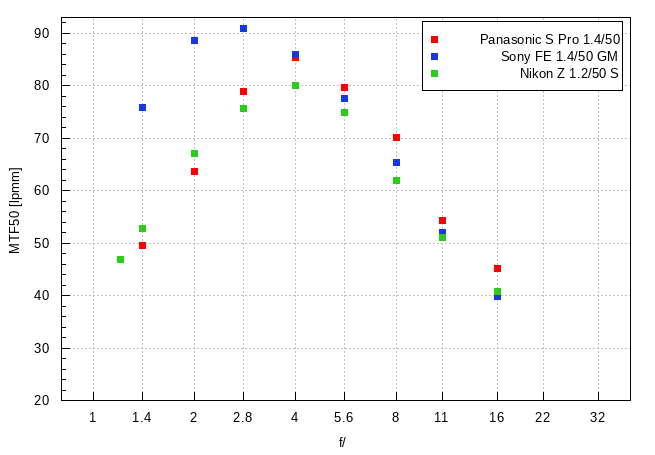
Once again you can realize that Sony produced a really brilliant and exceptional lens. In the wide area of the maximum relative aperture it fares noticeably better than the much bigger and heavier models of the rival companies. Only by f/4 the Panasonic matches the results of the Sony. On the other hand the fact that the Lumix can compete with the faster Nikkor on even terms, and up from f/2.8 it can fare even better, proves that its performance is really good.
It's also worth saying something about the performance of the Panasonic S Pro 1.4/50 on the edge of the frame. The edge of the APS-C sensor looks very well. Already at the maximum relative aperture you deal with a high value, over 47 lpmm. What's more, the results improve sinificantly on stopping down so by f/4.0 the lens reach an excellent level of over 74 lpmm.
You shouldn't complain also in case of full frame. Even at the maximum relative aperture you see a result of 42 lpmm so images produced by the lens are fully useful. By f/2.0 MTFs increase to over 46 lpmm and by f/2.8 to almost 59 lpmm. In the range from f/4.0 to f/8.0 MTFs increase a very good level of 60 lpmm. To sum up in its resolution test the Panasonic Lumix S Pro 50 mm f/1.4 didn't show any weaknesses; at the same tme on stopping down it got to such a level that its position on our list of record-holders seems to remain unchallenged for a very long time.
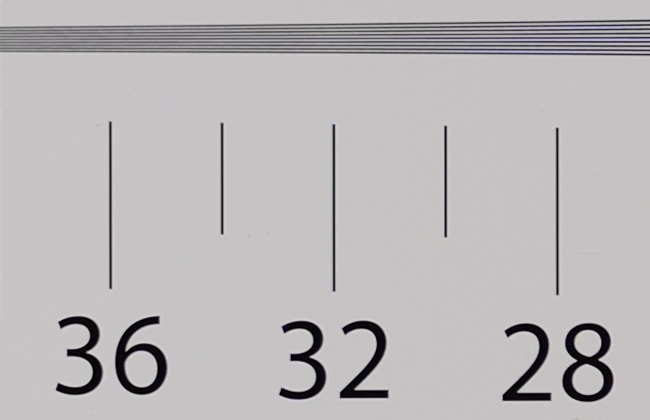
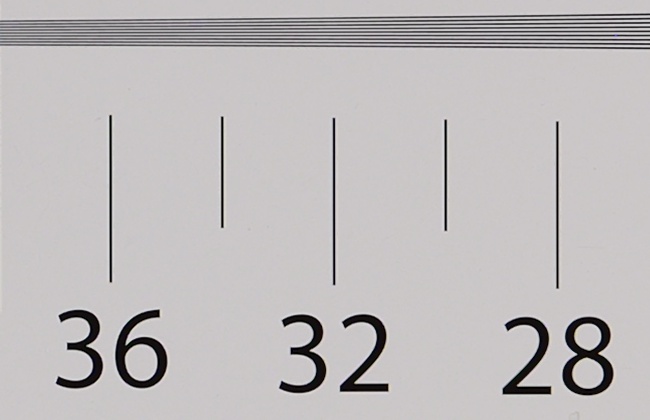
At the end of this chapter, traditionally, we present crops taken from photos of our resolution chart; they were taken from JPEG files saved along RAW files we used for the analysis above.
| Panasonic S1R II, JPEG, 50 mm, f/1.4 |
 |
| Panasonic S1R II, JPEG, 50 mm, f/4.0 |
 |