Panasonic Lumix S Pro 50 mm f/1.4
6. Distortion and field of view
Field of view
A rectilinear 50 mm lens on full frame should provide an angle of view amounting to 46.8 deg. In the official specification the producer states a value of 47 deg.As we are going to see in a moment, the Panasonic S Pro 50 mm f/1.4 attached to the camera body forces the automatic distortion correction. Our measurement on JPEG files will show a decreased field of view, already after the correction of deformations and cropping.
We took photos of a starry sky and saved them first as corrected JPEG files and then as uncorrected RAW files. Then we transformed the pixel layout (X,Y) from the photo into the equatorial coordinate system (right ascension and declination), which locates a star on a celestial sphere. That way we were able to measure the field very precisely, and exactly as it should be done, for rays of light coming from infinity.
Please Support UsIf you enjoy our reviews and articles, and you want us to continue our work please, support our website by donating through PayPal. The funds are going to be used for paying our editorial team, renting servers, and equipping our testing studio; only that way we will be able to continue providing you interesting content for free. |
- - - - - - - - - - - - - - - - - - - - - - - - - - - - - - - - - - - - - - - - - - - - - - - -
Our transformation of JPEG format files was based on positions of 105 stars spread evenly across the frame. An average mesh-fitting error amounted to just 7 seconds of arc. Our final result amounted to 47.24 degrees with a measurement error on a level of 0.03 of a degree. It's even a tad higher than official specifications but the difference is not that significant.
In case of uncorrected RAW files the transformation was based on positions of 120 stars and an average mesh-fitting error increased to 59 seconds of arc. In this case the result amounted to as much as 50.67 degrees with a measurement error on a level of 0.08 of a degree. It's a surprisingly high value, being an equivalent of a field provided by a rectalinear full frame 45.7 mm lens.
Distortion
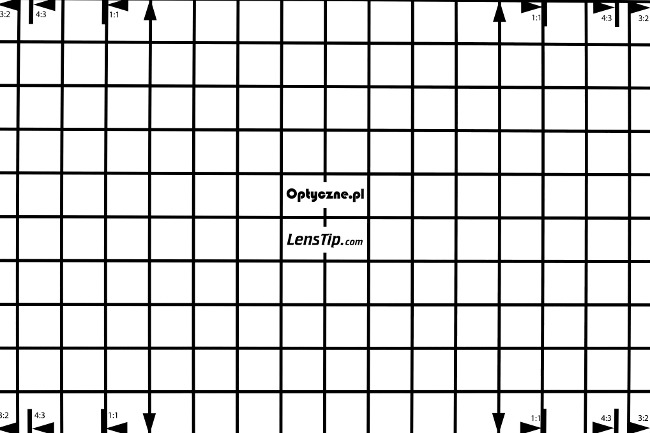
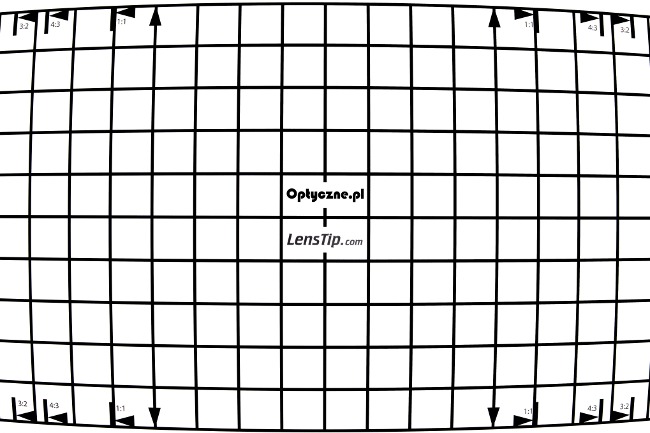
When you look at distortion results reached on JPEG or RAW files developed by the software of the producer nothing seems to be shifty. Like we saw in the previous chapter, the field of view slightly exceeds 47 deg so is in accordance with the field that should be provided by a standard 50 mm lens. Distortion measurement produces a symbolic value of -0.16% that, within the margin of error, is in accordance with zero. If you want to reach a distortion level that is exactly zero you might correct this field even a tad more – the slight amount of spare field of view is more than enough to do so.A problem? This nice image disappears completely as soon as you start to analyze photos developped by neutral software. They show you how the optics of the camera deals geometric deformations.
| Panasonic S1R II, 50 mm, JPEG, FF | |||
 |
|||
| Panasonic S1R II, 50 mm, RAW, FF | |||
 |
|||
The results we got prove that the optics doesn't deal with them at all – you see huge barrel distortion of -4.44%. It is such a high level that I don't hesitate to say the optics constructors didn't even try to correct distortion. It is surprising. You deal here with a big lens with a complex optical construction so, in our opinion, if they wanted to, they would correct this distortion to practically zero. After all even these old, small double gauss constructions weighing just 200-300 grams, with only 7 elements positioned in 6 groups, without any special elements among them, were able to reduce distortion to a level ranging from -2% to -1%. New constructions are far more efficient. For example the Sony FE 50 mm f/1.4 GM reduces distortion on full frame to +0.60%. In case of the cheap Samyang AF 50 mm f/1.4 FE II its level is even a tad lower, amounting to +0.55%.
Such a decision of the producers we consider to be a big slip-up. Of course you can defend the Panasonic a bit and say that the corrected files don't feature any distortion at all and the parameters of your images still correspond the parameters of a classic 50 mm instrument. The problem is that correction of such a high level of distortion comes at a price and we can say exactly how much you will have to pay.
The resulting TIFF file, developed by neutral software, features a resolution of 8152x5428 pix. After distortion correction and cropping, so it fits a corresponding JPEG file from the camera the best, you get an image with a resolution of 7548x5032 pix, so 37.98 Mpix. It's worth understanding what's happened here. Panasonic constructs a camera with a high resolution level, that of 44.24 MPix, and adds to it a high quality, expensive lens that, in theory, is supposed to push that sensor to its maximum, squeezing all the juice out of it in the process. At the same time they burden it with such a high distortion level that, after the correction, 6.26 Mpix so over 14% of the initial value, simply disappear. Then they pump these missing pixels out of nothing, rescaling the image once again to these declared 44 Mpix or so.
Another interesting thing – the camera crops images a tad too much after distortion correction. After straightening the TIFF file and cropping it just as much as it is absolutely necessary you get an image of a resolution amounting to 7727x5145 pix, so 39.76 Mpix. However, then the field of view still remains noticeably higher than in specifications. Apparently the significant cropping, applied by Panasonic, is supposed to reduce the field to the declared value of 47 degrees.