Panasonic Lumix S 50 mm f/1.8
4. Image resolution
We can also mentioned the fact that the decency level is positioned here near 40-42 lpmm, the best system primes should reach about 80 lpmm and the record-breakers might go as high as near 85 lpmm or even slightly exceed this value. Of course as we add more and more tests of lenses from this system to our database we might refine these estimations even further. So far, the Leica APO-Summicron-SL 75 mm f/2 (83.4 lpmm) and the Panasonic S Pro 50 mm f/1.4 (85.4 lpmm) can boast of the highest resolution levels.
Now let's check how the performance of the Panasonic Lumix S 50 mm f/1.8 compares – its results in the frame centre, on the edge of the APS-C sensor and on the edge of full frame presents a graph below.
Please Support UsIf you enjoy our reviews and articles, and you want us to continue our work please, support our website by donating through PayPal. The funds are going to be used for paying our editorial team, renting servers, and equipping our testing studio; only that way we will be able to continue providing you interesting content for free. |
- - - - - - - - - - - - - - - - - - - - - - - - - - - - - - - - - - - - - - - - - - - - - - - -
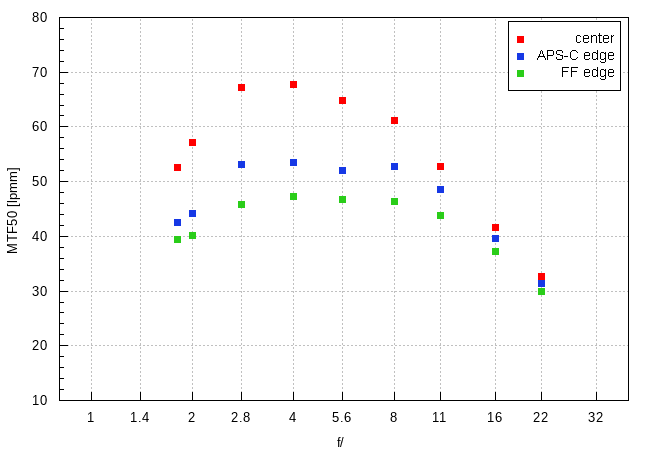
The frame centre fares very well. At the maximum relative aperture you deal with a really sensible value, amounted to almost 53 lpmm. Stopping down of the aperture improves the resolution distinctly – in the f/2.8-f/8.0 range the lens is able to reach very good value, exceeding easily 60 lpmm. The highest result, that of 67.7 lpmm, is reached by f/4.0. At the same time it is clear that the 1.8/50 model lags far behind its faster brother but also the slower APO-Summicron-SL.
In order to make the situation even clearer let's compare the performance of the Panasonic S 50 mm f/1.8 to two other mirrorless 1.8/50 models, the more expensive and more optically complex Nikkor Z 50 mm f/1.8 S and he cheaper Sony FE 50 mm f/1.8, a double gauss construction but slightly improved, with one aspherical element inside.
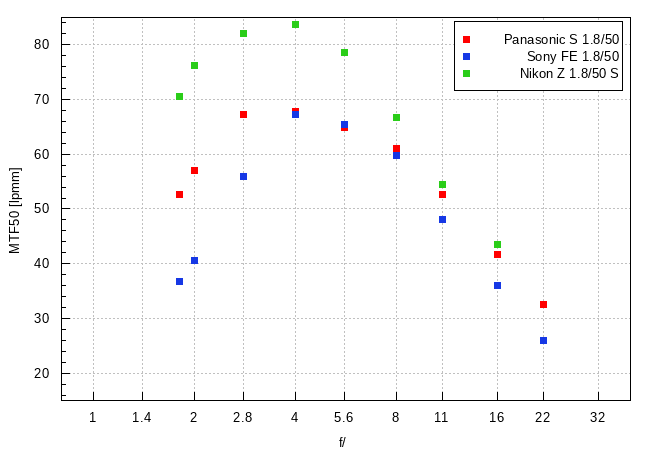
The reached results are in perfect accordance with the increase of the complexity of optics and the price. Like the majority of fast standards based on the double gauss construction the Sony in the close areas of the maximum relative aperture shows results that leave a bit to be desired but on stopping down the aperture they improve very fast. The Panasonic doesn't experience such problems and is able to provide sharp images up from f/1.8. A very important aperture range from f/1.8 to f/2.8 is a place where the Panasonic prevails significantly. Up from f/4.0 both lenses are able to offer you very good and practically identical image quality.
The most expensive Nikkor simply knocks out its rivals, not giving them any chances to win either at the maximum relative aperture or on stopping down. Still, you have to remember that the most packed sensor might be responsible for the additional 1-2 lpmm of its advantage. However, even if you deduct this value from the Nikkor's points on the graph, its advantage will remain unthreatened.
We already know how the Panasonic 1.8/50 fares in the frame centre; now let's tackle its performance on the edge of the frame.
In case of the APS-C sensor there are no reservations whatsoever. Even at the maximum relative aperture you get a result of almost 43 lpmm, a tad above the decency level. A good image quality, with results of 50 lpmm or higher, is reached in a wide range of apertures from f/2.8 to f/11.
The first small slip-up can be observed on the edge of the full frame sensor. In this case by f/1.8 and f/2.0 you deal with results of, respectively: 39.4 and 40.2 lpmm, so right below the decenly level or on the borderline. Stopping down the aperture to f/2.2 eliminates that problem completely, but, of course, you have to remember that the resolution on the edge of full frame will never bowl you over. Even on more distinct stopping down the MTFs don't exceed 50 lpmm at any point.
To sum up you can say that in this category the Panasonic delivers exactly what you could reasonably expect from a lens at such a price point and with such optics complexity. The results are noticeably better than the results of double gauss constructions but also weaker than the performance of the best and the most expensive 1.8/50 class models.
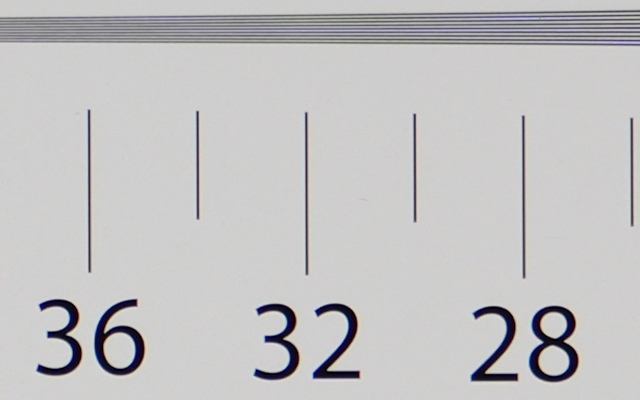
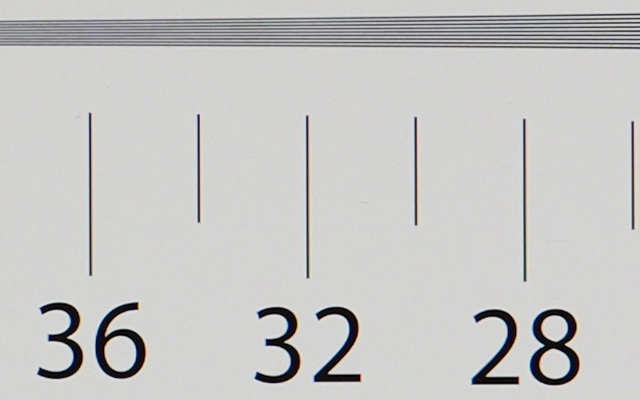
At the end of this chapter, traditionally, we present crops taken from photos of our resolution chart; they were taken from JPEG files saved along RAW files we used for the analysis above.
| Panasonic S1R II, JPEG, 50 mm, f/1.8 |
 |
| Panasonic S1R II, JPEG, 50 mm, f/4.0 |
 |