Panasonic Lumix S 50 mm f/1.8
6. Distortion and field of view
Field of view
A rectilinear 50 mm lens on full frame should provide an angle of view amounting to 46.79 deg. In the official specification the producer states a value of 47 deg.We decided to measure the real values of the field of view. We took photos of a starry sky and saved them first as corrected JPEG files and then as uncorrected RAW files. Then we transformed the pixel layout (X,Y) from the photo into the equatorial coordinate system (right ascension and declination), which locates a star on a celestial sphere. That way we were able to measure the field very precisely, and exactly as it should be done, for rays of light coming from infinity.
Our transformation of JPEG format files was based on positions of 102 stars spread evenly across the frame. An average mesh-fitting error amounted to just 7 seconds of arc. In this case we reached an angle of 46.97 degrees with a measurement error on a level of 0.1 of a degree. In other words our result was in perfect accordance with the official specification.
Please Support UsIf you enjoy our reviews and articles, and you want us to continue our work please, support our website by donating through PayPal. The funds are going to be used for paying our editorial team, renting servers, and equipping our testing studio; only that way we will be able to continue providing you interesting content for free. |
- - - - - - - - - - - - - - - - - - - - - - - - - - - - - - - - - - - - - - - - - - - - - - - -
In case of uncorrected RAW files the transformation was based on positions of 133 stars and an average mesh-fitting error increased to 57 seconds of arc. In this case the developed file always features a tad higher physical resolution so our result amounted to 47.23 degrees, a bit higher than in official specifications, with a measurement error on a level of 0.1 of a degree.
As you see, no surprises here – the lens delivers a field that was promised in its specifications. In a moment we are going to show that a surplus field of view is simply not needed here because the lens doesn't have any meaningful distortion problems.
Distortion
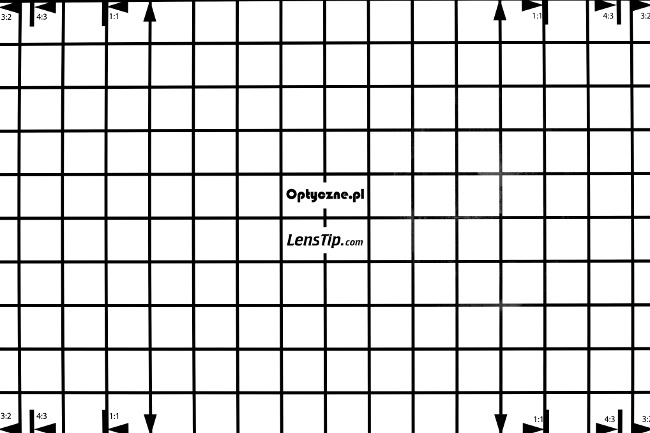
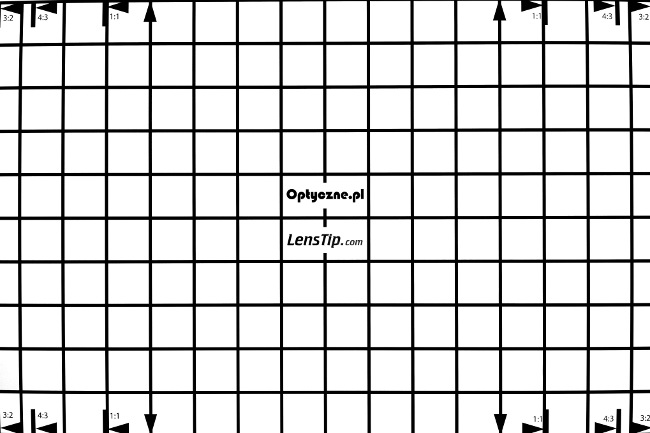
Very slight differences in fields of view reached on JPEG and RAW files suggest that the tested lens shouldn't have any problems with distortion correction. Indeed, such is the case. When it comes to JPEG files our result amounted to -0.20%, and it was -0.22% for RAW files. Both results are in accordance with each other within the measurment error and they mean that you won't notice any trace of geometric deformations in real life photos.As a much smaller , lighter, optically simpler, and cheaper Panasonic S 50 mm f/1.8 was able to correct distortion practically to zero I have been wondering who took a decision to pass on distortion correction in case of the big, heavy, and extremely expensive Panasonic S Pro 50 mm f/1.4.
By the way, the situation observed in the tests of the 50 mm Sigma devices is being repeated. A more expensive, lighter, and optically more complex model from the top-of-the-range Art line, the A 50 mm f/1.4 DG DN, had pincushion distortion of +2.58% whereas the cheaper, smaller, and lighter C 50 mm f/2 DG DN model corrected distortion in an exemplary manner with a result of -0.48% on full frame.
| Panasonic S1R II, 50 mm, JPEG, FF | |||
 |
|||
| Panasonic S1R II, 50 mm, RAW, FF | |||
 |
|||