Nikon Nikkor Z MC 105 mm f/2.8 VR S
4. Image resolution
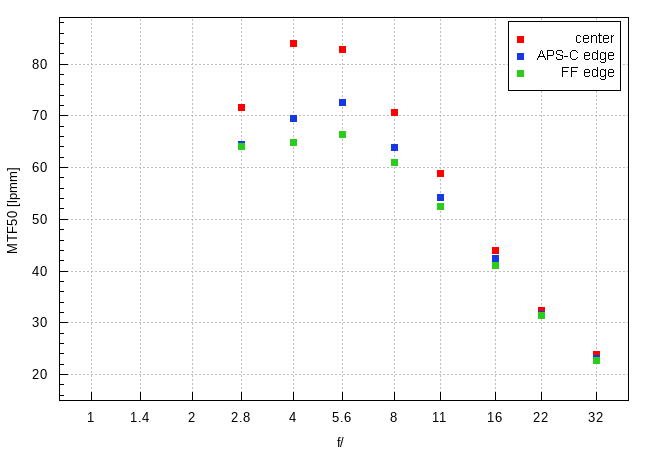
Let's check how the Nikkor Z MC 105 mm f/2.8 VR S compares- its results in the frame centre, on the edge of the APS-C/DX sensor and on the edge of full frame presents a graph below.
Please Support UsIf you enjoy our reviews and articles, and you want us to continue our work please, support our website by donating through PayPal. The funds are going to be used for paying our editorial team, renting servers, and equipping our testing studio; only that way we will be able to continue providing you interesting content for free. |
- - - - - - - - - - - - - - - - - - - - - - - - - - - - - - - - - - - - - - - - - - - - - - - -
Instead of describing the graph as usual, let's change our approach a bit and compare the results of the tested lens to these of its direct rivals that have also been tested with the help of the Nikon Z7 sensor. We mean here of course the Tamron 90 mm f/2.8 Di III Macro VXD and the Venus Optics LAOWA FFII 90 mm f/2.8 CA-Dreamer Macro 2X. A graph below shows such a comparison in the frame centre.
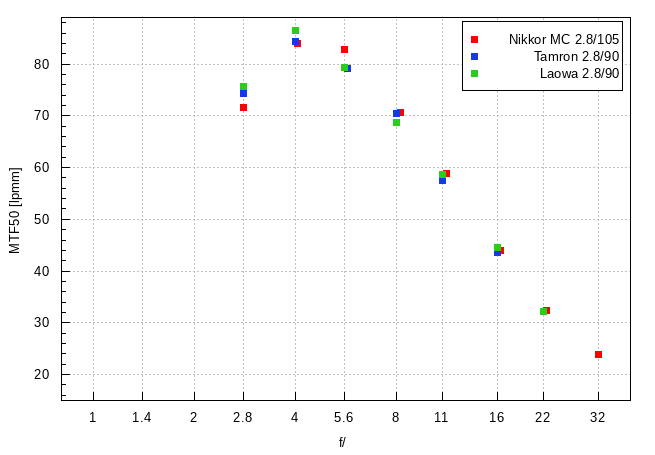
It's clear that all three lenses go head to head. If you take into account measuring errors you'll find out that real-life images produced by all these lenses are indistinguishable. Of course the fact that the most expensive Nikkor is also the weakest when it comes to the most demanding f/2.8 and f/4.0 apertures is a kind of surprise.
Still, before you start to complain let's check the same kind of comparison but this time for the edge of the APS-C/DX sensor – an appropriate graph can be found below.
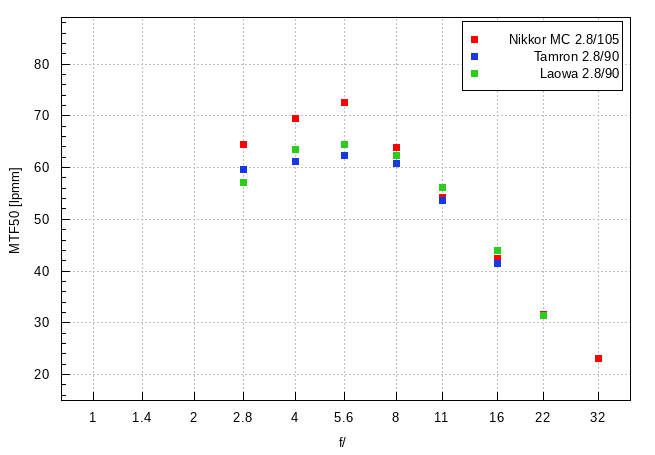
In this case the Nikkor doesn't leave any doubts and if fares definitely better than its rivals, exceeding a very good level of 70 lpmm as the only device in this group.
Now let's check the situation on the edge of full frame.
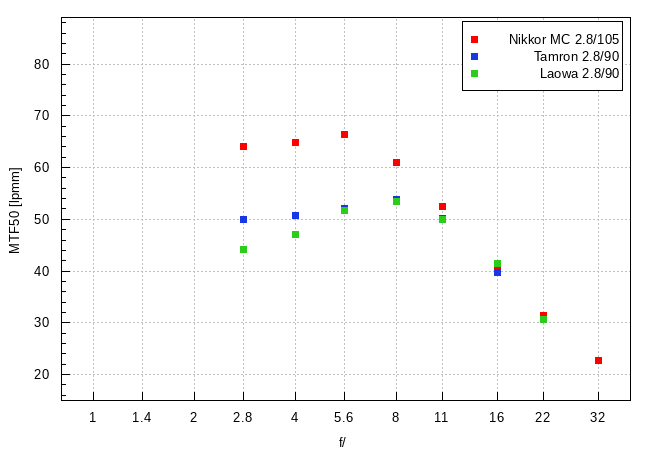
This time the superiority of the Nikkor is so pronounced that a word 'outclassing' comes to your mind immediately. It is clear now that the Nikkor focuses not only on the best performance possible in the frame centre, but also across the frame. Let's face it – its rivals should take a leaf out of its book, especially that a macro lens is often used also for e.g. producing reproductions and in such a case reaching a high image quality across the frame is very important.
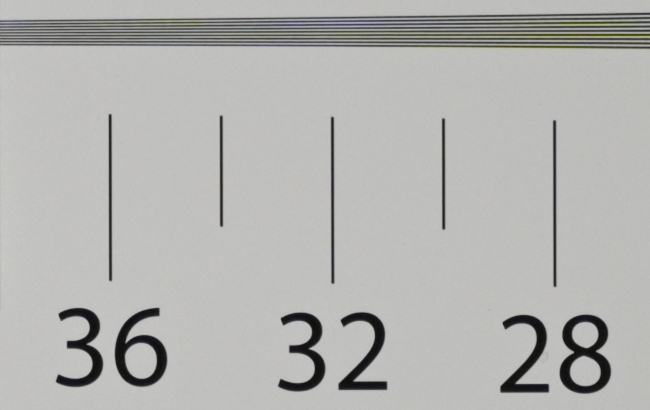
At the end of this chapter, traditionally, we presents crops taken from photos of our resolution testing chart; they were saved as JPEG files along with RAW files we used for the analysis above.
| Nikon Z7, JPEG, 105 mm, f/2.8 |
 |
| Nikon Z7, JPEG, 105 mm, f/4.0 |
 |