Nikon Nikkor Z MC 105 mm f/2.8 VR S
8. Vignetting
| Z7, APS-C/DX, f/2.8 | Z7, APS-C/DX, f/4.0 |

|

|
At the maximum relative aperture vignetting is slight but noticeable, reaching 20% (−0.66 EV). By f/4.0 the problem becomes marginalized completely, amounting to just 3% (−0.09 EV).
Please Support UsIf you enjoy our reviews and articles, and you want us to continue our work please, support our website by donating through PayPal. The funds are going to be used for paying our editorial team, renting servers, and equipping our testing studio; only that way we will be able to continue providing you interesting content for free. |
- - - - - - - - - - - - - - - - - - - - - - - - - - - - - - - - - - - - - - - - - - - - - - - -
After passing to a bigger, full frame sensor it makes itself felt more and you can notice it very clearly in photos below.
| Z7, FF, f/2.8 | Z7, FF, f/4.0 |

|

|
| Z7, FF, f/5.6 | Z7, FF, f/8.0 |

|

|
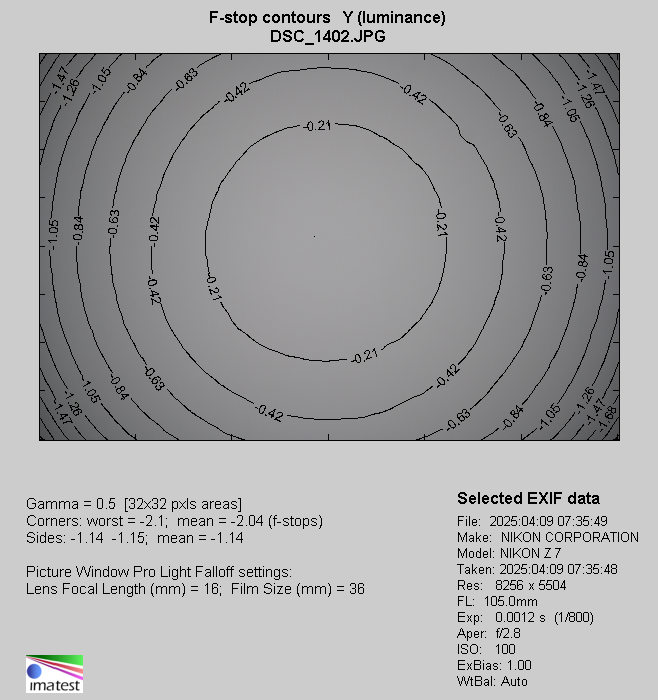
Brightness loss in frame corners at the maximum relative aperture reaches 51% (-2.04 EV). It's a lot – the rival Sigma showed a result of just 36% and in case of the small Sony it was 53%.
Fortunately the vignetting of the tested Nikkor is very susceptible to stopping down the aperture. By f/4.0 it reaches 30% (-1.02 EV), by f/5.6 it decreases to 13% (-0.42 EV) and by f/8.0 it becomes completely imperceptible, with a result of just 2% (-0.05 EV).
| Nikon Z7, JPEG, 105 mm, f/2.8 |
 |