Sigma A 17-40 mm f/1.8 DC
6. Distortion and field of view
Field of view
A rectilinear 17-40 mm lens on the APS-C/DX sensor should give you a range of angles of view from 79.75 to 39.09 degrees. In their official specification Sigma provides almost identical range, from 79.7 to 39.1 deg. Of course we decided to check these declarations. In order to do so we took photos of a starry sky and saved them as both corrected and uncorrected JPEG files. Then we transformed the pixel layout (X,Y) from the photo into the equatorial coordinate system (right ascension and declination), which locates a star on a celestial sphere. That way we were able to measure the field very precisely, and exactly as it should be done, for rays of light coming from infinity.At 17 mm focal length and uncorrected JPEG file the transformation was based on the positions of 123 stars spread evenly across the frame. An average mesh-fitting error amounted to just 15 seconds of arc. Our final result amounted to 83.12 degrees with a measurement error on a level of 0.05 of a degree. It's a result by as much as 3.4 deg higher than the value stated in official specifications. It's clear that the producers left a spare amount of field for distortion correction, a wise decision as we are going to find out in a moment. It's also worth mentioning that such a value of field of view corresponds to the 16 mm focal length, perfectly corrected for distortion.
In case of corrected JPEG files the transformation was based on 111 stars and this time the mesh-fitting error amounted to 59 seconds of arc. We got a result of 78.98 deg with an error on a level of 0.08 deg. The field is a bit wider than stated in official specifications also in this case but this time the spare amount of it is very small. For the 40 mm focal length and uncorrected JPEG files we used he positions of 81 stars and the average mesh-fitting error decreased to just 8 seconds of arc. The angle of view, measured by us, amounted to 38.24 deg with an error not exceeding 0.03 deg. Here the field is a bit narrower than stated in specifications (being almost a precise equivalent of the rectilinear 41 mm focal length) and it decreases when you correct distortion. Still, in this case the decrease of the field is nothing bad – the effect is the same as if you used a lens with a tad wider focal range.
Distortion
When Sigma differentiated their line-up of lenses into A,S, and C series, they emphasized the fact that two first series were going to consist of optically the best and uncompromising devices, and the series C might feature some compromises in order to ensure good value for money: a proper combination of quality, dimensions, and weight.
Soon it turned out that Sigma didn't manage to keep their own promises – the optics specialists have sometimes to cut corners even when it comes to the top-of-the-range Art series. It is exactly the case of the Sigma A 17-40 mm f/1.8 DC. It seems that distortion correction is a task passed to the software of a camera.
Please Support UsIf you enjoy our reviews and articles, and you want us to continue our work please, support our website by donating through PayPal. The funds are going to be used for paying our editorial team, renting servers, and equipping our testing studio; only that way we will be able to continue providing you interesting content for free. |
- - - - - - - - - - - - - - - - - - - - - - - - - - - - - - - - - - - - - - - - - - - - - - - -
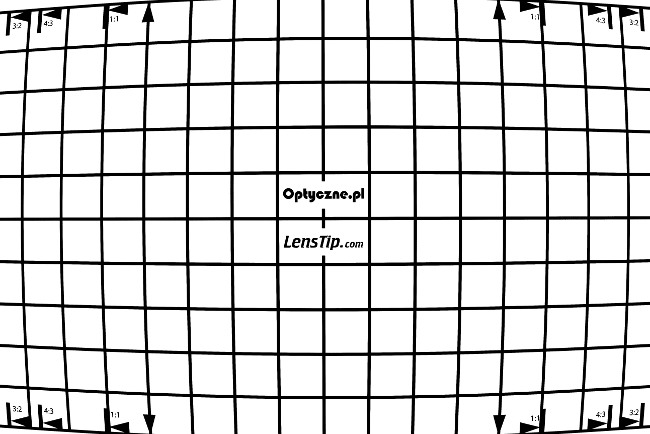
When you work with RAW files or uncorrected JPEG files at the 17 mm focal length you have to deal with a very high level of barrel distortion, that of -5.82%. Fortunately, there are no traces of moustache distortion so the correction should be rather simple.
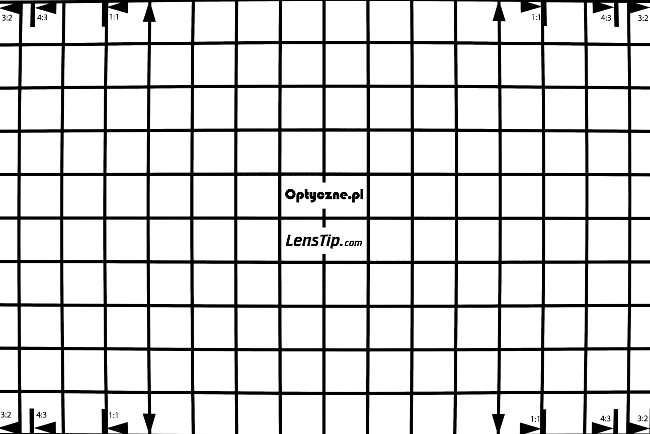
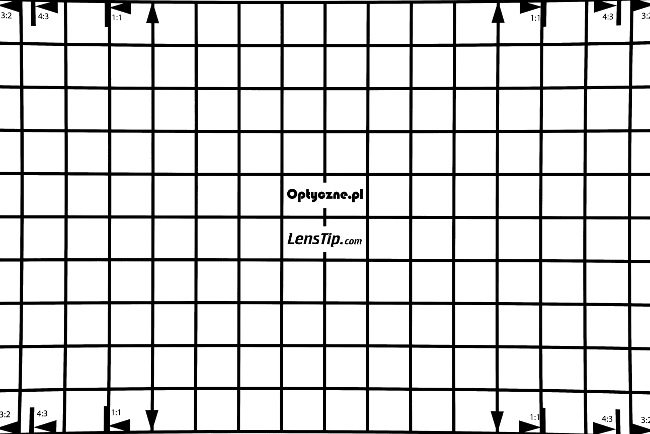
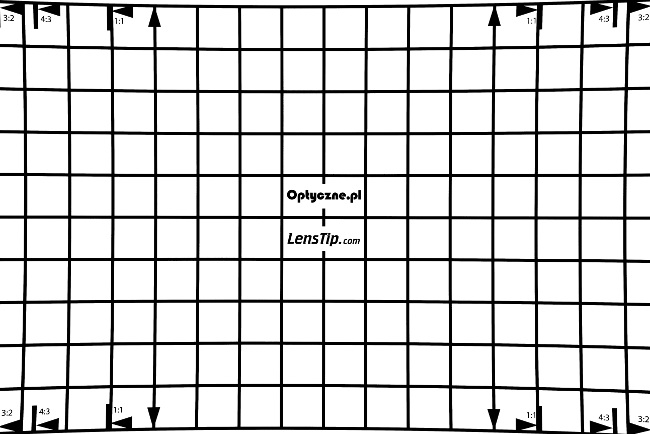
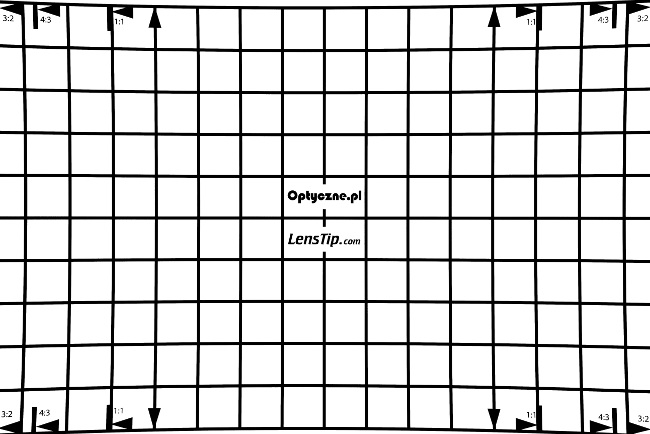
At the 22 mm focal length you still deal with a 'barrel' type but its level is far lower, that of -1.21%. Then distortion changes the sign and at 28 mm focal length you already see slight 'pincushion' which value we determined as +1.52%. Unfortunately, after further increase of the focal length deformations increase as well – at 35 mm you get a level of +2.79%, at 40 mm it amounted to as much as +3.03%.
It is clear constructor of the Sigma didn't try to correct distortion at any of two focal range ends. Pity...
It is a stark contrast compared to the performance of the reflex camera model, the Sigma A 18-35 mm f/1.8 DC HSM, which distortion changed from -2.46% to +1.10%. Of course you dealt with a narrower focal range but it is not a significant argument because you can find other examples as well. For instance the Tamron 17-70 mm f/2.8 Di III-A VC RXD. Here the focal range is far greater so it makes distortion correction more difficult and yet the Tamron managed to keep its level in a range from -3.33% to +2.71%. Both these results are noticeably lower than the results of the Sigma, tested here, where is a will there's a way. In my opinion, Sigma had no will in this case.
| Sony A7R IIIa, APS-C, JPEG, 17 mm | |||
|
|||
| Sony A7R IIIa, APS-C, JPEG, 22 mm | |||
|
|||
| Sony A7R IIIa, APS-C, JPEG, 28 mm | |||
|
|||
| Sony A7R IIIa, APS-C, JPEG, 35 mm | |||
|
|||
| Sony A7R IIIa, APS-C, JPEG, 40 mm | |||
|
|||
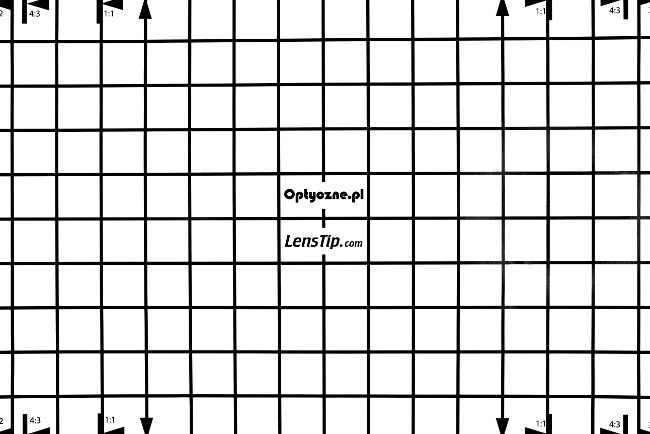
It's important to remember, however, that at wide-angle, we were provided with a substantial field of view. This was to allow for distortion correction and cropping the image to the target size, where the final field of view is very close to that specified in the specifications. At the same time, the photo below clearly shows that at the corrected JPEG and 17 mm focal length, distortion is already negligible, amounting to only +0.18%.
| Sony A7R IIIa, APS-C, CORRECTED JPEG, 17 mm | |||
|
|||
You can say Sigma offers you two choices. You can make do with significant distortion and high vignetting but also enjoy a lens with an effective 16-41 mm focal range. You also can switch on distortion correction in the camera body and take photos with practically zero deformations and lower vignetting but with an effective focal range changing into 17-43 mm.
Of course the second variant entails the necessity of cropping the image after distortion correction and losing a significant part of the initial resolution of the detector. As if it wasn't enough, the resulting frame is also scaled up to the original size and it generates empty pixels.