Tamron 16-30 mm f/2.8 Di III VXD G2
4. Image resolution
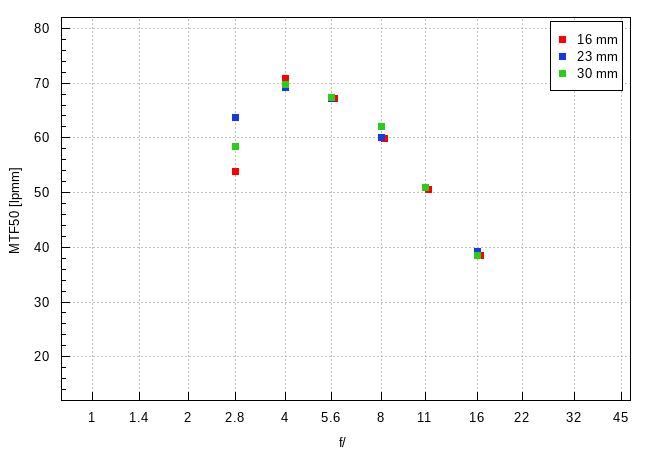
Let's see how the Tamron 16-30 mm f/2.8 Di III VXD G2 compares – a graph below shows its performance in the frame centre.
Please Support UsIf you enjoy our reviews and articles, and you want us to continue our work please, support our website by donating through PayPal. The funds are going to be used for paying our editorial team, renting servers, and equipping our testing studio; only that way we will be able to continue providing you interesting content for free. |
- - - - - - - - - - - - - - - - - - - - - - - - - - - - - - - - - - - - - - - - - - - - - - - -
Taking into account the combination of physical dimensions, weight, and parameters that are difficult to construct the performance in the frame centre is really worth your praise, especially as it is very even. Up from f/4.0 particular focal lengths are practically indistinguishable. At the same time by this aperture exactly the lens is able to get maximum results that keep a very good level of 70 lpmm.
Noticeable differences between focal lengths are visible only and solely at the maximum relative aperture, with the best results in the middle of the range and the weakest results at 16 mm. Even there you still deal with a good resolution value of almost 54 lpmm. As you see the tested Tamron definitely should be praised here.
It's worth emphasizing the fact that the results, presented here, are very similar to the performance of the much more expensive Sony FE 16-35 mm f/2.8 GM II that is able to win with the Tamron by and large only by f/2.8 and at both ends of the focal range.
Now let's check the performance on the edge of the APS-C/DX - an appropriate graph that can be found below.
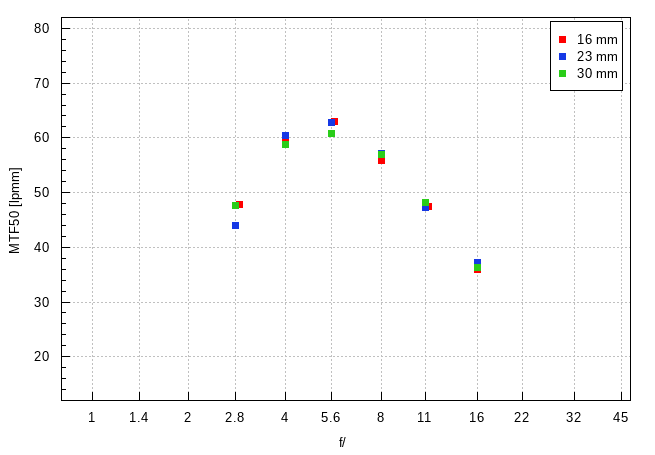
Once again you should praise a very even performance because all focal lengths are very similar. A sensible image quality is offered already up from the maximum relative aperture and it improves very quickly on stopping down the aperture. As a result by f/4.0 and f/5.6 you deal with a really good level of about 60 lpmm.
This time the more expensive Sony FE 16-35 mm f/2.8 GM II prevails – its advantage is especially visible at the maximum relative aperture where it was able to exceed distinctly 50 lpmm.
Of course the performance on the edge of the full frame detector is the most demanding test for constructions of this type – let's glance at a graph below and find out how the Tamron fares.
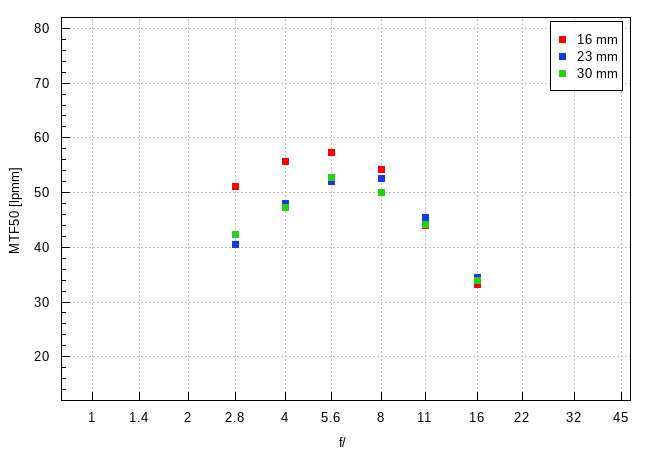
In this case the performance is not as even as previously but Tamron took proper care of the shortest focal length, so important in this segment, a very wise strategy. At this point already at the maximum relative aperture you get results exceeding 50 lpmm. It means that while working with this focal length you have sharp images across the frame guaranteed, no matter what aperture you apply.
Longer focal lengths look not so well but even in their case you don't have any reasons to complain. At the maximum relative aperture you get very decent images, with MTFs keeping a level of 40-42 lpmm. On stopping down they can even exceed 50 lpmm.
At this place the advantage of the more expensive Sony model is once again distinct; the fact that this lens has its performance optimized at 16 mm is worth noticing.
To sum up: not only the Tamron 16-30 mm f/2.8 Di III VXD offers you a very good and even performance in the frame centre but also it manages to avoid any slip-ups at the most demanding edge of the frame. With such an aperture fastness and such wide angles of view it is no mean feat.
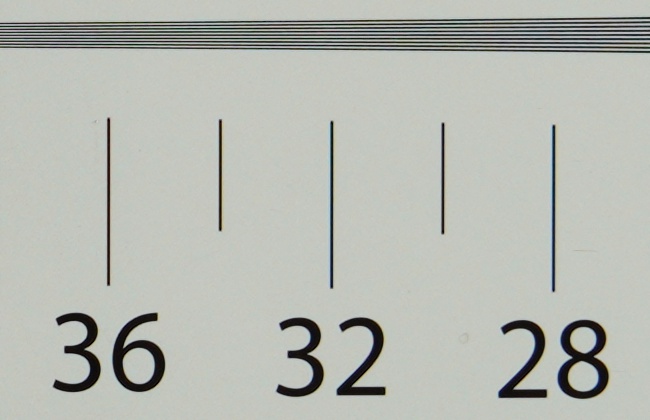
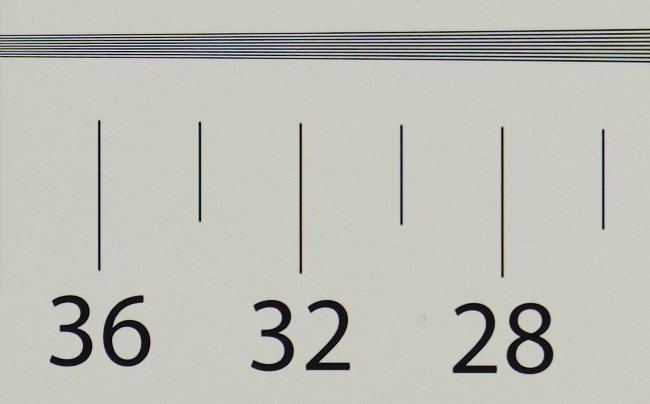
At the end of this chapter, traditionally, we present crops taken from photos of our resolution test chart. These photos were saved as JPEG files alongside RAW files used for the analysis above.
| A7R IIIa, JPEG, 16 mm, f/2.8 |
 |
| A7R IIIa, JPEG, 30 mm, f/4.0 |
 |