Tamron 16-30 mm f/2.8 Di III VXD G2
8. Vignetting
| A7R IIIa, APS-C, JPEG, 16 mm, f/2.8 | A7R IIIa, APS-C, JPEG, 16 mm, f/4.0 |

|

|
| A7R IIIa, APS-C, JPEG, 24 mm, f/2.8 | A7R IIIa, APS-C, JPEG, 24 mm, f/4.0 |

|

|
| A7R IIIa, APS-C, JPEG, 30 mm, f/2.8 | A7R IIIa, APS-C, JPEG, 30 mm, f/4.0 |

|

|
At 16 mm and by f/2.8 vignetting is low, reaching just 16% (-0.50 EV). Stopping down the aperture to f/4.0 decreases this aberration to 13% (-0.39 EV), and by f/5.6 it amounts to just 11% (-0.34 EV).
Please Support UsIf you enjoy our reviews and articles, and you want us to continue our work please, support our website by donating through PayPal. The funds are going to be used for paying our editorial team, renting servers, and equipping our testing studio; only that way we will be able to continue providing you interesting content for free. |
- - - - - - - - - - - - - - - - - - - - - - - - - - - - - - - - - - - - - - - - - - - - - - - -
In the middle of the focal range the situation is a bit worse: at the maximum relative aperture brightness loss in frame corners reaches 20% (-0.63 EV), and by f/4.0 it decreases to 11% (-0.33 EV).
The worst situation can be observed at the maximum focal length: by f/2.8 vignetting gets to 24% (-0.80 EV), and by f/4.0 it drops to 10% (-0.30 EV).
On the APS-C/DX sensor the tested Tamron doesn't provide you any more serious reasons to worry but of course we were very curious how it would change after passing to full frame. Let's take a look at thumbnails showing images saved as uncorrected JPEG files.
| A7R IIIa, FF, JPEG, 16 mm, f/2.8 | A7R IIIa, FF, JPEG, 16 mm, f/4.0 |

|

|
| A7R IIIa, FF, JPEG, 24 mm, f/2.8 | A7R IIIa, FF, JPEG, 24 mm, f/4.0 |

|

|
| A7R IIIa, FF, JPEG, 30 mm, f/2.8 | A7R IIIa, FF, JPEG, 30 mm, f/4.0 |

|

|
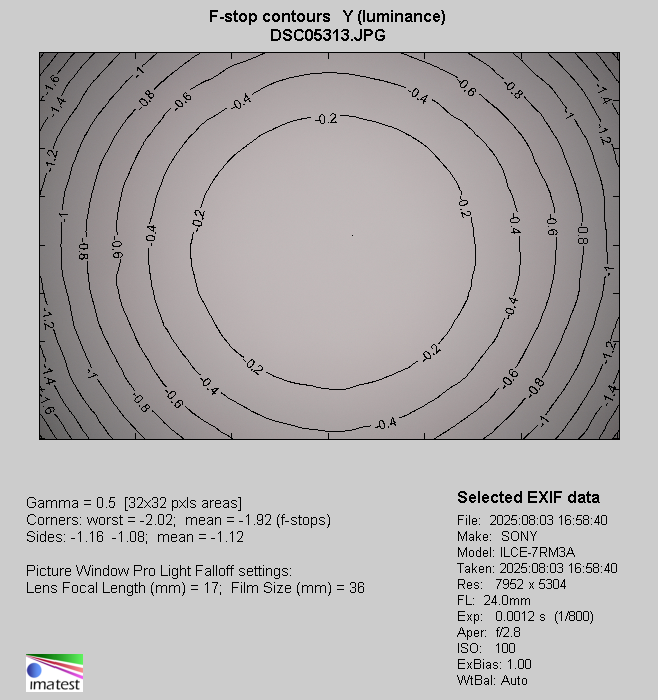
At the most demanding combination of the 16 mm focal length and f/2.8 aperture you have to tolerate brightness loss of as much as 67% (-3.19 EV) in frame corners. It's a very weak result but still a bit better than the result of the Sony, 70%. Fortunately stopping down is quite effective here so by f/4.0 you deal with a value of 53% (-2.18 EV), and by f/5.6 it's 42% (-1.56 EV).
Then the vignetting decrease slows down so by f/8.0 it amounts to 36% (-1.29 EV), and by f/11.0 it reaches 35% (-1.26 EV). Further stopping down of the aperture doesn't bring any measureable effects anymore.
In the middle of the focal range and by f/2.8 vignetting still remains high, reaching 49% (-1.92 EV) but such a value is nothing unusual for fast ultra wide angle lenses. By f/4.0 you see a decrease to 32% (-1.13 EV), by f/5.6 it's a value of 29% (-0.99 EV). Further stopping down doesn't have any measureable effect on the results.
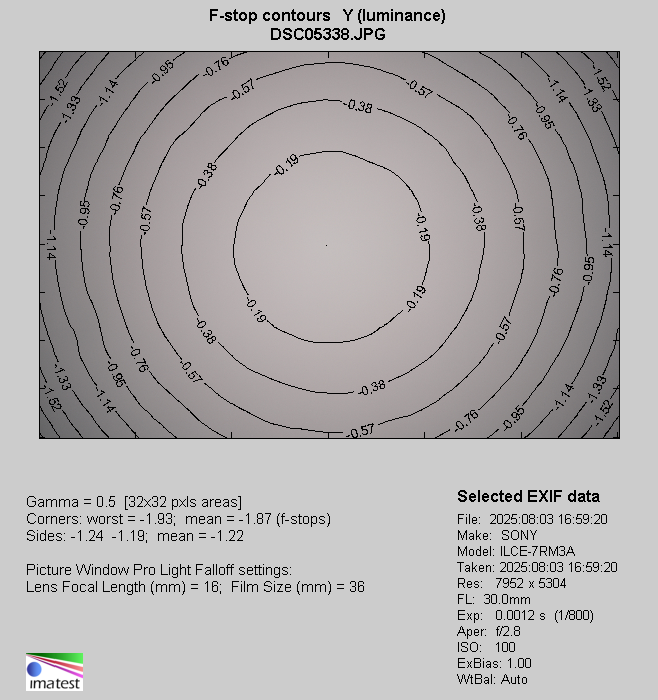
The combination of the maximum focal length and f/2.8 aperture means light fall-off in frame corners amounts to 48% (-1.87 EV). By f/4.0 vignetting decreases to 30% (-1.04 EV), and by f/5.6 to 26% (-0.89 EV). By f/8 and f/11 our results, within the margin of measuring error, don't differ from the value we got by f/5.6.
| Sony A7R IIIa, 16 mm, JPEG, f/2.8 |
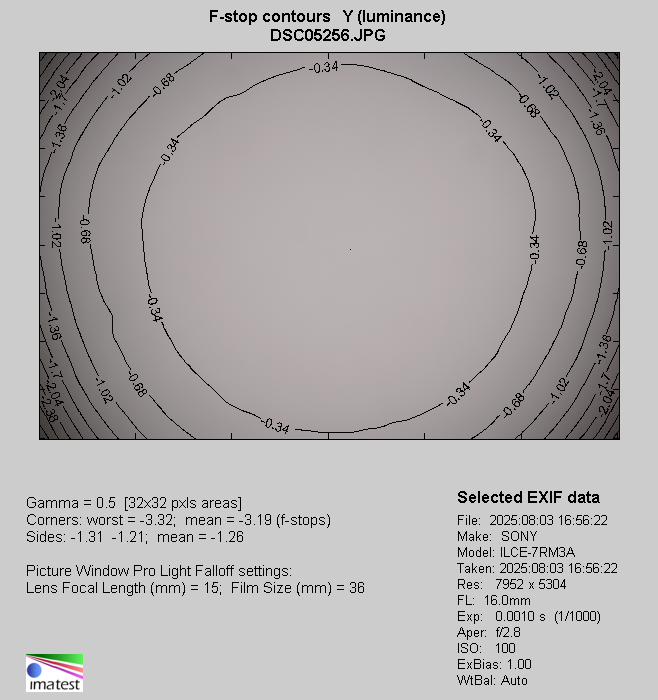 |
| Sony A7R IIIa, 24 mm, JPEG, f/2.8 |
 |
| Sony A7R IIIa, 30 mm, JPEG, f/2.8 |
 |
Now let's pass to the analysis of the performance at 16 mm and distortion corrected files. From the distortion and field of view chapter we remember that on uncorrected JPEG files the lens provides an angle of view amounting to almost 109.2 deg, by 2.2 deg wider than in official declarations. This spare amount of field is used to make the files closer to the declared value of 107 deg after distortion correction and cropping of images.
What about vignetting on corrected JPEG files that provide a field of view of 107.44 deg, almost half of a degree wider than in specifications? Let's consult thumbnails posted below.
| A7R IIIa, FF, CORR. JPEG, 16 mm, f/2.8 | A7R IIIa, FF, CORR. JPEG, 16 mm, f/4.0 |

|

|
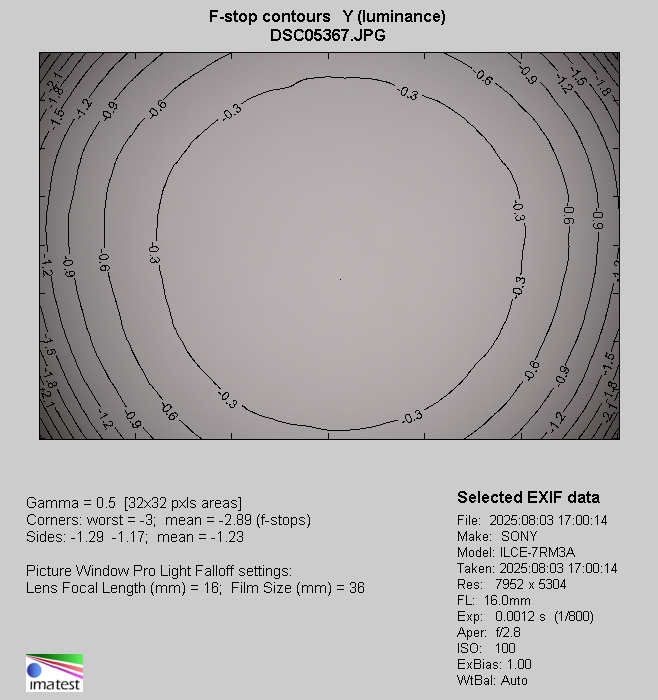
This time at the maximum relative aperture brightness loss in frame corners amounts to 63% (-2.89 EV). It's still a very high value, proving that you have to pay a lot for limited physical dimensions and weight. By f/4.0 vignetting decreases to 50% (-1.99 EV), by f/5.6 it drops to 37% (-1.32 EV), and by f/8.0 to 34% (-1.18 EV). Further stopping down of the aperture doesn't bring any measureable effects.
| Sony A7R IIIa, 16 mm, JPEG SKORYGOWANY, f/2.8 |
 |