Voigtlander Septon 40 mm f/2 Aspherical
4. Image resolution
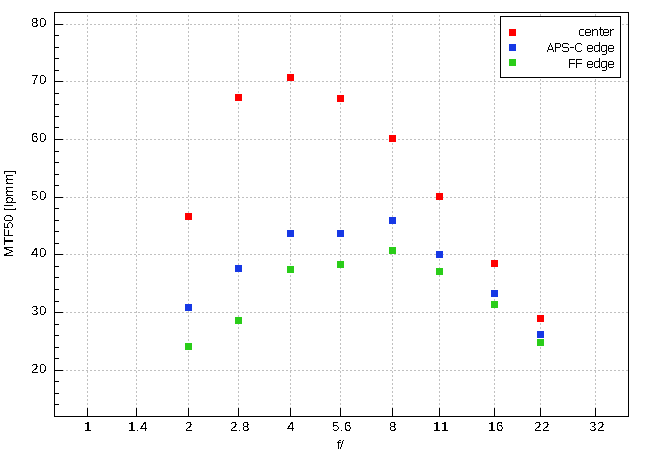
Let's see how the Voigtlander Septon 40 mm f/2 Aspherical performs against this background. Its results at the centre of the frame, at the edge of the APS-C/DX sensor and at the edge of the full-frame sensor are presented in the graph below.
Please Support UsIf you enjoy our reviews and articles, and you want us to continue our work please, support our website by donating through PayPal. The funds are going to be used for paying our editorial team, renting servers, and equipping our testing studio; only that way we will be able to continue providing you interesting content for free. |
- - - - - - - - - - - - - - - - - - - - - - - - - - - - - - - - - - - - - - - - - - - - - - - -
To be honest, I'm not sure which came first. Was the lens designed first, with the Septon name chosen because it uses exactly seven elements (from the Latin septem, meaning seven)? Or was the optical designer a fan of George R.R. Martin's fiction and wanted to pay tribute to the Septon of the Faith of the Seven, thus somewhat artificially limiting the design to seven optical elements? Regardless of which scenario is true, limiting the design to just these seven elements did not do the lens any favours.
The centre of the frame looks reasonably good, and this is demonstrated quite well by the comparison with other competitors featuring the same 40 mm f/2 specifications, as illustrated in the graph below.
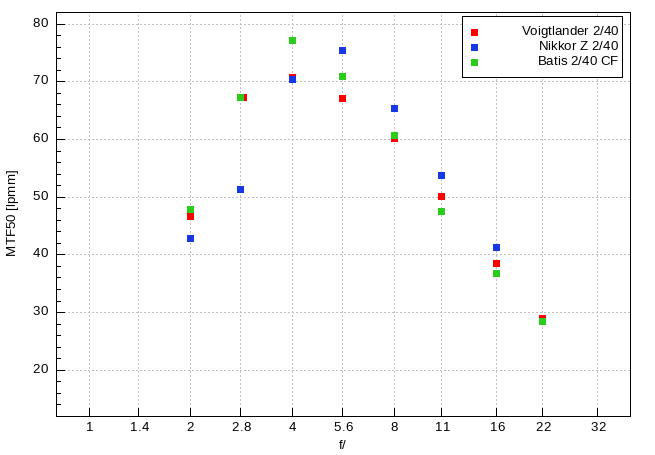
At f/2.0 and f/2.8, the Septon goes head-to-head with the larger and optically more complex Batis, while also outperforming the Nikkor. It is worth recalling, however, the result achieved by the Sony FE 40 mm f/2.5 G, which at f/2.8 was able to exceed 70 lpmm, thus outperforming all the f/2 40 mm models presented here. From f/4.0 onwards, however, the Voigtlander starts to fall behind its competitors. This is due to the specific behavior of its off-axis aberrations, which we will discuss in the following chapters.
Even more reservations arise when we look at the Septon's performance at the edge of the frame. Things are already really poor with the smaller APS-C/DX sensor, as acceptable image quality is achieved only when stopping down to around f/3.5. Performance is even worse at the edge of the full-frame sensor, where acceptable results are obtained only around f/8.0. It has been a long time since we have seen such poor performance from a modern lens.
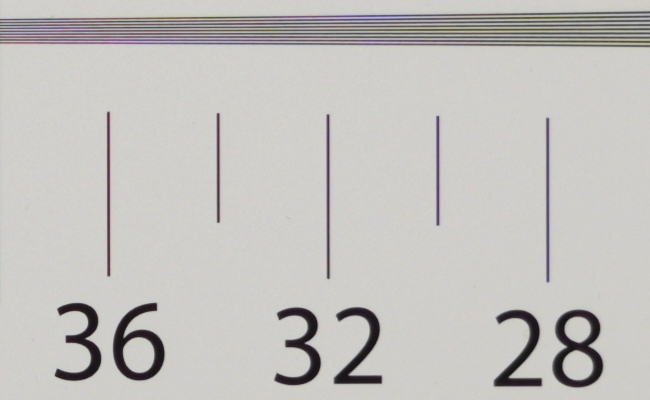
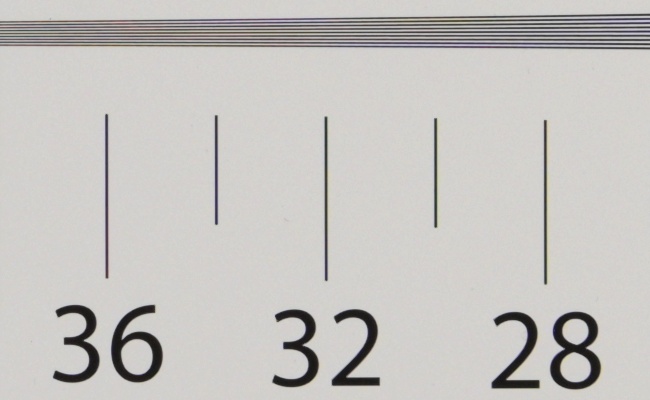
At the end of this chapter, as usual, we present crops from photographs of our resolution test chart, taken from JPEG files recorded simultaneously with the RAW files used for the analysis above.
| Nikon Z8, JPEG, 40 mm, f/2.0 |
 |
| Nikon Z8, JPEG, 40 mm, f/4.0 |
 |