Voigtlander Septon 40 mm f/2 Aspherical
8. Vignetting
| Z8, APS-C/DX, f/2.0 | Z8, APS-C/DX, f/2.8 |

|

|
Even at the maximum relative aperture, vignetting is not particularly pronounced here, reaching a modest 24% (-0.79 EV). The problem practically disappears at f/2.8 and f/4.0, where our measurements yielded 15% (-0.46 EV) and 14% (-0.43 EV), respectively.
Please Support UsIf you enjoy our reviews and articles, and you want us to continue our work please, support our website by donating through PayPal. The funds are going to be used for paying our editorial team, renting servers, and equipping our testing studio; only that way we will be able to continue providing you interesting content for free. |
- - - - - - - - - - - - - - - - - - - - - - - - - - - - - - - - - - - - - - - - - - - - - - - -
Switching to the larger full-frame sensor reveals noticeably more problems, as clearly illustrated by the photographs below.
| Z8, FF, f/2.0 | Z8, FF, f/2.8 |

|

|
| Z8, FF, f/4.0 | Z8, FF, f/5.6 |

|

|
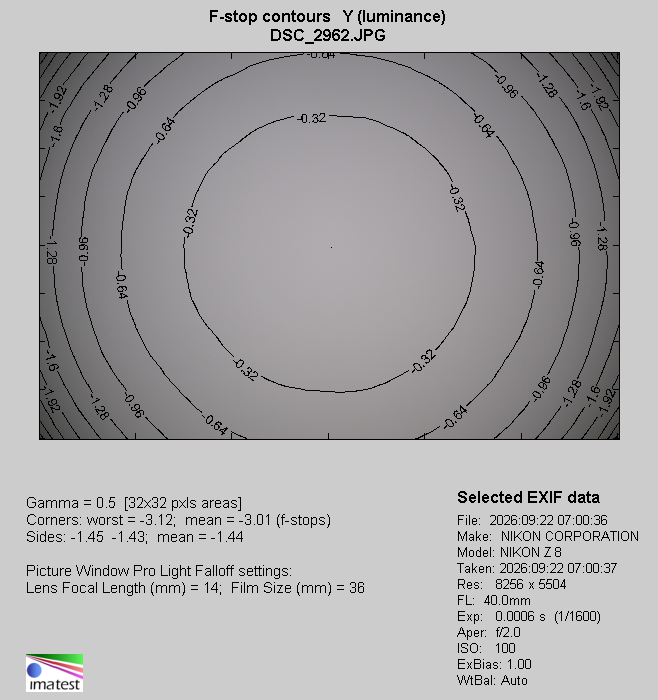
At the maximum relative aperture, our measured result is enormous, reaching as much as 65% (−3.01 EV). At f/2.8, the aberration in question amounts to 50% (-2.01 EV), at f/4.0 it drops to 38% (-1.38 EV), while at f/5.6 it decreases to 32% (-1.13 EV). Stopping down further produces no measurable improvement.
| Nikon Z8, JPEG, f/2.0 |
 |