Samyang AF 14-24 mm f/2.8 FE
6. Distortion and field of view
Field of view
A full frame rectilinear 14-24 mm lens should give you a range of angles of view from 114.2 to 84.1 degrees. In their official specification Samyang provides these values exactly. We decided to check these declarations. In order to do so we took photos of a starry sky and saved them as both corrected JPEG files and uncorrected RAW files developped by a third-party software as dcraw. Then we transformed the pixel layout (X,Y) from the photo into the equatorial coordinate system (right ascension and declination), which locates a star on a celestial sphere. That way we were able to measure the field very precisely, and exactly as it should be done, for rays of light coming from infinity.At the 14 mm focal length and a corrected JPEG file our transformation was based on positions of 173 stars spread evenly across the frame. An average mesh-fitting error amounted to 1 minute and 21 seconds of arc. Our final result amounted to 115.17 degrees with a measurement error on a level of 0.05 of a degree. It's a result by about one degree higher than the value stated in official specifications. This value is an equivalent of a field provided by a rectilinear 13.7 mm lens.
Very interesting things happen at 14 mm focal length on uncorrected RAW files. Here the tranformation is based on position of 156 stars spread evenly across the frame. An average mesh-fitting error amounted to 3 minutes and 41 seconds of arc and we got a result of as much as 118.93 deg with a measurement error not exceeding 0.08 deg. Here the amount of spare field is really significant because it is an equivalent of a rectilinear 12.8 mm lens. In a moment we are going to show that his amount of spare field is indeed badly needed.
Please Support UsIf you enjoy our reviews and articles, and you want us to continue our work please, support our website by donating through PayPal. The funds are going to be used for paying our editorial team, renting servers, and equipping our testing studio; only that way we will be able to continue providing you interesting content for free. |
- - - - - - - - - - - - - - - - - - - - - - - - - - - - - - - - - - - - - - - - - - - - - - - -
In case of the 24 mm focal length we used only uncorrected RAW files and the positions of 157 stars; an average mesh-fitting error decreased to 53 seconds of arc. The angle of view, measured by us, amounted to 85.55 deg with a measurement error not exeeding 0.03 deg. Here the field is also wider than stated in official specifications and it means the angle of view is an equivalent of the angle of a rectilinear 23.4 mm lens.
Distortion
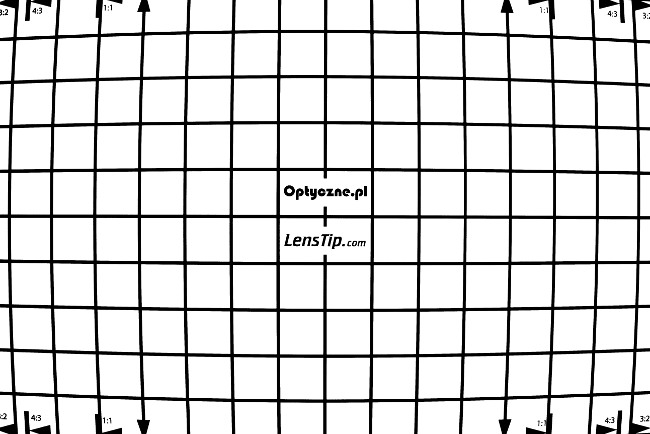
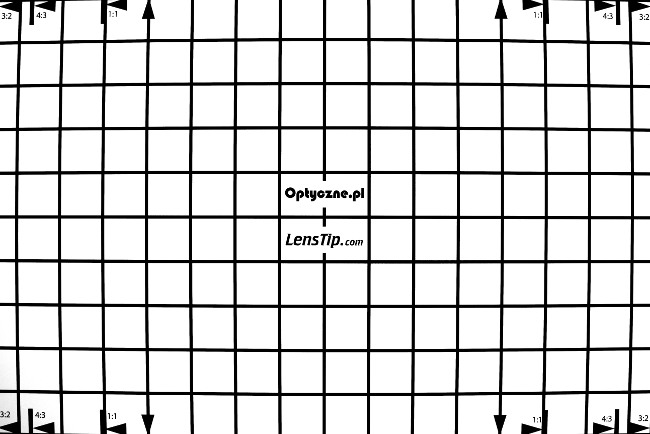
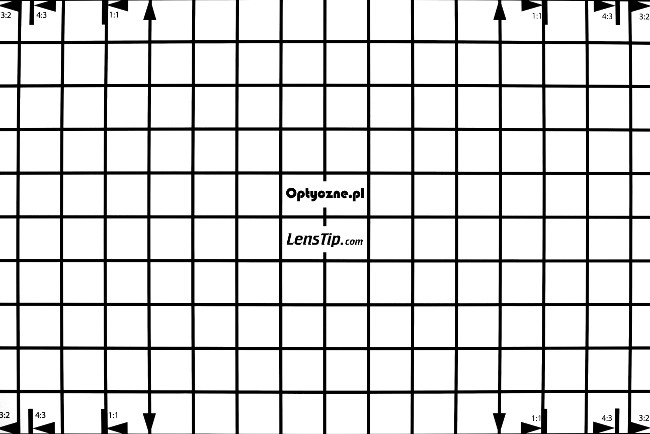
We know at once that distortion problems are going to be serious – already at the smaller APS-C/DX sensor you can notice this aberration without any problems. At the 14 mm focal length you deal with high barrel distortion amounting to -4.37%. After passing to 19 mm this value decreases to -1.80% and at 24 mm – to -0.59%.
| Sony A7R IIIa, APS-C, JPEG, 14 mm | |||
|
|||
| Sony A7R IIIa, APS-C, JPEG, 19 mm | |||
|
|||
| Sony A7R IIIa, APS-C, JPEG, 24 mm | |||
|
|||
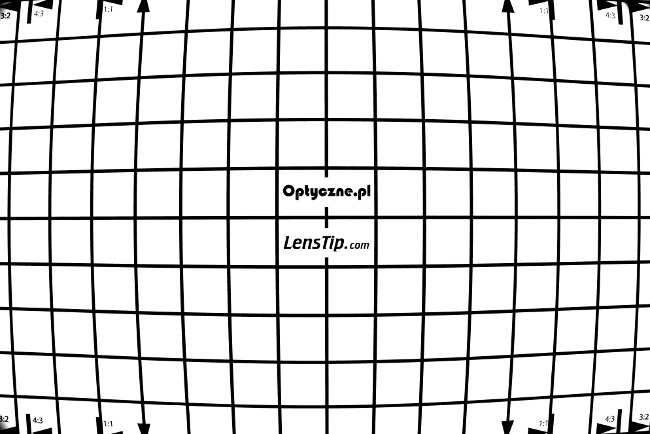
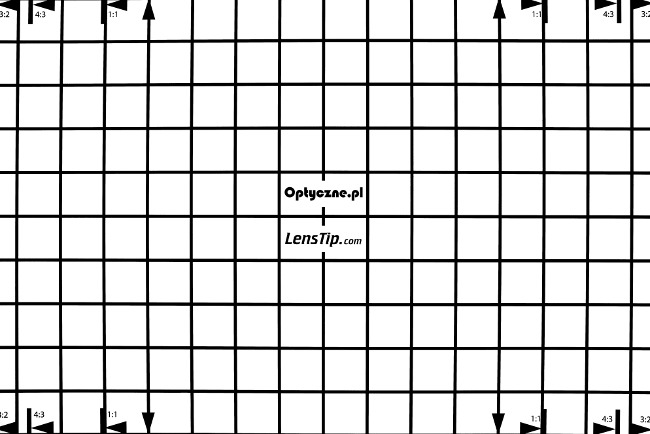
Still on full frame real madness happens. At the widest angle of view you have to deal with a huge barrel distortion, reaching as much as -7.39%. What's more, that value, computed by us by averaging out data taken from the whole image, the producers tried to minimize by introducing moustache distortion. If you limit your measurements to the area within 1:1 markings barrel distortion will increase to -8.08%.
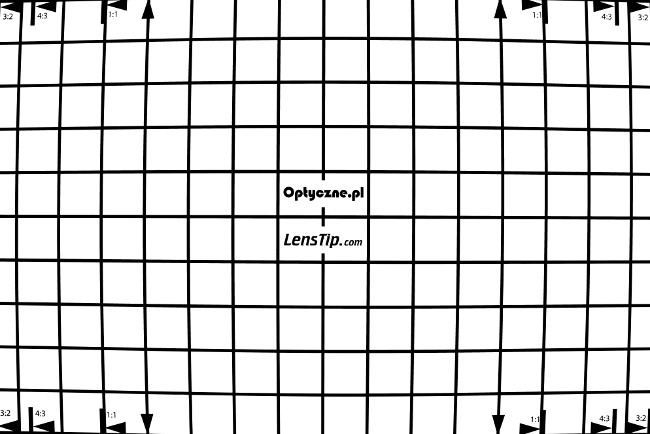
Fortunately, here too, we see a rapid decline in distortion with increasing focal length. At 19 mm, the "barrel" decreases to a still-perceptible -3.02%, and only at 24 mm does it reach a moderate level, where we achieved a result of -0.88%.
| Sony A7R IIIa, FF, JPEG, 14 mm | |||
|
|||
| Sony A7R IIIa, FF, JPEG, 19 mm | |||
|
|||
| Sony A7R IIIa, FF, JPEG, 24 mm | |||
|
|||
In order to be honest you also have to show distortion level at the widest angle of view after correction – after all uncorrected images have a significantly wider field of view than the declared one and even the frame you get after switching on an automatic distortion correction also features a slightly wider field than the one stated in specifications.
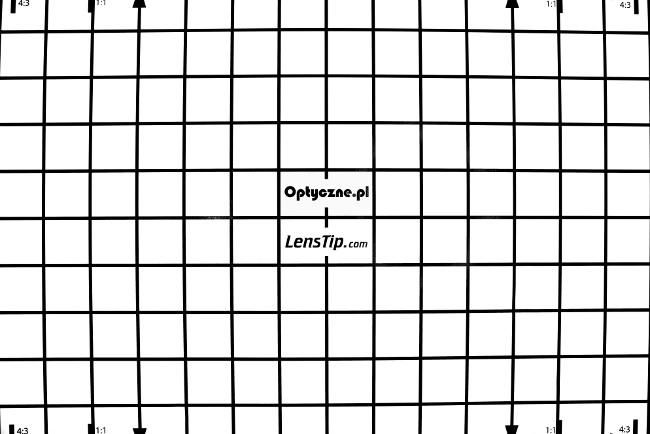
The photo below shows an image you get after switching the automatic distortion correction on in the camera menu. In this case distortion decreases to a moderate value of -1.21% although, if you look at it closely, you might also notice that software wasn't able to get rid of moustache distortion completely.
| Sony A7R IIIa, FF, CORRECTED JPEG, 14 mm | |||
|
|||
Of course, at first glance, the situation is much better. After all, in fact, you just get exactly the officially declared field so an image with an angle of view of 115 deg with a relatively low distortion level. Unfortunately the whole issue is more complicated than that. Correction of a high distortion value entails further image cropping and rescaling to the original resolution by 'pumping up' pixels out of thin air.
In comments section under our tests you have been asking to provide an exact value of pixel loss that stemms from distortion correction. The problem is that it's hardly easy – it would be if only the initial distortion was just barrel or pincushon and in the final image it was reduced to zero. Unfortunately even images already corrected by software of a camera still feature some distortion level. I would have to write my own piece of software that is able to scale down distortion from one non-zero value to other non-zero value. Mind you, in many cases it still wouldn't be enough. When the optics allows moustache distortion the situation becomes really tricky and getting a precise value is really difficult.
As if it wasn't enough, in most of contemporary constructions that set focus by changing the whole optical system distortion depends on the distance from the photographed object. In different photos taken by the same lens distortion level, so also the correction degree and pixel loss, might be noticeably different.
The tested Samyang might be an excellent example – at the very beginning it features a high level of barrel distortion with moustache and after the correction this distortion decreases to a moderate level. Mind you moustache remains visible. As a result, without writing a dedicated piece of software, we are able state just an estimated amount of pixel loss.
The resolution of the TIFF file, developed by dcraw, amounts to 7968x5320 pixels, so 42.39 Mpix. When you correct distortion so its average value along a straight line approaches zero and then crops the image, the resolution of the resulting image is 7388x4928 pixels so 36.41 Mpix. In this case you lose 14% of pixels. When the correction is even more pronounced, so the moustache don't disturb you so much, the resulting resolution drops further to 7094x4732 pix, so 33.56 Mpix. Both these results are not so nice but you have to remember that an image after camera software correction features moustache distortion anyway and the pixel loss should be smaller. A very rough estimate shows that in this case the loss shouldn't be greater than 10%, remaining close to this value.