Samyang AF 14-24 mm f/2.8 FE
8. Vignetting
| A7R IIIa, APS-C, JPEG, 14 mm, f/2.8 | A7R IIIa, APS-C, JPEG, 14 mm, f/4.0 |
|
|
| A7R IIIa, APS-C, JPEG, 19 mm, f/2.8 | A7R IIIa, APS-C, JPEG, 19 mm, f/4.0 |

|
|
| A7R IIIa, APS-C, JPEG, 24 mm, f/2.8 | A7R IIIa, APS-C, JPEG, 24 mm, f/4.0 |

|
|
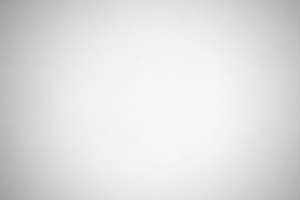
At the 14 mm and by f/2.8 vignetting can be spotted without any problems as it reaches 33% (-1.15 EV). After stopping down the aperture to f/4.0 this aberration decreases to 18% (-0.58 EV), and by f/5.6 it amounts to just 16% (-0.50 EV).
Please Support UsIf you enjoy our reviews and articles, and you want us to continue our work please, support our website by donating through PayPal. The funds are going to be used for paying our editorial team, renting servers, and equipping our testing studio; only that way we will be able to continue providing you interesting content for free. |
- - - - - - - - - - - - - - - - - - - - - - - - - - - - - - - - - - - - - - - - - - - - - - - -
In the middle of the focal range the situation is a tad better – at the maximum relative aperture brightness loss in the frame corners reaches 31% (-1.06 EV), by f/4.0 it decreases to 17% (-0.56 EV), and by f/5.6 it is 14% (-0.43 EV).
The best situation can be observed at the maximum focal length where, by f/2.8, vignetting reaches 28% (-0.94 EV), by f/4.0 it drops to 17% (-0.53 EV), and by f/5.6 it is just 13% (-0.39 EV).
As you see the performance of the tested Samyang at the smaller APS-C/DX sensor was hardly perfect. It made us curious about the full frame. Let's glance at thumbnails, presented below.
| A7R IIIa, FF, JPEG, 14 mm, f/2.8 | A7R IIIa, FF, JPEG, 14 mm, f/4.0 |
|
|
| A7R IIIa, FF, JPEG, 19 mm, f/2.8 | A7R IIIa, FF, JPEG, 19 mm, f/4.0 |

|
|
| A7R IIIa, FF, JPEG, 24 mm, f/2.8 | A7R IIIa, FF, JPEG, 24 mm, f/4.0 |

|

|
I had conducted the vignetting test before I managed to measure fields of view and immediately I thought about the wreck of the day when it comes to engineering. In 1999 the Mars Climate Orbiter was heading toward Mars. Instead of entering the Mars' orbit it entered the Mars's atmosphere at a much lower altitude, broke into pieces and burned, wasting several years of intensive work and $125 million .
The main reason of this catastrophe was the communication error. The navigation team at the Jet Propulsion Laboratory (JPL) used the international system of units (SI), whereas the Lockheed Martin team of engineers which designed and built the spacecraft, provided crucial acceleration data in the English system of inches, feet, and pounds.
As a result the data concerning engine thrust were interpreted by the navigation system as far higher than they were in reality. It made the space probe to enter the wrong trajectory, lower than planned, and in was destroyed in the upper Mars' atmosphere.
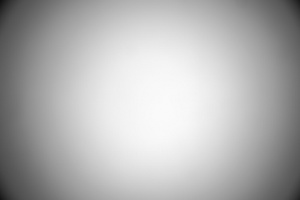
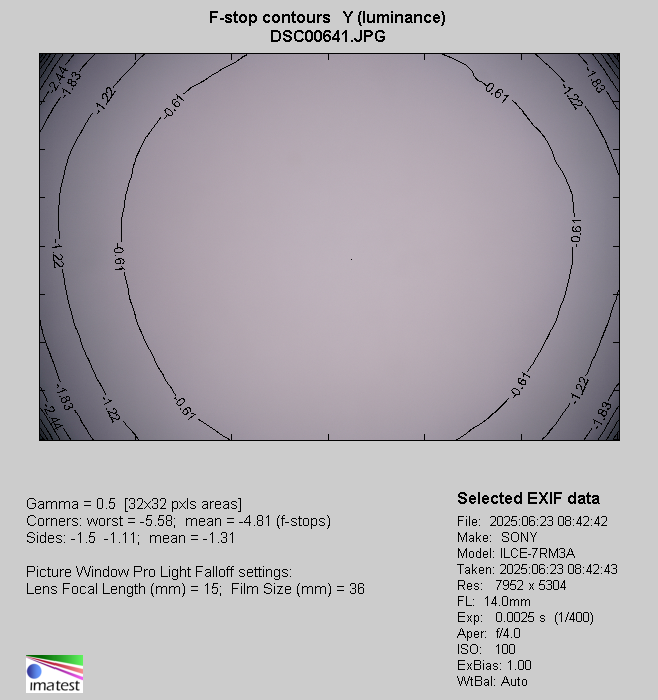
When I looked at the vignetting results of the tested lens at its shortest focal length I thought that Samyang engineers used different dimensions of the casing than the dimensions passed to the Schneider-Kreuznach team, perhaps responsible for the final optics project. How else you can explain light fall-off in the frame corners that, at the combination of 14 mm and f/2.8, amounts to monstrous 89% (-6.48 EV), suggesting that you deal here with a lens that doesn't covers full frame completely.
Stopping down the aperture helped reducing vignetting but even by f/4.0 you still deal with a really huge value of 81% (-4.82 EV), and by f/5.6 it remains very high, amounting to 72% (-3.78 EV).
Only up from f/8.0 with a value of 62% (-2.84 EV) you can call the results more or less useful. By f/11 vignetting still remains visible, reaching 53% (-2.20 EV), by f/16 it drops to 43% (-1.63 EV), and by f/22 to 40% (-1.48 EV).
Dear Reader, if you are after the lecture of the chapter concerning the field of view and distortion you know pretty well the reason behind such monstrous results. Still before the summing up vignetting let's have a glance at the performance of the Samyang 14-24 mm at its longer end of the focal range.
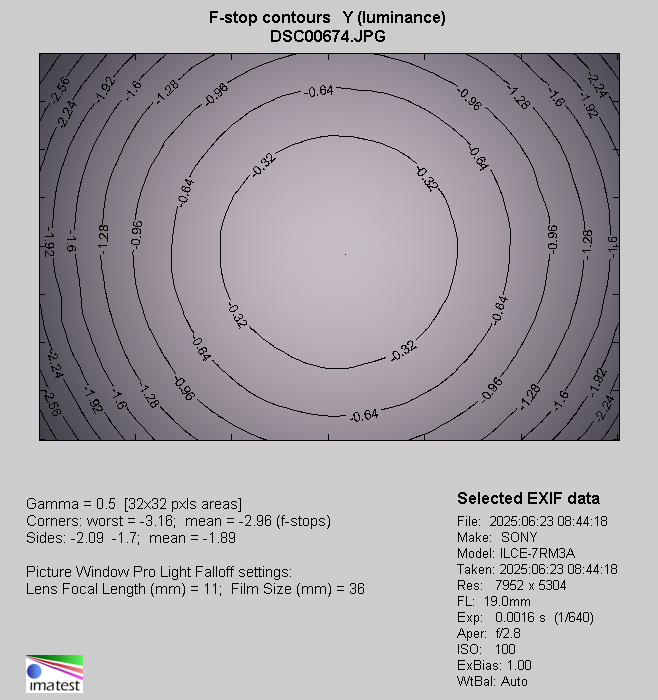
At 19 mm and by f/2.8 vignetting still remains very high, reaching 64% (-2.96 EV), but this value is nothing unusual in case of fast ultra wide angle lenses. By f/4.0 it drops to 45% (-1.74 EV), by f/5.6 it decreases further to 37% (-1.34 EV). By f/8.0 we got a result of 35% (-1.24 EV), and further stopping down didn't have any measurable influence on vignetting levels.
The combination of 24 mm nd f/2.8 means that light fall-off in the frame corners amounts to 53% (-2.21 EV). By f/4.0 vignetting decreases to 40% (-1.49 EV), by f/5.6 to 33% (-1.16 EV), and by f/8.0 it is 30% (-1.04 EV). By f/11 and f/16 our results are, within the margin of error, the same as the results we got by f/8.0.
| Sony A7R IIIa, 14 mm, JPEG, f/2.8 |
 |
| Sony A7R IIIa, 19 mm, JPEG, f/2.8 |
 |
| Sony A7R IIIa, 24 mm, JPEG, f/2.8 |
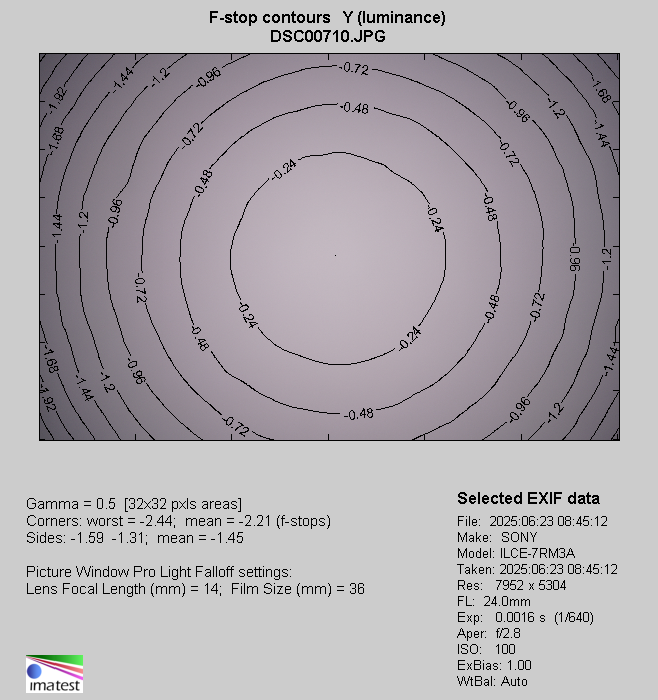 |
Now let's progress to the analysis of the situation we saw at the 14 mm focal length. The chapter covering distortion and field of view informed us that the lens offers you an angle of view of almost 119 deg for uncorrected JPEG files. It's almost five degrees more than in official specifications. The spare amount helps you to come closer to the declared value of about 114 deg after distortion correction. Small wonder the producers didn't care that much about monstrous vignetting in the corners of that surplus field; they knew pretty well that these corners would be removed after distortion correction anyway.
What about the vignetting situation on corrected JPEG files that provide a field of view of 115.2 deg anyway, one degree more than in specifications? Let's glance at thumbnails below.
| A7R IIIa, FF, CORR. JPEG, 14 mm, f/2.8 | A7R IIIa, FF, CORR. JPEG, 14 mm, f/4.0 |
|
|
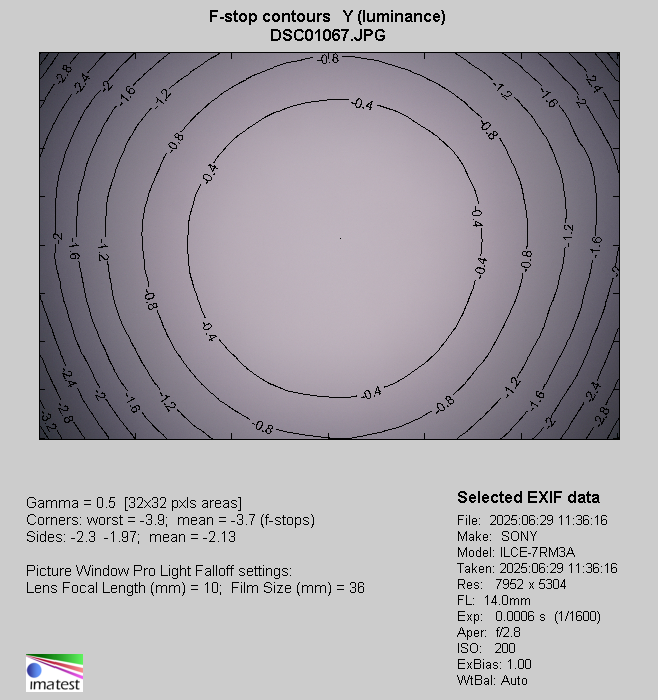
This time at the maximum relative aperture the brightness loss in frame corners amounts to 78% (-3.70 EV). It's still a lot, making you realize how much you have to pay for limiting physical dimensions and weight of the tested lens. By f/4.0 vignetting decreases to 57% (-2.46 EV), by f/5.6 it decreases to 42% (-1.58 EV), and by f/8.0 it drops to 36% (-1.28 EV).
| Sony A7R IIIa, 14 mm, CORRECTED JPEG, f/2.8 |
 |