Samyang AF 14-24 mm f/2.8 FE
4. Image resolution
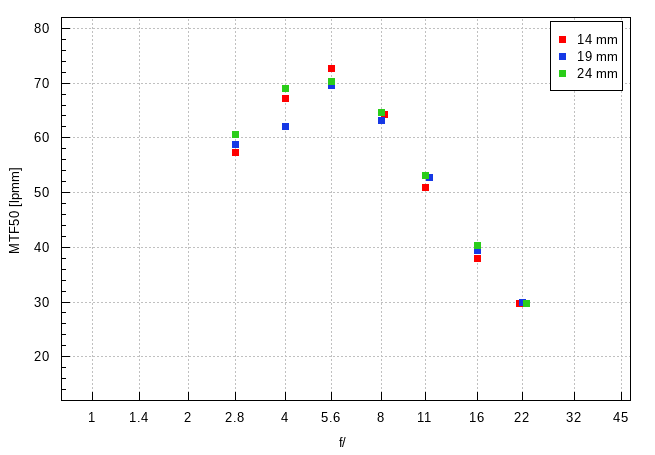
Let's check how the Samyang AF 14-24 mm f/2.8 FE compares with its frame centre results.
Please Support UsIf you enjoy our reviews and articles, and you want us to continue our work please, support our website by donating through PayPal. The funds are going to be used for paying our editorial team, renting servers, and equipping our testing studio; only that way we will be able to continue providing you interesting content for free. |
- - - - - - - - - - - - - - - - - - - - - - - - - - - - - - - - - - - - - - - - - - - - - - - -
I admit it: for a zoom lens that is so difficult to construct, a lens also optimized when it comes to its weight, dimensions and price, the performance is a really nice surprise. First of all the lens fares quite evenly, with all focal lengths performing similarly. What's more, it's difficult to find any weak points here. In case of the maximum relative aperture, no matter what focal length you employ, you land close to a good value of 60 lpmm. With stopping down the lens image quality improves further and, as a result, by f/5.6 MTFs keep a level near 70 lpmm and at 14 mm they reach to almost 73 lpmm.
What about the edge of the APS-C/DX sensor? Let's find out.
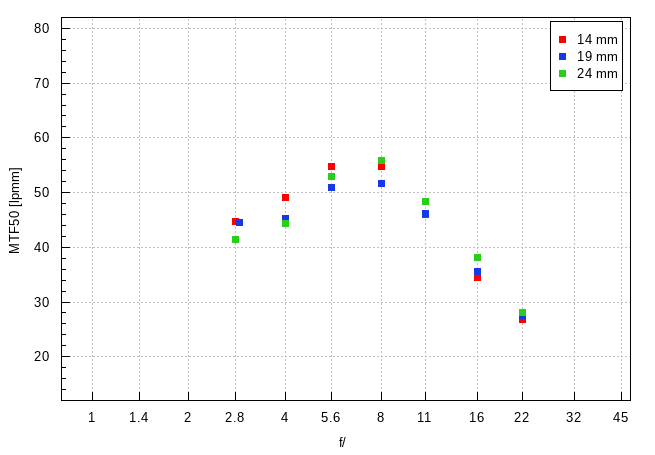
Everything looks properly well. Once again, there are no significant differences between particular focal lengths and once again image quality, even at the maximum relative aperture, doesn't provide you any reason to complain. On stopping down the aperture the lens is able to hover around a really good level of 50-55 lpmm.
Still, with such wide angles of view and fast aperture the performance on the edge of full frame is the most difficult part of this test – let's find out how the Samyang manages to handle it.
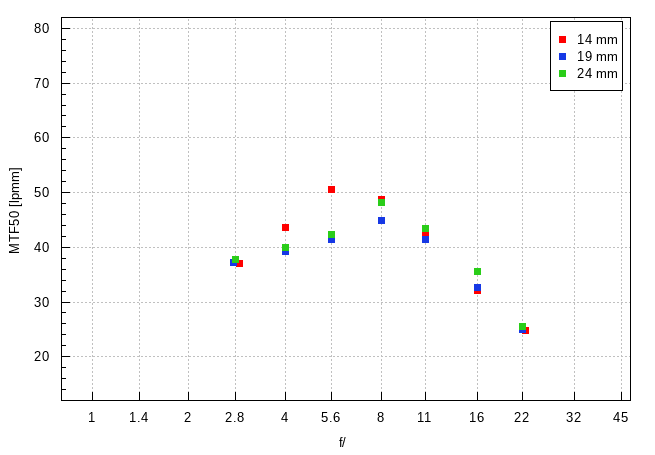
It's perhaps hardly a surprise that here we manage to find first reasons to complain – not especially important ones but still. The results at the maximum relative aperture keep near 37-38 lpmm at every focal length so are literally right below the decency level. Slight stopping down of the aperture allows the lens to reach that level. Mind you, this stopping down is the most effective at the shortest focal length, where getting images that are sharp across the frame is simply vital. Many people buy such lenses mainly because of the widest angles of view available so it's good to know the producers took proper care of this feature.
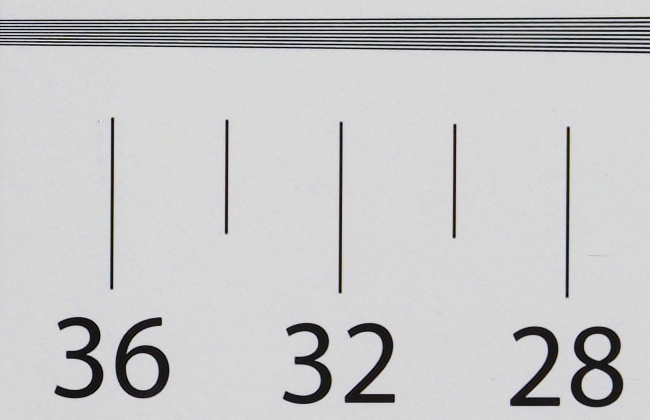
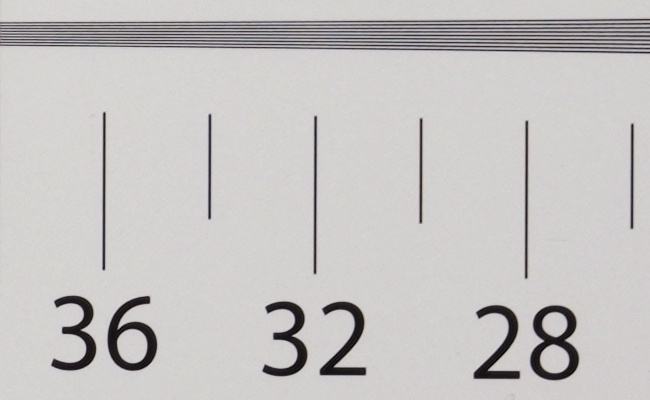
The summary of this chapter can be only positive – looking at the dimensions and weight of this lens, and at its very sensible price that doesn't exceed 5000 PLN, I was sure there would be more flaws. Meanwhile there were no really serious slip-ups and the majority of results is, all things considering, a very nice surprise. At the end of this chapter, traditionally, we present crops taken from photos of our resolution testing chart; they were saved as JPEG files along RAW files, used for the analysis above.
| A7R IIIa, JPEG, 14 mm, f/5.6 |
 |
| A7R IIIa, JPEG, 24 mm, f/2.8 |
 |