Sigma C 12 mm f/1.4 DC
4. Image resolution
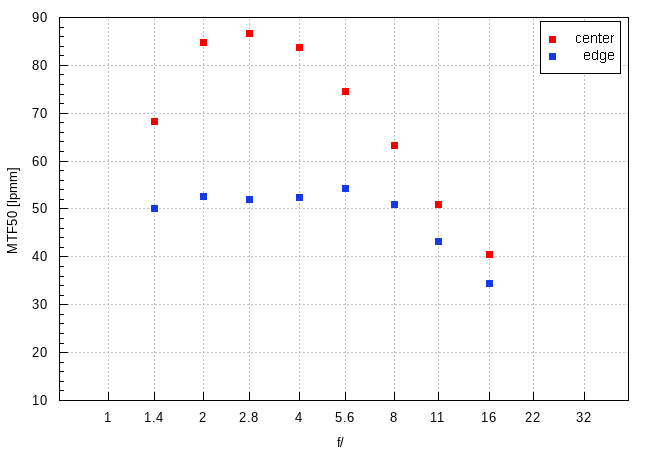
Let's check how the Sigma C 12 mm f/1.4 DC compares – its results in the frame centre and on its edges presents a graph below.
Please Support UsIf you enjoy our reviews and articles, and you want us to continue our work please, support our website by donating through PayPal. The funds are going to be used for paying our editorial team, renting servers, and equipping our testing studio; only that way we will be able to continue providing you interesting content for free. |
- - - - - - - - - - - - - - - - - - - - - - - - - - - - - - - - - - - - - - - - - - - - - - - -
The frame centre looks splendid. Already at the maximum relative aperture you deal with a very high value of 68 lpmm, and in the aperture range from f/2.0 to f/4.0 the lens exceeds a sensational level of 80 lpmm. The highest result, that of 86.6 lpmm, is reached by f/2.8. The Sigma performs here perfectly well.
When it comes to the edge of the frame it differs from the centre a lot, quit a surprise I admit. In some places the resolution in the centre is higher than this on the edge by over 30 lpmm – a real abyss. What's more, the performance is quite untypical because the image quality on the edge improves very slowly on stopping down. In the next chapter you are going to find out that lateral chromatic aberration is here to blame as it increases quickly on stopping down.
In order to defend the Sigma a bit you can say that values of about 50 lpmm you get in the range from f/1.4 to f/8.0 are safely above the decency level so you can't count them among any weaknesses.
A comparison to the performance of the rivals is also very important – a graph below shows results in the frame centre of the tested Sigma and the Sony E 11 mm f/1.8.
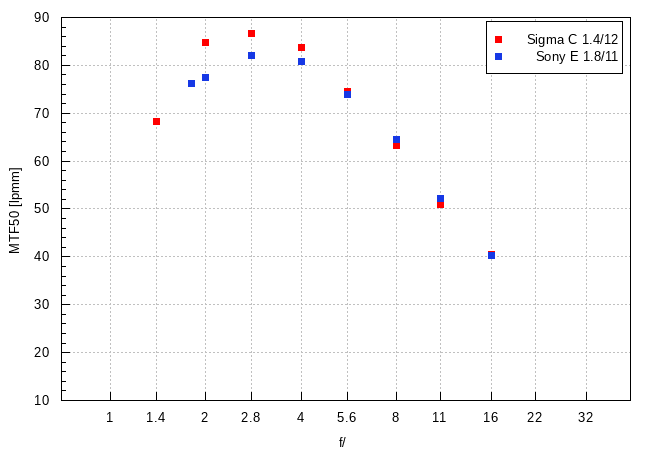
It's clear that it's a very fierce duel; the Sigma prevails but only slightly. You could expect such an outcome because it is a faster lens, with more room for stopping down and limiting optical aberrations. What's more, it provides a slightly narrower angle of view so it has it easier here. Still I have to admit both lenses perform really sensationally well in this category.
The next graph compares the performance on edges of the frame.
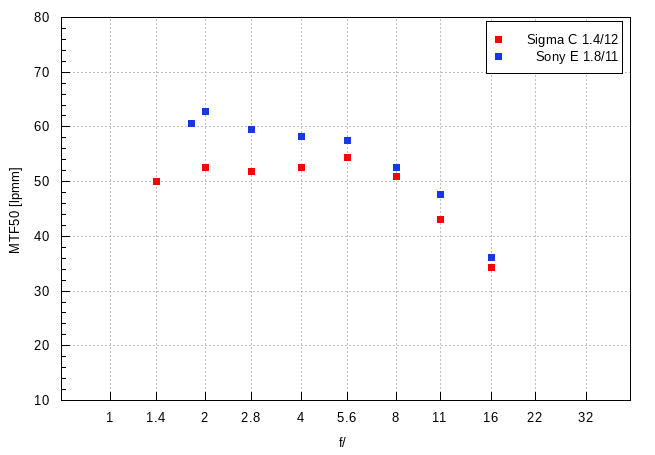
A huge surprise here – the faster Sigma, with a narrower angle of view, loses here significantly. It's clear that limiting physical dimensions of the tested lens definitely has its price. With such angles of view you care a lot about the performance on the edges and the Sigma might dissuade many potential customers with its approach.
To sum up the Sigma C 12 mm f/1.4 DC presents itself exceedingly well in the frame centre and didn't have any slip-up on the edges. Still, a huge gap between the centre and the edges is not satisfactory enough and because of this we cannot praise this lens as much as we would like.
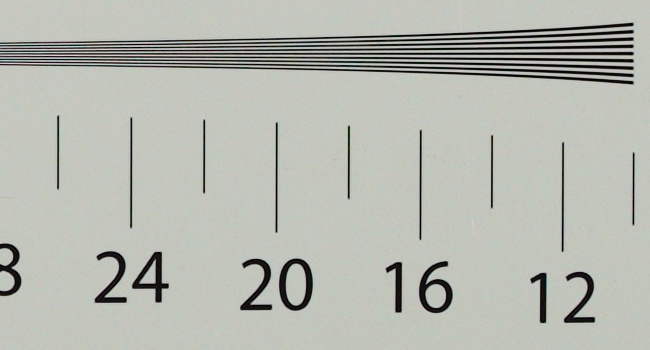
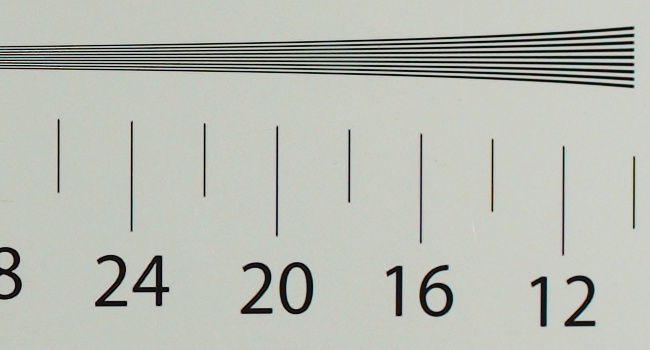
At the end of this chapter, traditionally, we present crops taken from photos of our resolution testing chart, saved as JPEG files along with RAW files we used for our analysis.
| Sony A7R IIIa, JPEG, f/1.4/td> |
 |
| Sony A7R IIIa, JPEG, f/2.8 |
 |