Sigma S 200 mm f/2 DG OS
8. Vignetting
| A7R IIIa, APS-C, f/2.0 | A7R IIIa, APS-C, f/2.8 |

|

|
In case of this type of detector at the maximum relative aperture vignetting is low, amounting to just 18% (−0.58 EV). All problems end by f/2.8 and f/4.0, where we got the following results: 7% (-0.20 EV) and 3% (-0.09 EV).
Please Support UsIf you enjoy our reviews and articles, and you want us to continue our work please, support our website by donating through PayPal. The funds are going to be used for paying our editorial team, renting servers, and equipping our testing studio; only that way we will be able to continue providing you interesting content for free. |
- - - - - - - - - - - - - - - - - - - - - - - - - - - - - - - - - - - - - - - - - - - - - - - -
Now let's check the brightness loss in frame corners on the full frame detector – appropriate thumbnails you can find below.
| A7R IIIa, FF, f/2.0 | A7R IIIa, FF, f/2.8 |

|

|
| A7R IIIa, FF, f/4.0 | A7R IIIa, FF, f/5.6 |

|

|
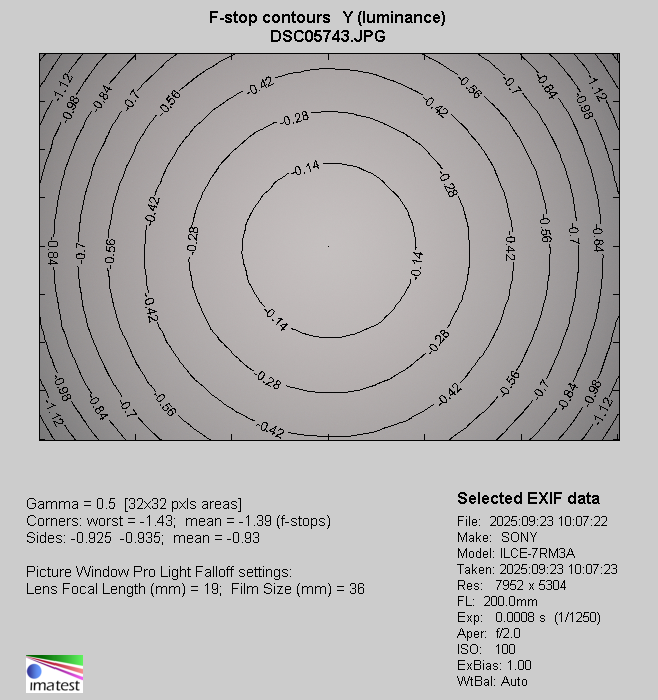
At the maximum relative aperture the vignetting level of the tested Sigma reaches 38% (-1.39 EV). It is not a high level, positioning this lens exactly between its reflex camera rivals. In case of the Nikkor we saw a level of 32% and the vignetting of the Canon reached 48%.
Stopping down the aperture is able to limit this aberration quite efficiently. By f/2.8 you deal with a level of 23% (-0.76 EV), by f/4.0 it is a value of 17% (-0.55 EV), and by f/5.6 we registered a result of 11% (-0.35 EV). Vignetting becomes completely imperceptible by f/8.0 where we got a result of just 7% (-0.21 EV).
| Sony A7R IIIa, JPEG, f/2.0 |
 |