Viltrox AF 85 mm f/2 EVO
4. Image resolution
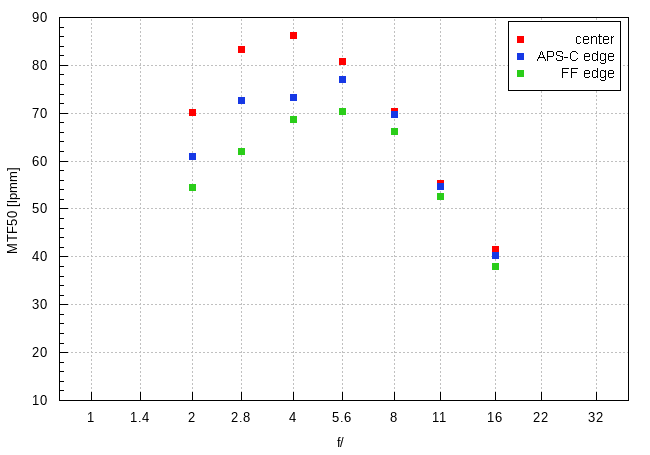
Let's see how the Viltrox AF 85 mm f/2 EVO compares – its results in the frame centre, on the edge of the APS-C/DX sensor and on the edge of full frame presents a graph below.
Please Support UsIf you enjoy our reviews and articles, and you want us to continue our work please, support our website by donating through PayPal. The funds are going to be used for paying our editorial team, renting servers, and equipping our testing studio; only that way we will be able to continue providing you interesting content for free. |
- - - - - - - - - - - - - - - - - - - - - - - - - - - - - - - - - - - - - - - - - - - - - - - -
The results in the frame centre are really splendid. Already at the maximum relative aperture the lens exceeds a level of 70 lpmm, at f/2.8 you see a very high value of over 83 lpmm and by f/4.0 the resolution increases to 86 lpmm. Another graph shows us how these results compare to the results of the rivals.
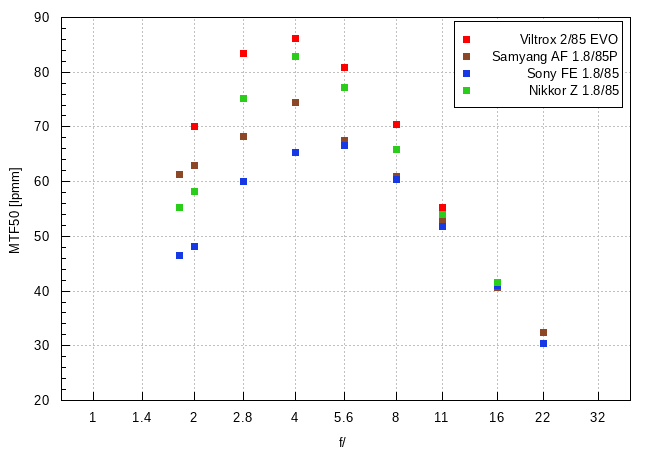
The Viltrox, even though it is the slowest and the cheapest, manages to prevail in this category. It defeats even the Nikkor, a lens the most expensive in this group, for which you have to pay over two times more.
What's important, the Viltrox doesn't have to sacrifice its edges for excellent values in the frame centre. On the edge of the APS-C/DX sensor the results remain very good up from the maximum relative aperture. There are no weak points on the very demanding edge of full frame where, by f/2.0, you deal with a result amounting to almost 55 lpmm so really good. What's more, on stopping down the aperture you are able to reach even 70 lpmm. In the aperture range from f/4.0 to f/8.0 you deal with an excellent image quality across the frame.
I don't doubt that the summary of this chapter should feature only superlatives concerning the results of the Viltrox. It is really difficult to believe that such a great performance is offered by a lens that can be bought for $275.
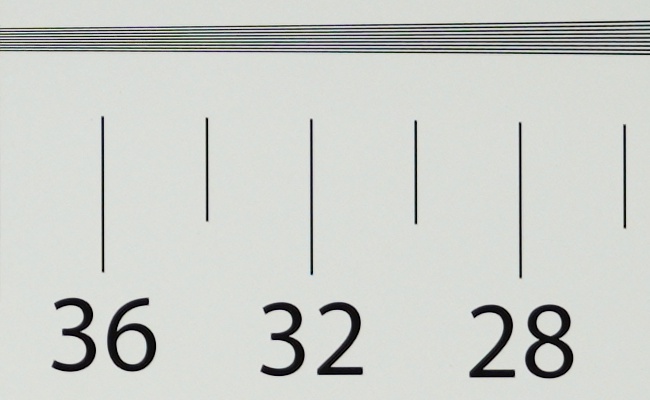
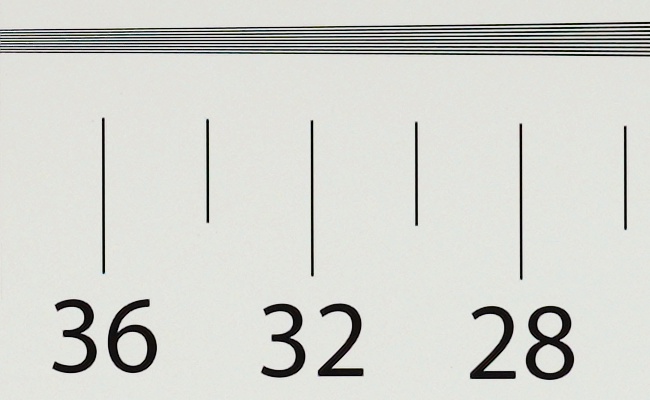
At the end of this chapter, traditionally, we present crops taken from photos of our resolution chart; they were taken from JPEG files saved along RAW files we used for the analysis above.
| A7R IIIa, JPEG, 85 mm, f/2.0 |
 |
| A7R IIIa, JPEG, 85 mm, f/4.0 |
 |