Viltrox AF 85 mm f/2 EVO
6. Distortion and field of view
Field of view
A rectilinear 85 mm lens should give you on full frame an angle of view of 28.56 degrees. In their official specification the producer of the Viltrox AF 85 mm f/2.0 EVO states that the offered angle of view is a bit higher, amounting to 29.09 degrees. We decided to take a reality check. In order to do so we took photos of a starry sky and saved them as uncorrected JPEG files. Then we transformed the pixel layout (X,Y) from the photo into the equatorial coordinate system (right ascension and declination), which locates a star on a celestial sphere. That way we were able to measure the field very precisely, and exactly as it should be done, for rays of light coming from infinity. Our transformation was based on positions of 116 stars spread evenly across the frame. An average mesh-fitting error amounted to 20 seconds of arc.Our final result amounted to 28.73 degrees with a measurement error on a level of 0.07 of a degree. It's even a tad lower than stated in official specifications and, at the same time, a tad higher than the focal length value suggests. The differences are cosmetic and are of no importance.
Distortion
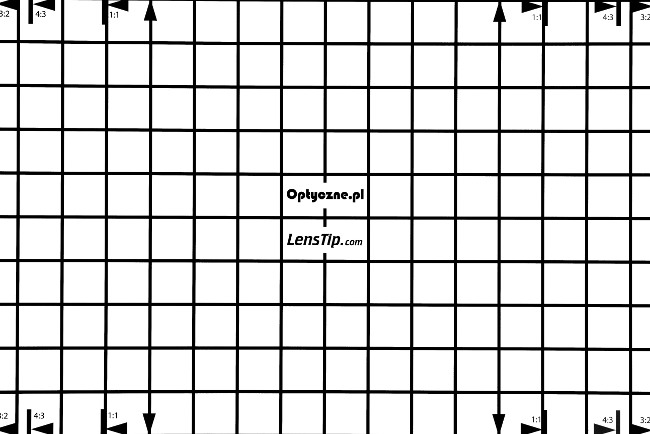
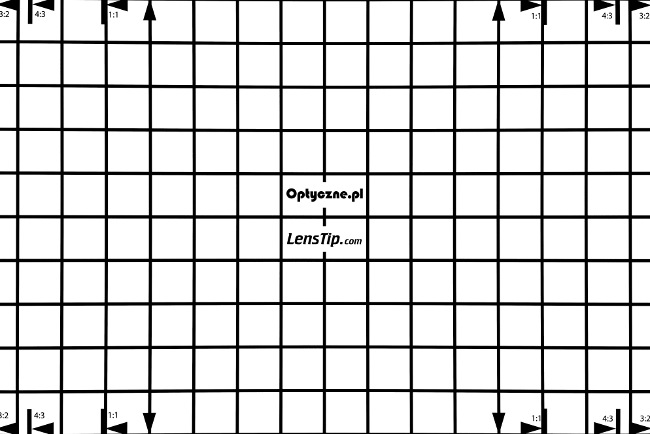
You don't expect any geometric deformations from a 85 mm lens and indeed, in case of the Viltrox AF 85 mm f/2.0 EVO there are no such problems, at least on the APS-C sensor. In this case we got a negligible value of +0.60%, still nothing to complain about.
On full frame the results are a tad weaker – the value we measured amounted to +1.07%. Of course you should mention the fact that this result is noticeably better than +1.89% of the Viltrox PFU RBMH 85 mm f/1.8 STM and +1.91% showed not so long ago by the Samyang AF 85 f/1.8 P.
Please Support UsIf you enjoy our reviews and articles, and you want us to continue our work please, support our website by donating through PayPal. The funds are going to be used for paying our editorial team, renting servers, and equipping our testing studio; only that way we will be able to continue providing you interesting content for free. |
- - - - - - - - - - - - - - - - - - - - - - - - - - - - - - - - - - - - - - - - - - - - - - - -
On the other hand you can certainly achieve better results and the Nikkor Z 85 mm f/1.8 S proved it by taking care of this aberration in a better way and reducing it to +0.47%. An even slightly better result, +0.38%, was reached by the Sony FE 85 mm f/1.8. The Panasonic S 85 mm f/1.8 fared a tad weaker, with a value of +1.14% - in this case you get a level, within the measuring errors, the same as in case of the Viltrox, tested here.
Of course it's worth remembering that the results lower than 2% in terms of absolute value are still considered to be moderate and shouldn't worry you too much.
| Sony A7R IIIa, 85 mm, APS-C | |||
 |
|||
| Sony A7R IIIa, 85 mm, FF | |||
 |
|||