Nikon Nikkor Z 35 mm f/1.2 S
4. Image resolution
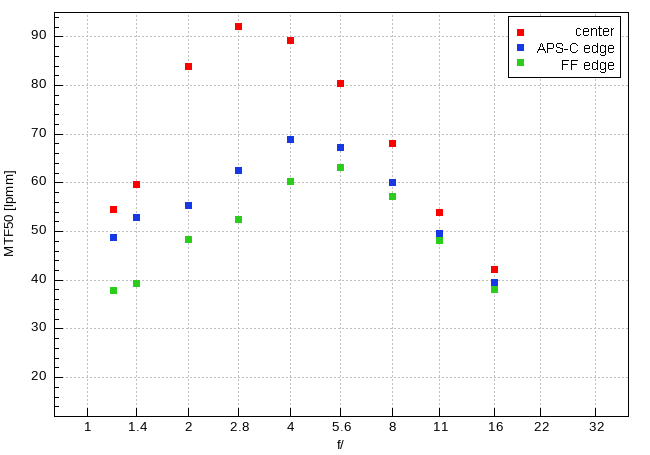
Let's check how the performance of the Nikkor Z 35 mm f/1.2 S compares – its results in the frame centre, on the edge of the APS-C/DX sensor, and on the edge of full frame are presented in a graph below.
Please Support UsIf you enjoy our reviews and articles, and you want us to continue our work please, support our website by donating through PayPal. The funds are going to be used for paying our editorial team, renting servers, and equipping our testing studio; only that way we will be able to continue providing you interesting content for free. |
- - - - - - - - - - - - - - - - - - - - - - - - - - - - - - - - - - - - - - - - - - - - - - - -
When it comes to the performance in the frame centre you can describe it in superlatives only. Already at the maximum relative aperture you see a really good level, that of almost 55 lpmm. What's more, on stopping down the aperture MTFs improve very quickly so even before f/2.0 the lens exceeds a level of 80 lpmm and by f/2.8 it is able to reach 92.2 lpmm, the second best result in the whole history of the Nikon Z7/Z8 sensor tests, only a tad weaker than the record set by the Nikkor Z 135 mm f/1.8 S Plena. You have to admit it is a great achievement.
A comparison to the performance of the rivals shows a graph below.
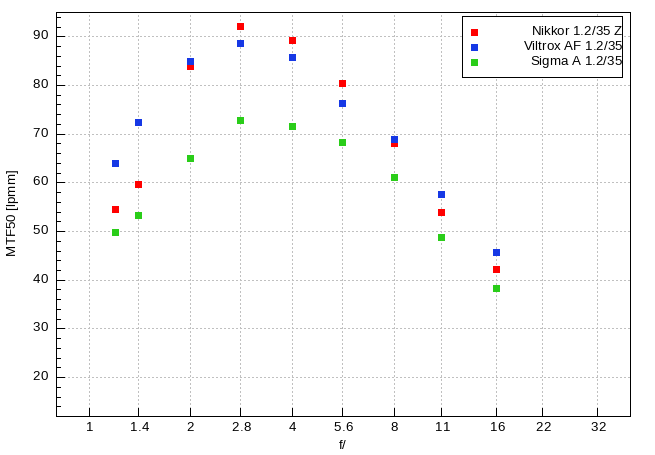
Both the Nikkor and the Viltrox simply outclass the older Sigma version, but hold the assessment of the last company until we test its newest model shown in 2025. When you compare the Viltrox and the Nikkor you get a kind of surprise. On the one hand, the bigger, heavier, and three times more expensive Nikkor can reach a better maximum result, but, on the other hand, near the maximum relative aperture, the cheaper lens is capable of prevailing.
As if it wasn't enough, when you consult the edge of the frame, the Viltrox fares definitely better. While in the case of the Nikkor you see a big difference in resolution between the centre and the edge of the frame, without reaching the decency level on the edge of full frame by f/1.2 and by f/1.4, the Viltrox doesn't have any problems with it, and its results are by several lpmm higher. It is certainly a big surprise.
I can understand the approach of Nikon constructors up to a point. The results suggest that they wanted to kill two birds with one stone. On the one hand, they tried to offer an outstandingly sharp lens that, on stopping down the aperture, is able to break resolution records – and they succeeded. On the other hand, in the close area of the maximum relative aperture the results aren't pumped up by force, so the lens provides nice out-of-focus areas. I would applaud such an approach if not for the weight and dimensions of the tested Nikkor. I guess exactly the same effect could be achieved with significantly smaller dimensions and at a lower price. When you get a lens that is the biggest in its class, very heavy and very expensive to boot, you might expect that it is an instrument free of any compromises, with an outstanding performance regardless of where you look. It is not the case of the tested Nikkor so we are left unsatisfied.
Of course it doesn't change the fact that the Nikkor Z 35 mm f/1.2 S is an excellent lens, optically brilliant, that can produce crisp, sharp photos.
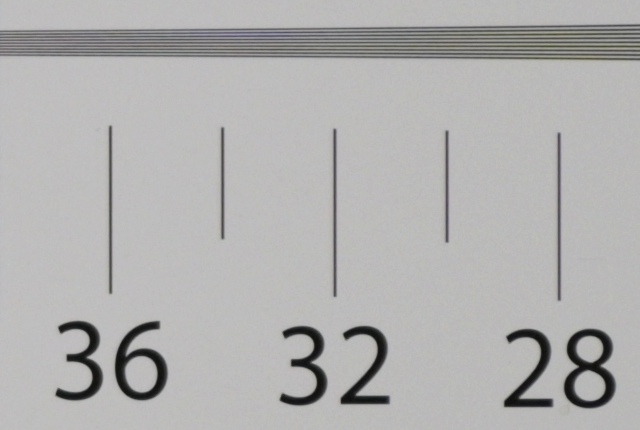
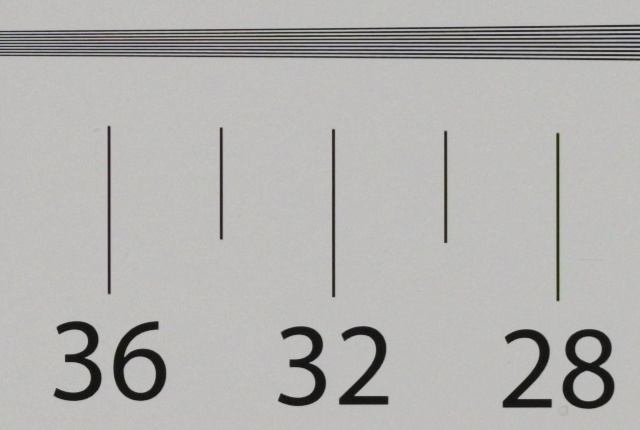
At the end of this chapter, traditionally, we present crops taken from photos of our resolution testing chart, which were saved as JPEG files along with the RAW files, used for the analysis above.
| Nikon Z8, JPEG, 35 mm, f/1.2 |
 |
| Nikon Z8, JPEG, 35 mm, f/2.8 |
 |