Nikon Nikkor Z 35 mm f/1.2 S
8. Vignetting
| Z8, APS-C/DX, f/1.2 | Z8, APS-C/DX, f/1.4 |

|

|
At the maximum relative aperture vignetting is moderate, reaching 26% (−0.89 EV). By f/1.4 you get 18% (-0.59 EV), and by f/2.0 this problem is marginalized completely, with a value of just 6% (−0.19 EV).
Please Support UsIf you enjoy our reviews and articles, and you want us to continue our work please, support our website by donating through PayPal. The funds are going to be used for paying our editorial team, renting servers, and equipping our testing studio; only that way we will be able to continue providing you interesting content for free. |
- - - - - - - - - - - - - - - - - - - - - - - - - - - - - - - - - - - - - - - - - - - - - - - -
After passing to the bigger full frame sensor the vignetting becomes far more bothersome and photos, shown below, prove that much.
| Z8, FF, f/1.2 | Z8, FF, f/1.4 |

|

|
| Z8, FF, f/2.0 | Z8, FF, f/2.8 |

|

|
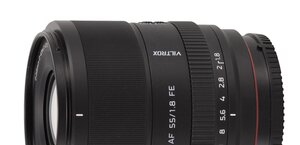
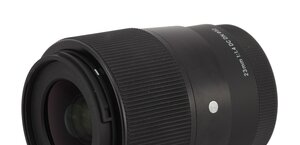
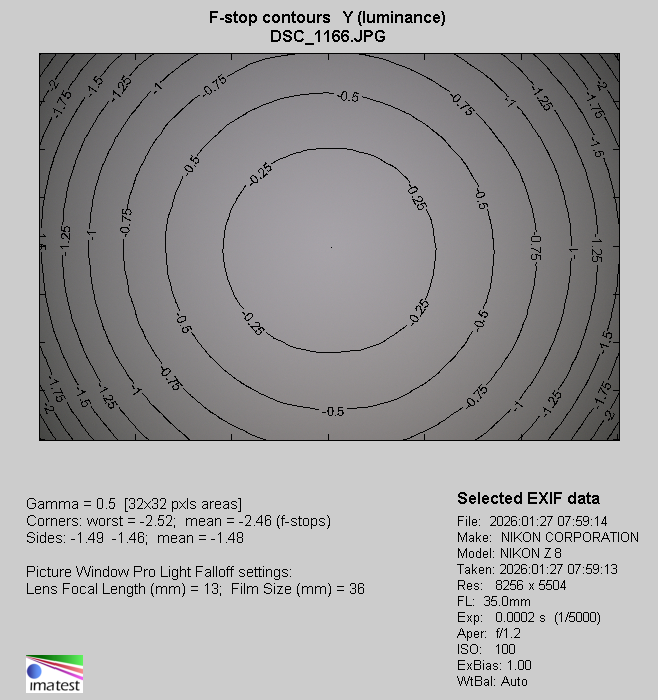
Loss of light in frame corners at the maximum relative aperture reaches 57% (-2.46 EV). It's a lot, but still the Nikkor fares better than its rivals in this category. The older Sigma model has a result of as much as 73%, and in the case of the Viltrox it is 64%. Of course you have to admit that, considering the dimensions of the tested lens, I expected even a tad better results.
Fortunately vignetting of the tested Nikkor decreases swiftly on stopping down. By f/1.4 it reaches 50% (-1.98 EV), by f/2.0 it drops to 31% (-1.09 EV), andy by f/2.8 it decreases even further to 25% (-0.82 EV). As you employ f/4.0 and f/5.6 the problems are reduced even further, with the results amounting to, respectively, 18% (-0.57 EV) and 15% (-0.46 EV). Further stopping down doesn't provide any measureable effects.
| Nikon Z8, JPEG, 35 mm, f/1.2 |
 |