Viltrox AF 50 mm f/1.4 Pro
4. Image resolution
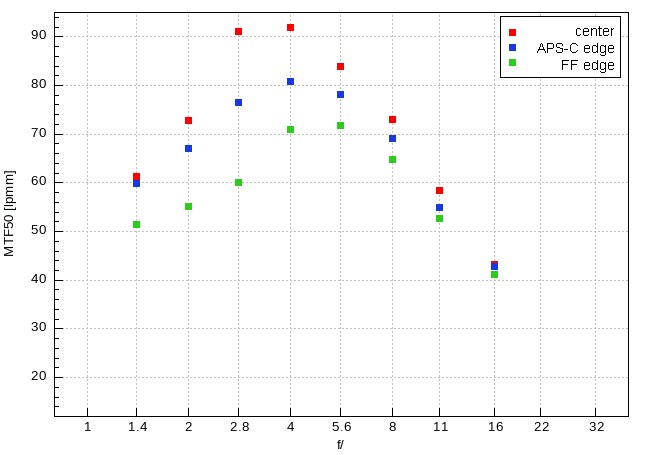
Let's check how the performance of the Viltrox AF 50 mm f/1.4 Pro compares – its results in the frame centre, on the edge of the APS-C/DX sensor, and on the edge of full frame are presented in a graph below.
Please Support UsIf you enjoy our reviews and articles, and you want us to continue our work please, support our website by donating through PayPal. The funds are going to be used for paying our editorial team, renting servers, and equipping our testing studio; only that way we will be able to continue providing you interesting content for free. |
- - - - - - - - - - - - - - - - - - - - - - - - - - - - - - - - - - - - - - - - - - - - - - - -
You can say at once that the tested lens didn't disappoint us – the results are simply splendid. In the frame centre, already at the maximum relative aperture, you get a very high result of over 60 lpmm. As if it wasn't enough, stopping down of the aperture is very effective; as a result by f/2.0 you get a value of almost 73 lpmm, by f/2.8 and f/4.0 the lens can exceed a value of 91.9 lpmm. Officially, the highest result we registered was by f/4.0 and it amounts to 91.9 lpm so, within the error boundaries, it is in accordance with resolution levels of the Nikkor 1.2/35 and the Nikkor 1.8/135.
A graph below presents an even better-detailed picture of the situation as it compares the performance of the Viltrox and other 1.4/50 class models.
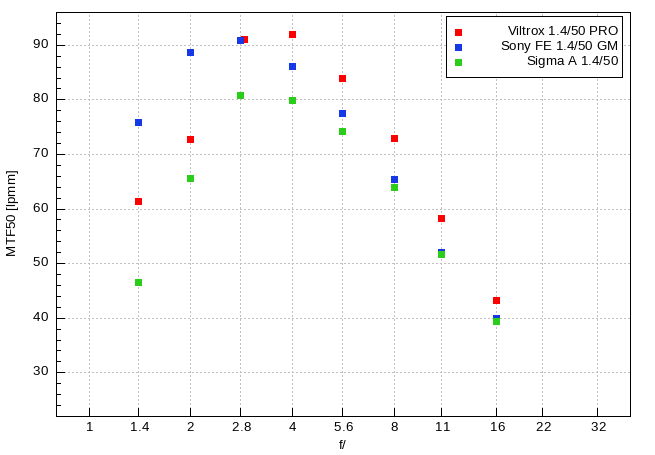
The Viltrox can slightly overperform even the Sony FE 50 mm f/1.4 GM, a record-breaker of the Sony detector, but the difference here can stem from the fact that the sensor of the Nikon Z8 is a bit more densely packed. It's safer to say that both lenses represent a very similar level of resolution, which is, of course, outstanding. What about the Sigma? Well, if its producers aren't already working on the successor of their 50 mm device, they should start such a process immediately.
We liked very much the Viltrox performance in the frame centre and it made us doubly curious about the frame edge. The first graph, presented in this chapter, shows clearly that the tested lens fares very well – on the edge of the APS-C/DX sensor, even at the maximum relative aperture, it achieves a very high level of almost 60 lpmm and on stopping down, it can even exceed 80 lpmm.
When it comes to the edge of full frame, you won't find any weak points either. By f/1.4 the results are good, reaching over 51 lpmm, and on stopping down the aperture, the MTFs are able to get to an excellent level of about 70 lpmm.
As you see the summary of this chapter can be only positive. For a sum of $466 you get a lens that is outstanding in the frame centre and very good on the edge. It would be foolish to expect more.
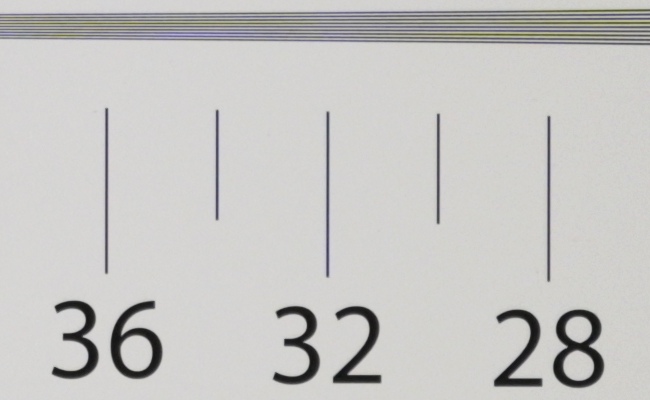
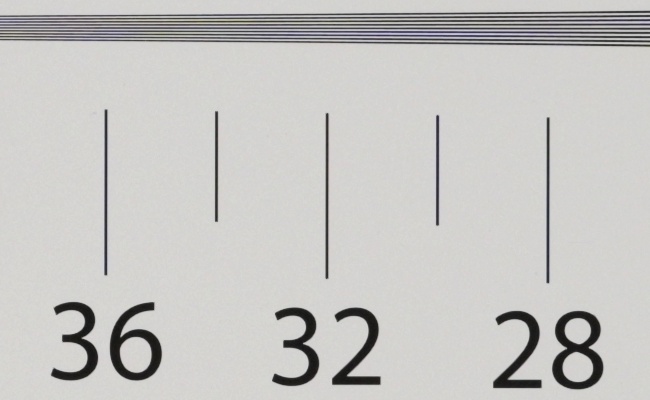
At the end of this chapter, traditionally, we present crops taken from photos of our resolution chart; they were taken from JPEG files saved along with RAW files we used for the analysis above.
| Nikon Z8, JPEG, 50 mm, f/1.4 |
 |
| Nikon Z8, JPEG, 50 mm, f/4.0 |
 |